Russian

  • Aleksandr Sokurov – Mariya aka Maria (1988)

    Documentary1981-1990Aleksandr SokurovUSSR

    Aleksandr Sokurov creates a visually poetic, elegant, and unforgettable synthesis of art and life in Mariya. The lush and textural initial sequence, shot using color film, presents the austere life of the titular Mariya – a robust, genial, and hard-working middle-aged collective farmer with an engaging smile – during an arduous flax harvest season in the summer of 1975: operating heavy machinery, sharing a meal at a communal table with fellow workers, visiting her young son’s grave, enjoying a lazy afternoon by the lake with her family on her day off, and proudly (and uninhibitedly) describing her responsibilities and work ethic before the camera.Read More »

  • Nikita Mikhalkov – Rodnya AKA Kinfolk (1981)

    1981-1990ComedyDramaNikita MikhalkovUSSR

    Free Image Hosting at www.ImageShack.us

    29f7c043f76a2bde437fd0d52a185152

    One of the most popular movies tells, in an ironic manner, about complicated relationships between close people. Among the film’s achievements is not only splendid acting, but also the fact that “Kinfolk” remains as contemporary and topical as before. The relations between a son-in-law and a mother-in-law are as everlasting a theme as love itself. Especially when the role of the son-in-law Stasik is brilliantly played by Yuri Bogatyryov, and that of the mother-in-law by the incomparable Nonna Mordyukova. Marusya Konovalova, a kind, simple-hearted country woman, comes to Moscow to visit her only daughter (Svetlana Kryuchkova) and tries to help “glue together” her broken-up family. Acting with best intentions, she cannot understand why her interference provokes a stormy protest…First film role of Oleg Menshikov. N. Mikhalkov, A. Adabashyan and P. Lebeshev as waiters and cooks!

    Source :ruscico.com
    Read More »

  • Hussein Erkenov – Sto dney do prikaza AKA 100 Days Before the Command (1994)

    2001-2010ArthouseHussein ErkenovPoliticsRussia

    29f7c043f76a2bde437fd0d52a185152

    Quote:
    Banned By The Soviets!

    Visually astonishing, erotically charged and emotionally jarring, 100 Days Before The Command is Hussein Erkenov’s courageous and stinging indictment of communism.

    Five young Red Army recruits struggle for survival against the merciless violence that surrounds them on a daily basis. Their only means of saving their dignity is by preserving the humanity and compassion they share for each other.

    Although not an overtly gay film, Erkenov’s 100 Days Before The Command is remarkably direct in it’s homoerotic imagery and subtexts. The film includes scenes where the soldiers share an intimacy and tenderness that is far removed from the brutality of most of their waking hours. (Amazingly, all the roles are played by real-life soldiers except for one professional actor.)

    Banned by Soviet censors upon its initial release, Erkenov was forced to create his own sales company in order for the film to be screened at the 1995 Berlin Film Festival. 100 Days Before The Command is a unique entry into the world of post-cold war filmmaking from behind the former Iron Curtain.
    Read More »

  • Serge Avedikian & Olena Fetisova – Paradjanov (2013)

    Drama2011-2020Olena FetisovaSerge AvedikianSergei ParajanovUkraine


    29f7c043f76a2bde437fd0d52a185152

    Sergei Paradjanov can, without exaggeration, be called one of the most distinctive filmmakers of the 20th century. Indeed, Federico Fellini, Michelangelo Antonioni and Andrei Tarkovsky were among the many admirers of his fascinating powers of visualization. This biopic, evincing an original take on the genre, relates some of the key moments in the life and work of this director of genius, a native Armenian who was persecuted by the Soviet authorities. We watch Paradjanov as he makes his ground-breaking films Shadows of Forgotten Ancestors and The Colour of Pomegranates, and also during his imprisonment by the communist regime. The filmmakers present Paradjanov as a gifted artist overflowing with ideas, but also as a complicated personality. In creating the film’s artistic vision, the directing duo relies heavily on Paradjanov’s own, unmistakable trademark style, vividly showing the audience his distinctive way of seeing the world.Read More »

  • Viktor Kosakovsky – Sreda AKA Wednesday (1997)

    1991-2000ArthouseDocumentaryRussiaViktor Kosakovsky

    Free Image Hosting at www.ImageShack.us

    29f7c043f76a2bde437fd0d52a185152

    Quote:
    Wednesday, July 19, 1961: it’s summertime and the newspapers are full of the usual articles. The world is comfortably embedded in the Cold War. An average day in Leningrad. 51 girls and 50 boys are born in Leningrad on this day.
    One of them is Victor Kossakovsky. Why here and not somewhere else? Why then and not another time? These questions are the starting point for his film. Could it be that this child was mistaken for another in hospital? Who are all the people who began their lives on that same day? Do they somehow share the same fate or are they merely contemporaries?Read More »

  • Aleksandr Sokurov – Tikhiye stranitsy aka Whispering Pages (1994)

    1991-2000Aleksandr SokurovArthouseExperimentalRussia

    Quote:
    ‘Whispering Pages’ may be the most dimly lit film ever made. Set to the strains of Mahler, this 1993 film takes place in a city whose streets are rarely penetrated by sunlight. Look hard enough and you’ll discover the world of Dostoevsky, whose Crime and Punishment is the source of whatever scant plot exists in Whispering Pages.

    Sokurov is one of the most painterly filmmakers alive, but he’s seldom interested in conventionally pretty imagery (or conveying the same grandeur sought by his former mentor, Andrei Tarkovsky). Instead, Sokurov’s images often seem flat and hollow, with the movie screen’s two-dimensionality emphasized rather than disguised. Some of the images in the shadowy Whispering Pages — like the wizened bureaucrat who covers his face with his newspaper or the prostitutes who wrestle in the street — might as well have been made from woodcuts.Read More »

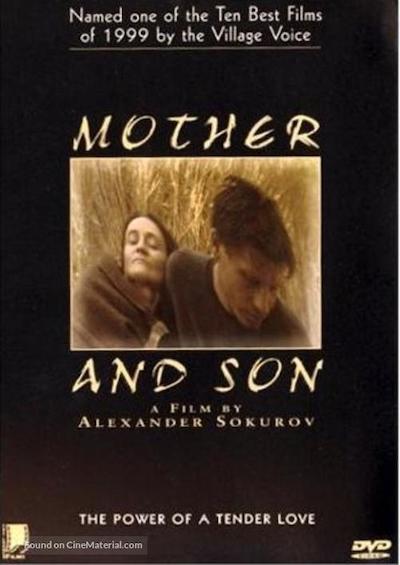
  • Aleksandr Sokurov – Mat i syn AKA Mother and Son (1997)

    1991-2000Aleksandr SokurovArthouseRussia

    Quote:
    Mother and Son is one of those films that provides a genuine challenge to anyone trying to clearly define exactly what it is that makes it so damned special. As a reviewer you get used to dealing in the traditional elements of narrative cinema, things like pace, story, humour, dialogue, action and tension. But consider the following plot summary:

    A loving and dutiful son comforts his dying mother in her final days.

    And that’s it.Read More »

  • Anatoly Petrov – Rozhdenie Erota AKA The birth of Eros (1989)

    1981-1990Anatoly PetrovAnimationEroticaRussia

    Quote:
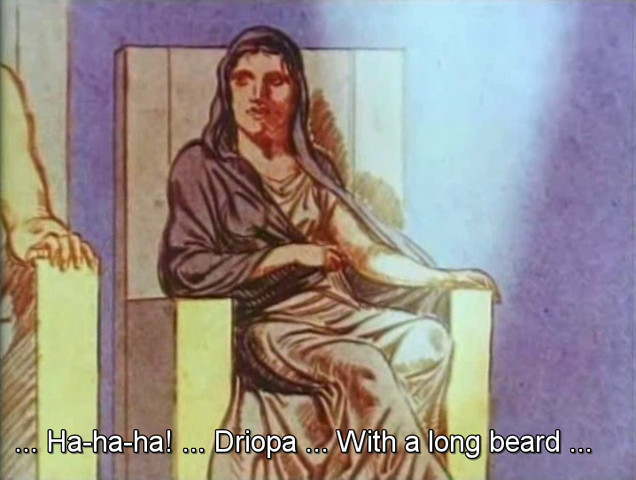
    Animation by Anatoly Petrov, The first of 4 Greek mythological stories with an erotic character about Aphrodite and Eros he made between 1989 and 1996.
    The style is quite experimental on the first two, as he strived for a 3 dimensional effect using just handcrafted cel-animation means.

    For animating it means he drew 2 layers for each animation sequence, which doubles the amount of animation drawings.and he drew them all by himself, showing his extraordinary skills and speed as animator.
    There are many switches in style in the animation, sometimes using sketch material,at other times fully worked out animation, and from black and white to colour, etc. It gives the animation a quit experimental character. A sort of deconstructed style
    The nudity and erotique character of the 4 animations is unique for soviet animation. With every animation of the serie the erotism gets more explicit. The 4 are the only Russian erotic animation art known to meRead More »

  • Aleksandr Dovzhenko – Aerograd (1935)

    1931-1940Aleksandr DovzhenkoClassicsDramaUSSR

    Quote:
    A Russian outpost in Eastern Siberia comes under threat of attack by the Japanese in this patriotic film from 1935. Aerograd is a new town with a strategically located airfield of vital interest to the government. Work on the new outpost is complicated when tensions develop between workers and a religious sect. The sect threatens to give their support to a band of marauding samurai warriors who battle for control of the region. Relations between the two countries are further strained in the days before World War II, dating back to the Russo-Japanese War of 1905. In this feature, the Russians are victorious as airplanes throughout the country come to the aid of the beleaguered new town. Director Alexander Dovzhenko, long considered a giant in Russian classic cinema, also wrote the screenplay for this feature.Read More »

Back to top button