Quote: “An underground revolutionary group struggles against internal strife to stage urban guerilla attacks against a fictionalized fascist regime in the United States. Interspersed throughout the narrative are rhetorical sequences that explain the philosophy of radical action and restrain the melodrama inherent in the thriller genre.”Read More »
Quote:
An old man is kidnapped. His interrogation uncovers the biography of a mass muderer: The 80 years old man was a SS leader and responsible for the killing of thousands of people in Russia. He also “invented” an evil technique of eliminating political prisoners: the manipulated suicide. Thomas Harlan reconstructs the history of a burocratic muderer, he also develops a direct connection between the Nationalsocialism and the treatment of prisoners of the RAF terrorists in the Stuttgart isolation prison. Robert Kramer filmed the shooting of Harlan’s Wundkanal: Notre Nazidocuments a social experiment in which the children of Nazis and of victims meet a real culprit. The reality seems to be stronger that the fiction in Harlan’s film.Read More »
An angry young man goes to Europe to find his father, a ’60s radical turned doctor in exile.
Doc lives on the edge of Europe where it imperceptibly slides over into the Third World. As a doctor, he knows that the illness he has contracted ten years before in war-torn Africa is getting worse. The diagnosis is cholera, but Doc Knows the disease’s real name: despair. His thoughts about his failed struggle for justice and ideals are drowned regularly in alcohol. On the other side of the world lives Jimmy, a speed-loving motorbike freak who, when his mother dies, finds a letter from Doc and discovers that his father, whom he thought was dead, is still alive. The encounter of the two men leads to a reappraisal of two worlds in opposition.Read More »
Synopsis: In Starting Place, Robert Kramer revisits Hanoi, two decades after the end of the war and his making of People’s war. He succeeds in creating an impressionistic portrait of a country dealing with its haunting past while struggling to build a competitive economy.Read More »
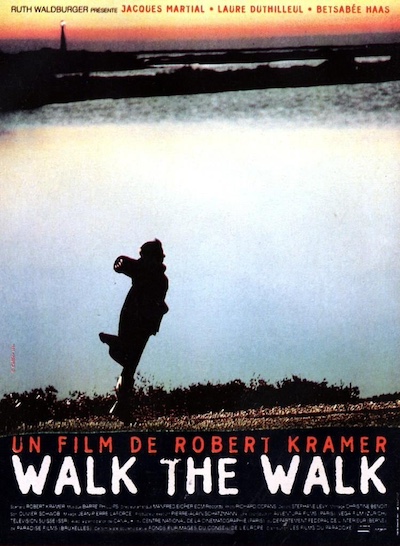
PLOT: The story of several trips, that of Raye, a young girl who leaves the family home for one or other European countries, that of her father, Abel, former athlete and finally that of Nellie, his wife, who does not not but travel among the micro-organisms that she studies with her microscope.Read More »
The final film from expatriate American filmmaker Robert Kramer, who died in France in 1999. Kramer and collaborators tell the somber life story of Ben. After leaving his homeland as a youth, he is greeted in France by menial jobs in industry. In time, he opens a fruit market, finds a wife, fathers a child, and has it all come crashing down when he learns his mother is in danger back home. Upon his return to France, he finds his life in ruin.Read More »
Quote: A troubled antiwar activist plans to assassinate the President of the United States. His resolve forces others in a fragmented and disillusioned group of political allies to face the threat of government counterintelligence and the temptations of middle-age security, and to reexamine their commitment to radical action.Read More »
Quote: We are on the continent of Robert Kramer’s essay-films. What country is this, what year, what time? There are no establishing shots, no introductions to ease us in. Everything is in medias res. Kramer never gives us a superimposed title telling us we are watching ‘Vietnam’ or ‘Paris’ or ‘USA’; he never includes the identifying names of people, typewritten on screen, the first time we see them (and indeed, if we ever do learn this, it is often indirectly, by accident); he rarely introduces a radically different piece of footage into the montage with a reassuring title saying ‘ten years ago’, or a voice-off saying ‘I remember …’.Read More »
Following a series of films questioning commitment and politics in America and culminating with Milestones 1975, and a 1977 documentary on Lisbon’s Carnation Revolution, Scenes from the Class Struggle in Portugal, Robert Kramer moved to France with his family. The first film he made there was Guns, an intricate feature which echoed the paranoid films of 1970’s Hollywood. With Guns, Kramer continues his exploration of the militant psyche, while at the same time experimenting with different forms of narration.Read More »