

Quote:
Shot in 1967 but not released until 1975, actor Pierre Clémenti’s acid-infused experimental whirlwind of color and music featuring a who’s who of the French 60s underground.Read More »
Quote:
Shot in 1967 but not released until 1975, actor Pierre Clémenti’s acid-infused experimental whirlwind of color and music featuring a who’s who of the French 60s underground.Read More »

“Blood-red posters featuring portraits of wanted ‘terrorists’ decorated every street wall in occupied France during World War II, and this account of how 23 foreigners working for the Resistance were caught and executed dramatises one of the heroic myths of the Occupation. But Cassenti adopts a radically different perspective from the humanist ‘honesty’ of L’Armée des Ombres or even Lacombe Lucien, and instead attempts a Marxist analysis of the myth and what it means, historically, to re-enact it. As it moves from one level of representation to another with a Brechtian approach to performance, the film occasionally obscures its aims but never fails to challenge the way we receive history in the cinema.” – Time Out Film Guide
Read More »

Quote:
Two actors performing in Strindberg’s “Inferno” as God and Lucifer, find themselves competing in real life as well. One of them, Henrique, has spiritual obsession with John Wayne and his way of walking. He and de Dieu, his fellow actor who plays Lucifer and also directs the Strindberg play, engage in a philosophical and spiritual tug-of-war, especially when they meet an author named God, who has plans for another drama to feature both actors.Read More »
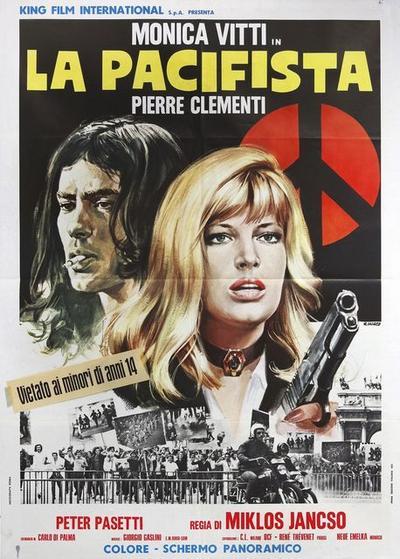
This highly symbolic and enigmatic political drama by Hungarian director Miklos Jancso was produced by a consortium from Italy, France and West Germany. This film is considered to be an homage to Antonioni as it uses his favorite leading actress (Monica Vitti) and his cameraman Carlo di Palma. This film was made during a time when Jancso was not allowed to make films in his native Hungary. In the middle of the crowd, while covering an Italian political protest by leftists, The Journalist (Monica Vitti), a pacifist, finds herself surrounded by a quite different group of people who jostle her, remove her recording equipment from her and set her car on fire. She complains to the police about this. However, when the police bring one of the young men before her for her to identify him, she says he is not one of her attackers. This leads to her having a romantic relationship with the young man. The group, and the young man, are young Italian neo-fascists, and the young man has been given the job of assassinating a leftist. He is too gentle to do this, and his group kills him right before The Journalist’s eyes. She goes to the police again, but they begin to believe that she is insane, even when she is forced to kill her boyfriend’s assailants right there in the police station.Read More »

Quote:
One of Pasolini’s most enigmatic films, it extends his cinematic obsessions into the realms of cannibalism and bestiality with two interweaving stories of two young men who become sacrificial victims of their different societies. One of them is a soldier and cannibal (Clementi) in a medieval wasteland and the other a son (Léaud) of an ex-Nazi industrialist (Tognazzi) in modern-day Germany. The young German is more attracted to pigs than to his fiancée (Wiazemsky). This rather silly parable, very much a product of the late 1960s, in which the bourgeoisie is caricatured, is filmed with such calm beauty and underlying disgust that it seems to gain in significance. Theorem (1968) and Pigsty were the only films in which the Marxist Pasolini dealt directly with the hated middle classes; thereafter he left the 20th-century behind until his final film, Salo (1975), which looks at even more extreme human actions.Read More »