Today Iranian cinema is one of the most highly regarded national cinemas in the world, regularly winning festival awards and critical acclaim for films which combine remarkable artistry and social relevance. Iran: A Cinematographic Revolution traces the development of this film industry, which has always been closely intertwined with the country’s tumultuous political history, from the decades-long reign of Reza Shah Pahlevi and his son, the rise of Khomeini and the birth of the Islamic Republic, the seizure by militants of the U.S. Embassy in Tehran, and the devastating war with Iraq.Read More »
Persian
-
Nader Takmil Homayoun – Iran: A Cinematographic Revolution (2006)
2001-2010DocumentaryIranNader Takmil Homayoun -
Massoud Bakhshi – Yek Khanévadéh-e Mohtaram AKA A Respectable Family (2012)
Drama2011-2020ArthouseIranMassoud Bakhshi
Synopsis
Upon returning home to Iran after more than two decades abroad, visiting professor Arash is quickly thrust into a past he’s spent his whole life trying to escape. With an estranged father on his deathbed and a mother who wants nothing to do with her husband’s shady past, Arash finds himself at the mercy of the rest of the family who have their own ideas about what should happen to his father’s assets. Meanwhile, Arash is also grappling with the legacy of his brother’s mysterious, long-ago death. A stranger in his native country, he struggles to navigate the labyrinthine state bureaucracy, as well as the darker twists and turns of a corrupt and violent netherworld.
Seattle Film FestivalRead More » -
Abbas Kiarostami – Be Tartib ya Bedoun-e Tartib AKA Orderly or Unorderly (1981)
1981-1990Abbas KiarostamiIranShort Film

SYNOPSIS:
This film’s first shot shows students descending a staircase in a calm, orderly fashion. Its second portrays the same action as a chaotic rush. Separated by slates and Kiarostami’s voice intoning, “sound, camera,” subsequent sequences describe the same dichotomous behavior in a schoolyard, on a school bus, and in the haphazard traffic of Tehran. Kiarostami described this as “a truly educational film,” but it plays more like a quirky philosophic aside.Read More » -
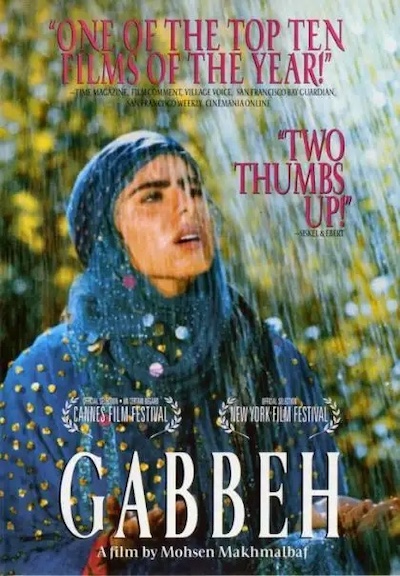
Mohsen Makhmalbaf – Gabbeh (1996)
Arthouse1981-1990FantasyIranMohsen Makhmalbaf

Quote:
Gabbeh is a brilliantly colorful, profoundly romantic ode to beauty, nature, love and art. Mohsen Makhmalbaf originally traveled to the remote steppes of southeastern Iran to document the lives of an almost extinct tribe of nomads. For centuries, these wandering families created special carpets – Gabbeh – that served both as artistic expression and autobiographical record of the lives of the weavers. Spellbound by the exotic countryside, and by the tales behind the Gabbehs, Makhmalbaf’s intended documentary evolved into a fictional love story which uses a gabbeh as a magic story – telling device weaving past and present’ fantasy and reality.Read More » -
Kamran Shirdel – An shab ke barun amad AKA The Night it Rained (1967)
1961-1970ArthouseDocumentaryIranKamran ShirdelAlso known as The Epic Of Gorgan Village Boy, is a modern-day epic that attempts to retrace the true circumstances of a heroic act in the north-Iranian countryside. One rainy night near the village of Gorgan, a schoolboy discovered that the heavy rains had washed away the soil underneath a section of railroad tracks. He proceeded to stop an oncoming train by lighting his coat on fire, standing on the tracks and waving it. Doing so, the schoolboy prevented a terrible railroad accident. Incorporating newspaper reports and interviews with railroad employees, the governor, the chief of police, the village teacher, students and villagers, Shirdel describes the events, or better, the divergent recollections of them. The skilfully and cyclically edited footage is riddled with contradictions. How could this young hero have set fire to his coat in the pouring rain? Did he even exist? According to one toothless old man, “It’s all just a pack of lies.”Read More »
-
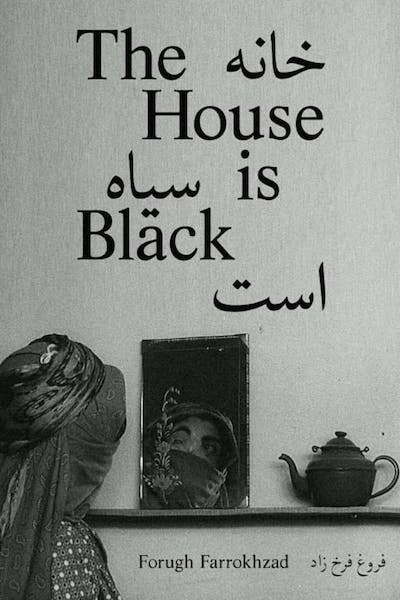
Forugh Farrokhzad – The House is Black aka Khaneh siah ast (1963)
1961-1970Amos Vogel: Film as a Subversive ArtDocumentaryForugh FarrokhzadIranShort Film

From Village Voice: In 1962, beloved and controversial poetess Forugh Farrokhzad went to Azerbaijan and made this short film on the grounds of a leper colony, presaging in 22 minutes the entirety of the Iranian new wave and the international quasi-genre of “poetic nonfiction.” It’s a blackjack of a movie, soberly documenting the village of lost ones with an astringently ethical eye, freely orchestrating scenes and simply capturing others, while on the soundtrack Farrokhzad reads her own poetry in a plaintive murmur—this in the same year as Vivre sa Vie and La Jetée. (Chris Marker has long been a passionate fan, as has Abbas Kiarostami, whose The Wind Will Carry Us owes its title and climactic verse to Farrokhzad.) It was the only substantial piece of cinema Farrokhzad ever made. Five years later, having already attained near legendary status in Iran for her writing, she was killed in a car crash at the age of 32, guaranteeing her posthumous fame as a feminist touchstone for generations of angry Persian women.Read More »
-
Jafar Panahi – Offside (2006)
2001-2010ComedyDramaIranJafar PanahiSince women are banned from soccer matches, Iranian females masquerade as males so they can slip into Tehran’s stadium to see the game between Iran and Bahrain. The ones who are caught and arrested are taken to a holding area and guarded by soldiers. One sympathetic soldier agrees to watch the game through a peephole and recount the action to the impatient fans.Read More »
-
Manijeh Hekmat – Zendan-e zanan aka Women’s Prison (2002)
Drama2001-2010IranManijeh Hekmat
Spanning 18 years in an Iranian women’s prison, this follows two women: the new prison warden, a tough as nails devout Muslim who has served in the army on the Iraqi front, and a young midwife, Mitra, who is serving her sentence for killing her mother’s abusive husband. In the early years, Mitra is repeatedly punished as the warden tries to break her. This includes punishment for delivering a baby in the prison cell while all of the prison staff has taken shelter during an Iraqi bombing. The warden’s attitude starts to change after 8 years, when Mitra tries to protect a new inmate from rape at the hands of her older cellmates. When the baby comes back in 1991 as a 17 year old delinquent, Sepideh, the warden respects Mitra enough to protect the girl.Read More »
-
Mani Haghighi – Kargaran mashghoole karand AKA Men at Work (2006)
Arthouse2001-2010IranMani HaghighiQuote:
A bare bones synopsis of this film might lead you to expect that it is lethally boring. Four middle aged buddies are returning to Tehran from a trip to the mountains, trying to get back in time to watch an important soccer match on TV. Their homeward journey grinds to a halt when they round a curve in the highway and are confronted by a natural monolith, a 10 foot high, narrow rock formation, projecting straight up out of the ground, overlooking the canyon below. They spend the rest of the movie trying to topple it.Read More »