Mitsuko Kusabue

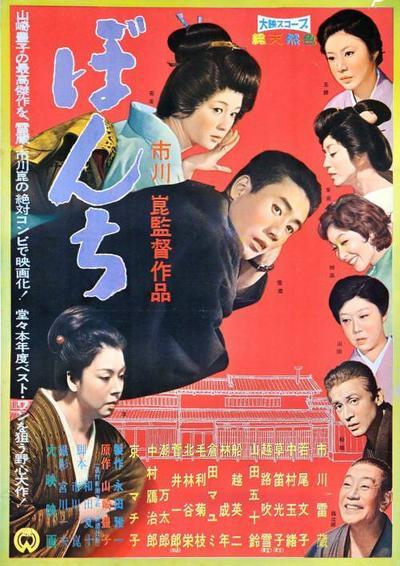
  • Kon Ichikawa – Bonchi (1960)

    1951-1960AsianDramaJapanKon Ichikawa

    29f7c043f76a2bde437fd0d52a185152

    Where Ichikawa skewered patriarchal family values in Her Brother, in this savage satire he hoists the matriarchal system on its own apron strings. Raizo Ichikawa (“in his best role yet”-Variety) is the scion of an Osaka merchant family whose traditional power is matrilineal. Instructed by his overbearing mother and grandmother to give them an heiress for the family business, he stands by helplessly as wife after wife is thrown out of the house for producing sons. Driven to a life of dissipation-his mistresses also fail to produce daughters-in the end he is just too tired to care. Ichikawa’s frighteningly funny picture of the matriarchy’s efforts to perpetuate itself was received as antifeminist, if not downright misogynistic, but Joan Mellon suggests that the target once again is “the institution of the family [which] places its own survival ahead of the needs and feelings of individuals.” If this looks forward to The Makioka Sisters, so does Donald Richie’s comment, “We find this cruel matriarchal story…told in terms of the most transcendental beauty.”Read More »

  • Mikio Naruse – Midareru AKA Yearning (1964)

    1961-1970DramaJapanMikio Naruse

    29f7c043f76a2bde437fd0d52a185152

    Slant Magazine wrote:
    At first, Yearning appears to be a typically late-Narusian offering, a low-key and observational drama that obsessively details Reiko’s day-to-day routines. In addition to keeping her small business afloat, Reiko must deal with her meddling in-laws, who have their minds set on selling the grocery store, and also attend to Koji, who inexplicably indulges in a rebellious cycle of petty crime and violence. One of Naruse’s great talents is in making the mundane mysterious so when Koji declares, seemingly out of nowhere, that he’s been in love with Reiko for years, it takes more than a few moments to acclimate to the film’s suddenly malleable emotional terrain, even though, in retrospect, it makes perfect psychological sense. It’s a shock to witness how charged and raw the duo become after Koji’s admission, and Naruse’s camera, under the guiding eye of cinematographer Jun Yasumoto, never blinks, maintaining a harsh, voyeuristic presence as the characters move, like increasingly frenzied celestial bodies, through a space made unfamiliar because of a naked confessional moment.Read More »

Back to top button