

A man and a woman in Rome evoke a civilization and an ancient love.Read More »

Vera Baxter is talking to a woman. It seems that the woman was attracted to her by hearing her name called out: “Baxter, Vera Baxter.” In response to her new friend’s queries, Vera recounts the story of her life.
The story begins with his marriage to Jean. Vera is a faithful wife to the point that her husband pays a man to be unfaithful to him, according to him, adultery paid revitalize the desire of the couple. But this does not happen and Vera will not see him anymore.Read More »

Quote:
Filmed in 1979, these four short films share a common method: they combine texts written and read by Duras (in voice-over) with images shot by Pierre Lhomme.Read More »
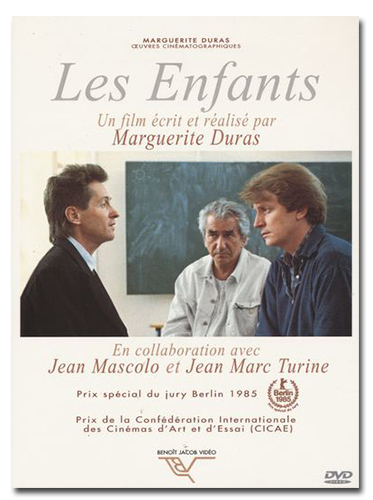
A sort of philosophical comedy written and directed by Marguerite Duras (with Jean Mascolo and Jean-Marc Turine), starring Axel Bogousslavsky, Daniel Gélin, Tatiana Moukhine, Martine Chevallier, André Dussollier and Pierre Arditi.Read More »

The most insidious thing about the nouveau movie, which is a polite way of describing Marguerite Duras’s newest, most minimal film, “Nathalie Granger,” is that it traps you in its own time, unlike the nouveau roman, which can be skipped through or read at leisure in an afternoon or a year. You can’t skip through “Nathalie Granger.” To see it you are forced to watch it for as long as it lasts, while, in turn, it watches its characters, rather as if the camera were a Siamese cat whose feelings had been hurt. Without betraying the slightest interest, the camera records the physical appearance of two expressionless women who look a lot like Jeanne Moreau and Lucia Bose. They share a house with their two children, one of whom, Nathalie, is apparently a problem. “She wants to kill everyone,” says one of the women, who seem to be interchangeable. “She wants to be an orphan, or a Portuguese maid.” Nathalie, however, remains docile—this being a minimal movie.Read More »

La mort du jeune aviateur anglais tells the story of a British airman whose grave Marguerite Duras discovered near Deauville. Although we don’t know where fiction begins, Duras’ narrative has a remarkable authenticity. A veritable manifesto of spontaneous writing, brilliantly directed by Benoît Jacquot, where the “direct writing” of Duras meshes perfectly with the unpretentious approach of the filmmaker. (Allocine)Read More »
A man returns to the place he once lived a passionate love affair with a woman who is now dead. So powerful are the emotions that seize him that he imagines she is still alive, and begins to live as if this were the case…
INTRODUCTION BY MARGUERITE DURAS
“Woman of the Ganges” is in a way two films. Parallel to the film is played out a purely vocal film, unaccompanied by images.
To avoid any contempt, we would like to let the spectator know that the two Voices Off of women do not belong at all to the characters which appear in the images.
We can add that the characters seen in the images are entirely unaware of the existence of the two women in the story who manifest themselves only in the dialogue which they hold.Read More »