Macedonian

  • Zivorad ‘Zika’ Mitrovic – Miss Stone (1958)

    1951-1960ClassicsDramaMacedoniaYugoslavian Cinema under TitoZivorad 'Zika' Mitrovic

    IMDB rating: 8.3 / 10
    First color film made in Republic of Macedonia. Based on a true story.

    At the turn of the century, Macedonia is under the administration of the Ottoman Empire. Macedonian freedom fighters, in order to raise money for their cause, kidnap an American Protestant missionary – MIss Stone – and demand ransom for her return.

    Whilst among her kidnappers, Miss Stone, who originally set out to convert Macedonians to Protestantism, was herself converted to the Macedonain cause for national independence. After her release she returned to the US where she campaigned for the Macedonian cause. Too bad American public opinion at the time equated ‘ransom’ with the tactics of Chinese brigands who also kidnapped American missionaries.Read More »

  • Branko Gapo – Denovi na iskusenie AKA Days of Temptation (1965)

    Drama1961-1970Branko GapoYugoslaviaYugoslavian Cinema under Tito

    In 1918, after the Balkan Wars and the First World War, thousands of Macedonians immigrate to Bulgaria. Among them are pro-Bulgarian Macedonians who want to exploit the emigrants for their own political agenda. Infighting in the revolutionary organization VMRO leads to the assassination of a number of Macedonian freedom fighters. The victim of one such assassination in Sofia is Gjorche Petrov, a hero of the Macedonian revolutionary movement. He is killed by a young boy who is not aware he is assassinating one of the last true fighters for Macedonian freedom. The realization that he has become unwittingly involved with the pro-Bulgarian organization and was used to execute this vile act is a death sentence for the young boy. The story revolves around the psychic condition of the young assassin who becomes easy prey to the intrigues woven around him until the final moment – his death.Read More »

  • Stole Popov – Gypsy Magic AKA Gipsy Magic (1997)

    1991-2000ComedyDramaMacedoniaStole Popov

    Quote:
    In a Macedonian gypsy village local man meets an Indian UNPROFOR physician whom he sees as solution to all his troubles.Read More »

  • Stole Popov – Tetoviranje AKA Tattoo (1991)

    1991-2000DramaPoliticsStole PopovYugoslavia

    Quote:
    After a quarrel with his wife, a man leaves their apartment with one suitcase only. Having slept in a train station, the police legitimates him and found him suspicious. Soon he’ll find himself locked in a prison with several other, mostly innocent people. The true horror begins only then.Read More »

  • Aco Petrovski – Dervishi (1955)

    1951-1960Aco PetrovskiDocumentaryMacedoniaYugoslavian Cinema under Tito

    Movie from 1955, in duration of 11 minutes.
    The movie is created in standard technique, with sound, in black and white

    Content:
    The film describes the religious rites of the dervishes, from the Moslem religious sect

    “Rifai”.Read More »

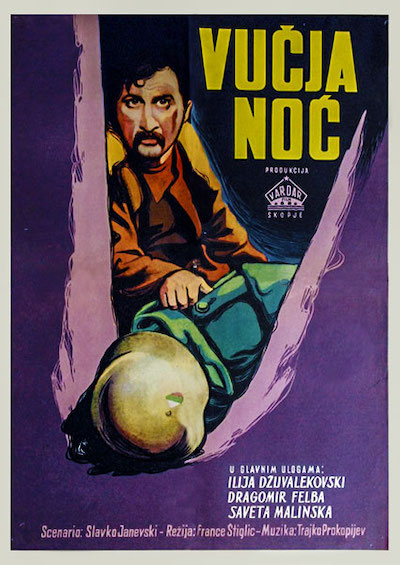
  • France Stiglic – Volca nok aka Night of the Wolves (1955)

    1951-1960DramaFrance StiglicMacedoniaWarYugoslavian Cinema under Tito

    Macedonian partisans take up the struggle against Bulgarian fascists that occupy Macedonia. This was not by any means an easy battle since Bulgaria was the only German ally that did not send troops to the Russian front. Thus, the entire Bulgarian military machine could, without distraction, dedicate its efforts to crushing the Macedonian resistance.Read More »

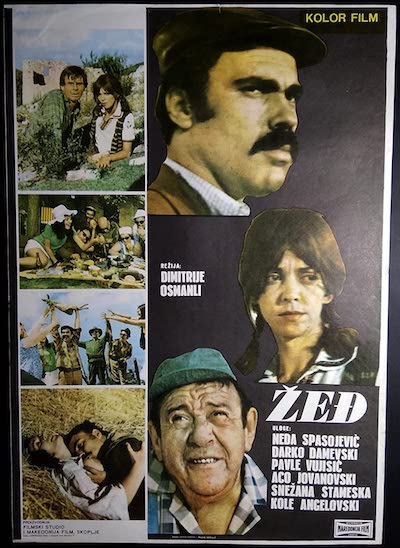
  • Dimitre Osmanli – Zedj AKA Thirst (1971)

    1971-1980Dimitre OsmanliDramaMacedoniaYugoslavian Cinema under Tito

    The inhabitants of a small village in a backward area of Macedonia earn their living by sending their men abroad in search of employment. Three young girls, named Elica, Maria and Nikolina live and work as schoolteachers in the village. Each of them try to make sense of their lives, in that situation where it is imposed on them. In the village the greatest problem is the supply of water. Spring water is carried by Marko from the distant mountains Marko is falls in love with the poor girl Kate. The monotonous peasant life is dispelled with the arrival of a group of mining engineers who come to do some research. The one engineer, named Victor is among them and he attracts the schoolteacher Maria’s attention. The return of Trendafil the old man working abroad, Kate’s uncle, is a special event in the village’s life. The destiny of a great number of the inhabitants depends on the wealth of the uncle returned from America. However there is no place for faith and hope as the uncle returns with no earnings at all.Read More »

  • Aco Petrovski – Partisan (1953)

    1951-1960Aco PetrovskiDocumentaryMacedoniaYugoslavian Cinema under Tito

    Content:
    It is about the members of the “Partisan” organization for physical education doing gymnastics. Reception and accompaniment of Tito’s (estafette?) baton is also presented.

    Movie from 1953, in duration of 11 minutes.
    The movie is created in standard technique, with sound, in black and white
    Read More »

  • Milcho Manchevski – Majki aka Mothers (2010)

    2001-2010ArthouseDramaMacedoniaMilcho Manchevski

    29f7c043f76a2bde437fd0d52a185152

    *Macedonian entry for the Best Foreign Language Film at the 83rd Academy Awards

    Two nine-year-old girls report a flasher to the police even though they never saw him. Three filmmakers meet the only residents of a deserted village – an elderly brother and sister who have not spoken to each other in 16 years. Retired cleaning women are found raped and strangled in a small town.

    The fiction slowly turns into a documentary.

    Marking the return of Milcho Manchevski, ‘Mothers’ portrays all types: dedicated, neglectful, loving, absent. Through these women, Manchevski renders the faces of human tragedy and joy.

    Employing an innovative structure, the three stories in ‘Mothers’ highlight the delicate relationships of truth and fiction, of drama and documentary. What is the nature of truth?

    Directed with a keen eye for contemporary Macedonia, the film eschews neat narrative devices and pushes the viewer to confront their own definitions of filmic reality.

    In a traditional structuralist manner, the structure of the film itself (two parts fiction and one part documentary) becomes part of its message.Read More »

Back to top button