

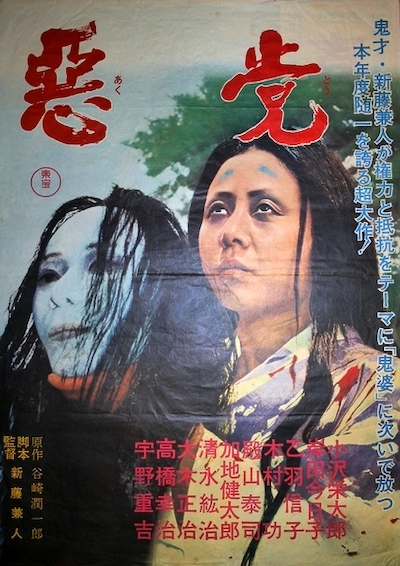
Hell manifests itself through the sins, shame and desires of an upper class rural family and a mother’s grief from beyond the grave.Read More »
Hell manifests itself through the sins, shame and desires of an upper class rural family and a mother’s grief from beyond the grave.Read More »

Quote:
A Jonan Station detective, Kikuchi, is framed for smuggling drugs and sent to prison. When he is paroled, he joins a private detective agency, where he is asked to investigate Mitsue Takazawa, the wife of a local trading firm president. While secretly conducting his own research, he finds out that Takazawa’s husband is the one, responsible for Kikuchi’s imprisonment, who also have set sights on Setsuko, a woman Kikuchi becomes romantically involved with.Read More »

Based on a novel by Mishima Yukio, The School of Flesh (1965) tells the story of a beautiful designer descended from nobility (Kishida Kyōko), who breaks away from an unhappy marriage after the war to greedily pursue a wild and pure love. Kinoshita Ryō directs this sophisticated tale of romantic intrigue in high style.Read More »
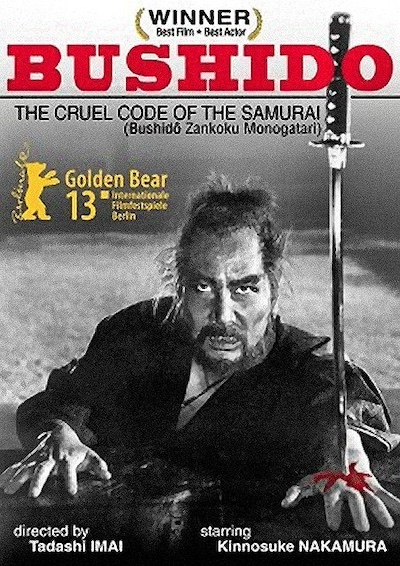
PLOT:
The attempted suicide of his fiancée prompts a Japanese salary-man to read his family chronicles and look back at the life of his ancestors. They were samurai, the military nobility caste who carried out acts of violence at the behest of feudal lords, but suffered even more so under their cruelty, often forced into ritual suicide (seppuku). The women were under constant threat of kidnapping and rape, and the men subjected to arbitrary disfigurement and homosexual slavery … In a radical departure from the usual romanticisation of the samurai, director Tadashi Imai – using period sets and sometimes graphic images – made a film fundamentally critical of medieval Japan’s feudal system and the inhumane samurai code called bushido. In addition, the final two of the eight episodes in the film draw parallels between that and kamikaze pilots of World War II, as well as Japan’s modern achievement-oriented society. Bushido zankoku monogatari was awarded the Golden Bear at the 1963 Berlin International Film Festival.Read More »

Synopsis:
Ume (Kyoko Kishida) and Kame (Kazuko Yoshiyuki) are two elderly sisters who live in a large house packed with discarded items they find while rummaging through trash in their town. One day, the two women find some red yarn and bring it home. That evening, the women discover a young girl (Ayu Kitaura) who has entered their home and knitting a sweater with their red wool. Who is this girl?Read More »
Quote:
A morally-suspect and self-serving retainer rashly baits her high-ranking employer, a regional governor, with a salacious story of a former acquaintance and catastrophe ensues.Read More »

The film is Yasuzo Masumura’s last feature film, based on Mio Saito’s novel which wons him a Seishi Yokomizo Award, shot by Setsuo Kobayashi, principle cinematographers of such Kon Ichikawa & Yasuzo Masumura classics as Fires on the Plain, An Actor’s Revenge, Being Two Isn’t Easy, Ten Dark Women, A Wife Confesses, Red Angel, Blind Beast, Manji, Black Express… (Indeed I think he’s responsible for the look (for example, the tight framing & deep focus) of these films). The film also boasts a fabulous cast, including Tetsuro Tamba, who seems uncredited.Read More »
The film is Yasuzo Masumura’s last feature film, based on Mio Saito’s novel which wons him a Seishi Yokomizo Award, shot by Setsuo Kobayashi, principle cinematographers of such Kon Ichikawa & Yasuzo Masumura classics as Fires on the Plain, An Actor’s Revenge, Being Two Isn’t Easy, Ten Dark Women, A Wife Confesses, Red Angel, Blind Beast, Manji, Black Express… (Indeed I think he’s responsible for the look (for example, the tight framing & deep focus) of these films). The film also boasts a fabulous cast, including Tetsuro Tamba, who seems uncredited.Read More »
