Quote:
These six reels of my film diaries come from the years 1949-1963. They begin with my arrival in New York in November 1949. The first and second reels deal with my life as a Young Poet and a Displaced Person in Brooklyn. It shows the Lithuanian immigrant community, their attempts to adapt themselves to a new land and their tragic efforts to regain independance for their native country. It shows my own frustrations and anxieties and the decision to leave Brooklyn and move to Manhattan. Reel three and reel four deal with my life in Manhattan on Orchard Street and East 13th St. First contacts with New York poetry and filmmaking communities. Robert Frank shooting The Sin of Jesus. LeRoy Jones, Ginsberg, Frank O’Hara reading at The Living Theatre.Read More »
Ken Jacobs
-
Jonas Mekas – Lost, Lost, Lost (1976)
1971-1980DocumentaryExperimentalJonas MekasUSA -
Ken Jacobs – Book of Eternalisms 40-43 (2025)
2021-2030ExperimentalKen JacobsUSAVideo Art
Kenneth Martin Jacobs (May 25, 1933 – October 5, 2025) was an American experimental filmmaker. His style often involved the use of found footage which he edited and manipulated. He also directed films using his own footage.Read More »
-
Ken Jacobs – Tourists of The Familiar 52 (2024)
2021-2030ExperimentalKen JacobsShort FilmUSAExperimental short film.Read More »
-
Ken Jacobs – Tourist of the Familiar 28 (2024)
Ken Jacobs2021-2030ExperimentalShort FilmUSA
Tourist of the Familiar 28 (2024) Experimental short film directed in 2024 by Ken Jacobs.Read More »
-
Ken Jacobs – XCXHXEXRXRXIXEXSX (2021)
2021-2030ExperimentalKen JacobsUSABased on a performance piece from the 1980s with his wife, Jacobs has transformed the physical performance into a 3D, phantasmagorical feature-length film using his eternalism technique. An open exploration of sexuality, using sexual elements to begin a dialogue relating to the depth of movement.Read More »
-
Ken Jacobs – The Georgetown Loop (1996)
Ken Jacobs1991-2000ExperimentalShort FilmUSATHE GEORGETOWN LOOP
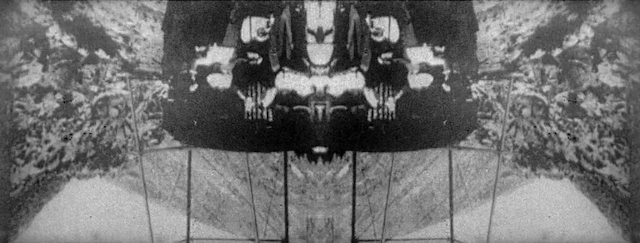
(Ken Jacobs, 1996, 11m, widescreen 35mm film, black and white, silent)Originally photographed in 1903, US Library of Congress collection. New arrangement in 1996 by Ken Jacobs, assisted by Florence Jacobs. 35mm optical rephotography by Sam Bush, Western Cine, Denver.
I’ve been raiding the Paper Print Collection of the Library Of Congress in Washington, DC, since the late 1960s with TOM, TOM, THE PIPER’S SON. It’s a preserve of early cinema. Until 1912, in order to copyright film, one deposited with the library a positive from the negative printed on paper, unprojectable, but – unlike nitrate prints – capable of weathering the years without Crumbling into chemical volatility. And there the stacks rested, safely out of mind, hundreds and hundreds of silent rolls most less than 30 meters, many Edisons, American Mutoscope And Biograph, Gaumont, Lubin, Vitagraph ; cine-snatches of life as it was lived, vaudevillians, proto-dramas, and too many state parades.Read More »
-
Ken Jacobs – A Tom, Tom Chaser (2002)
Ken Jacobs2001-2010ExperimentalShort FilmUSA

Quote:
A Tom Tom Chaser is Jacobs’ 2002 poetic riff on the transformation of his classic film Tom Tom the Piper’s Son from chemical to electronic form during the telecine process.Read More » -
Ken Jacobs – Capitalism: Child Labor (2006)
Ken Jacobs2001-2010ExperimentalShort FilmUSA

Quote:
“Jolting in every sense of the word, this short masterwork flickers between stereographic cards depicting Victorian-era child laborers, creating a portrait of standardized horrors, endlessly reproduced.” —MoMARead More » -
Ken Jacobs – Window (1964)
Ken Jacobs1961-1970ExperimentalShort FilmUSAQuote:
The moving camera shapes the screen image with great purposefulness, using the frame of a window as fulcrum upon which to wheel about the exterior scene. The zoom lens rips, pulling depth planes apart and slapping them together, contracting and expanding in concurrence with camera movements to impart a terrific apparent-motion to the complex of the object-forms pictured on the horizontal-vertical screen, its axis steadied by the audience’s sense of gravity. The camera’s movements in being transferred to objects tend also to be greatly magnified (instead of the camera the adjacent building turns). About four years of studying the window-complex preceded the afternoon of actual shooting (a true instance of cinematic action-painting). The film exists as it came out of the camera barring one mechanically necessary mid-reel splice. –K. J.Read More »
- 1
- 2