Isao Kimura

  • Kinji Fukasaku – Kuro tokage AKA Black Lizard (1968)

    1961-1970Film NoirJapanKinji FukasakuMystery

    Synopsis: Japanese sixties comedy featuring a cunning female jewel thief named Black Lizard who tries to kidnap Sanaye, a wealthy jeweler’s beautiful daughter as part of a plot to steal the jeweler’s expensive “Star of Egypt” diamond. To thwart the planned kidnapping, the jeweler hires Japan’s number one detective, the brilliant Akechi. This sets off a dual between Black Lizard and Akechi as each tries to outwit the other. In the process, the two adversaries develop a mutual respect and affection for each other. Despite Akechi’s efforts, Black Lizard and her crew are able to kidnap Sanaye and gain possession of the “Star of Egypt”. Black Lizard takes Sanaye to her secret lair on a remote island which is populated by an eerie collection of naked human dolls. There Black Lizard plans to preserve Sanaye’s beauty forever by turning her into one of her dolls. As Sanaye’s doom quickly approaches, it is up to Akechi to save the day.Read More »

  • Kôzaburô Yoshimura – Cape Ashizuri (1954)

    1951-1960DramaJapanKôzaburô Yoshimura

    Among Yoshimura’s complex and political works, this episodic film, set in the early 1930s, follows the life of a young left-wing student activist disenchanted by the increasingly hawkish state of Japanese society.Read More »

  • Mikio Naruse – Anzukko AKA Little Peach (1958)

    1951-1960DramaJapanMikio Naruse

    Quote:
    Director Mikio Naruse has admitted to going through a dark period as a younger man and his 1958 film Anzukko (the first he is credited with writing after 1950’s White Beast) seems, in part, his way of dealing with the tortures of his past.Read More »

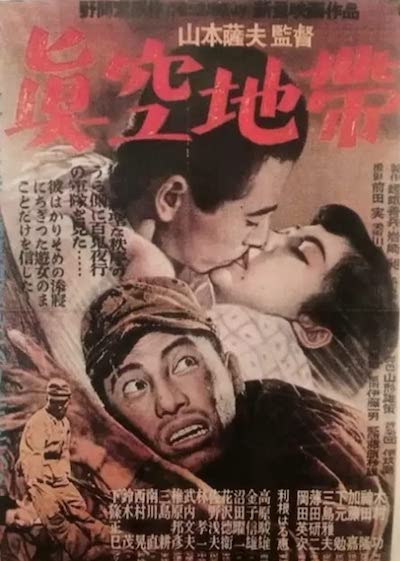
  • Satsuo Yamamoto – Shinkû chitai AKA Vacuum Zone (1952)

    1951-1960DramaJapanSatsuo YamamotoWar

    During the winter of 1944, Kitani, a soldier, returns to his unit in Osaka after a two year absence. None of the men inducted with him are left, and his new comrades greet his sulky attitude with suspicion and resentment. The men have been told that Kitani was in hospital during his absence, whereas he was actually in prison: caught between two officers competing for a lucrative position, Kitani had been accused of stealing a wallet belonging to Hayashi, a First Lieutenant. The resulting inquiry had extended into Kitani’s personal life, with letters written to his lover construed as expressing anti-military sentiments.Read More »

  • Yûzô Kawashima – Gan no tera AKA The Temple of Wild Geese (1962)

    Yûzô Kawashima1961-1970ArthouseDramaJapan

    Synopsis:
    Satoko is a mistress by trade, or fate: when her master, the silkscreen artist of the Kohoan Temple in Kyoto, dies, she is given to the temple’s lascivious head priest Kikuchi. She is drawn to a melancholy young acolyte, Jinen, who has observed the profligacy of his cruel master and Satoko’s utter dependence on the man. Jinen is both fascinated and disturbed by Satoko’s interest in him; he is similarly caught between loathing of Kikuchi and of the dark circumstances of his birth and his own moral weakness. The story unfolds in a dreamlike manner, a flashback inspired by a now-infamous image on a silkscreen in the souvenir shop at the so-called Temple of the Wild Geese.Read More »

  • Kon Ichikawa – Okuman choja aka A Billionaire (1954)

    1951-1960AsianComedyJapanKon Ichikawa

    A full description of the film can be found in James Quandt’s edited collection of writings on (and by) Ichikawa Kon from the Cinemateque Ontario (in Sato Tadao’s essay “Kon Ichikawa” on pages 109 – 111). A Billionaire was one of a handful of 50s comedies that Ichikawa directed that were extremely successful at the box office. These films were characterized by rapid-fire dialogue and biting social commentary (others like this include Pu-San and Mr Lucky). This is definitely a period of Ichikawa’s career that deserves more focus from the West.Read More »

  • Tomu Uchida – Yôtô monogatari: hana no Yoshiwara hyakunin-giri AKA Hero of the Red Light District AKA Killing in Yoshiwara (1960)

    1951-1960AsianDramaJapanTomu Uchida


    Overview:
    On the surface, this may seem to be an early example of the Japanese exploitation films that would become very popular about five years later. In fact, this film occasionally feels like Seijun Suzuki’s own interpretation, if only for the technicolor cinematography and the presence of some sleazy elements. However, past the surface, this is still very much a Tomu Uchida film. His compassion towards his character and the issues they face, is handled delicately and his semi-cynical humor is as apparent as ever. Still, I’d be lying if I said this was on the same level as Uchida’s own Bloody Spear on Mount Fuji.Read More »

Back to top button