Hans Christian Blech

  • Edgar Reitz – Cardillac (1969)

    1961-1970ArthouseDramaEdgar ReitzGermany

    Synopsis:
    ‘Cardillac is a craftsman and goldsmith who sells the products of his craft then becomes obsessed with reacquiring them. A devoted father to his daughter Madelon, Cardillac will even kill to get the precious jewelry back into his hands. As he sinks into irreversible insanity, he constructs a homemade electric chair and contemplates suicide.’
    – Rotten Tomatoes

    Based on the novel by E.T.A. HoffmannRead More »

  • Zivojin Pavlovic – Nasvidenje v naslednji vojni AKA Farewell until the Next War (1980)

    Zivojin Pavlovic1971-1980DramaWarYugoslaviaYugoslavian Cinema under Tito

    Quote:
    “[…] by far the most ambitious, honest, bitter, and controversial Partisan film produced in the country that was about the collapse in flames and genocide only a decade later. Based on an equally uncompromising novel by Vitomil Zupan, the enfant terrible of Yugoslav literature, Farewell until the Next War continues the comprehensive deconstruction and demythologization of the official narrative of Partisan heroism, initiated by Pavlović three years earlier with Manhunt.” Jurij Meden, in: Retrospective o partigiano! Pan-European Partisan Film, Austrian Film Museum & Viennale, 2019.Read More »

  • István Szabó – Oberst Redl AKA Colonel Redl (1985)

    1981-1990DramaHungaryIstván Szabó

    Set during the fading glory of the Austro-Hungarian empire, the film tells of the rise and fall of Alfred Redl (Brandauer), an ambitious young officer who proceeds up the ladder to become head of the Secret Police only to become ensnared in political deception.Read More »

  • Károly Makk – Magyar rekviem Aka Hungarian Requiem (1990)

    Károly Makk1981-1990ArthouseDramaHungary

    Quote:
    In 1956, there was an uprising of Hungarians against their Russian overlords, which the Russians briefly allowed to flower and then ruthlessly suppressed. One suspects that the country’s rulers knew about the uprising in advance and permitted it to continue so as to be able to identify who was most actively involved. In this film, it is 1958, and five very different men are waiting in their prison cells to be taken out and executed. Their dreams, fantasies and recollection relieve what might otherwise seem to be an unnecessarily repetitive situation. The internationally known French star Matthieu Carrière plays one of the condemned men. ~ Clarke Fountain, RoviRead More »

  • Armand Gatti – L’Enclos AKA Enclosure (1961)

    1961-1970Armand GattiDramaWarYugoslaviaYugoslavian Cinema under Tito

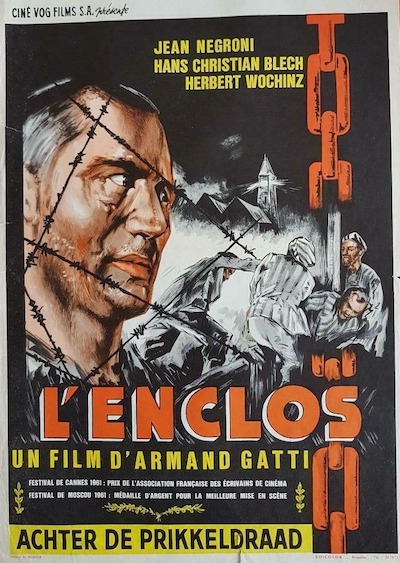
    This prison camp drama by director and co-scripter Armand Gatti, his first film, reflects the early ’60s resurgence of interest in the crimes against humanity committed by the Nazis in World War II. (In another year, the Adolph Eichmann trial would be the first ever seen live on American television.) Gatti focuses on two men in a German concentration camp who have been cruelly penned inside an enclosure. One of the men, Karl (Herbert Wochinz), is a strong, bitter anti-Nazi German — a target of the Gestapo. The SS wants information on a rumored organization of resistance fighters inside the prison and they know he has it. The other man, David (Jean Negroni) is a Jew. If one of the men dies within a certain time then the other will be released. He will not be killed. Otherwise, both will be executed. The resistance fighters in the prison try to help the two as best they can, while the pair inside the enclosure slowly come to know each other as though they were brothers. ~ Eleanor Mannikka, All Movie GuideRead More »

  • Wim Wenders – Falsche Bewegung AKA The Wrong Movement (1975)

    1971-1980DramaGermanyWim Wenders

    Quote:
    A loose contemporary adaptation of Goethe’s Wilhelm Meister’s Apprenticeship, the middle installment of Wim Wenders’ “road movie trilogy” opens with a scene that’s pure Wenders — a young man gazes out his window while American rock rollicks out of the LP player, until he suddenly puts both fists through the glass, quietly sobbing. That’s Wilhelm (Rudiger Vogler), who grudgingly accepts that, if he’s ever to become the writer he wants to be, he has to overcome his dislike for people and venture out to accumulate experiences. In place of inspiration, the journey hooks him up with a group of fellow loners, the “dead souls of Germany”: an apathetic actress (Hanna Schygulla), an aged ex-Nazi whose nose bleeds from “remembering” (Hans Christian Blech), his mute street-performer travelling companion (a teenage, almost tomboyish Nastassja Kinski), a pudgy poet (Peter Kern), and a suicidally bereft industrialist (Ivan Desny). Read More »

Back to top button