French

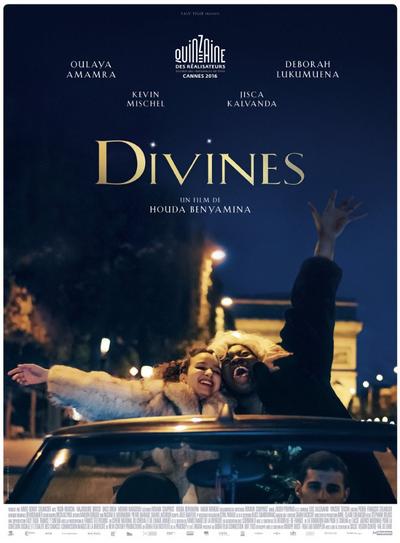
  • Houda Benyamina – Divines (2016) (HD)

    2011-2020CrimeDramaFranceHouda Benyamina

    With staggering self-assurance and disarming creativity, director Houda Benyamina bursts onto our screens with the frenetic story of Dounia, a teenage girl living in a crime-fuelled suburb on the outskirts of Paris. Along with her best friend Maimouna, the budding entrepreneur vies for the attention of local dealer Rebecca, whilst simultaneously embarking on a fraught emotional relationship with a handsome male dancer who has caught her eye. But as Dounia’s work and personal lives rapidly escalate, her control begins to slip and she soon finds herself dangerously out of her depth. A neat feminist twist on the typically male-centric terrain of the gangster thriller, this imaginatively directed and sharply-performed drama signals the arrival of some major new talents. In its depiction of female friendships and power dynamics, the film makes for an interesting companion piece to Céline Sciamma’s Girlhood, while as a vibrant explosion of youthful energy and imagination, it stands defiantly on its own.

    — BFIRead More »

  • Agnès Varda – Les Cent et une nuits de Simon Cinéma AKA A Hundred and One Nights of Simon Cinema (1995)

    1991-2000Agnès VardaComedyFrance

    Criterion wrote:
    A celebration of cinema’s centennial, One Hundred and One Nights finds Agnès Varda at her most playful. It is also perhaps her unlikeliest project: a star-studded comic fantasy with an extravagant sense of style and an adoring but slightly off-kilter perspective on the magic of filmmaking. French New Wave icon Michel Simon is a mysterious aging impresario named Simon Cinéma who has hired a young film student, Camille (Julie Gayet), to simply sit with him at his mansion and talk about movies. Skeptical yet increasingly enchanted, Camille bears witness to cinema itself coming to life, allowing Varda to wittily integrate a mind-boggling parade of appearances by screen legends (Catherine Deneuve, Marcello Mastroianni, Jean-Paul Belmondo, Anouk Aimée, Robert De Niro, and many others), and attest to the vigorous health of the movies at the close of the twentieth century.Read More »

  • Agnès Varda – Les créatures AKA The Creatures (1966)

    1961-1970Agnès VardaArthouseFantasyFrance

    Criterion wrote:
    One of Agnès Varda least-seen films is also one of her most fascinating: an eccentrically imaginative science-fiction fantasia that touches on human nature, free will, and the creative process. Working with major stars for the first time on a feature film, Varda casts Michel Piccoli as a writer and Catherine Deneuve as his silent wife, a couple who relocate to the island of Noirmoutier (a longtime second home for Varda and her husband, Jacques Demy) where strange goings-on hint at a sinister force controlling the minds and actions of the residents. Slipping between “reality” and fiction, genre spectacle and avant-garde experimentation, Les créatures is a beguiling, endlessly inventive exploration of the mysterious alchemy that transforms life into art.Read More »

  • Michel Deville – Martin Soldat AKA Soldier Martin (1966)

    1961-1970ComedyFranceMichel Deville

    Quotes :
    An actor disguises himself as a soldier during the Second World War, but is mistaken for a soldier and becomes involved in the events of WWII.

    Un comédien de troisième zone se déguise en officier Allemand pour les besoins de sa troupe de théâtre. Il est fait prisonnier par les soldats Américains le jour du Débarquement…Read More »

  • Sarah Maldoror – Monangambeee (1968)

    1961-1970African CinemaAngolaPoliticsSarah MaldororShort Film

    Quote:
    “Monangambeee” was a rallying cry used by activists during Angola’s anti-colonial liberation struggle to gather villages together. The film of the same title addresses Portuguese arrogance towards Angolan culture. Sarah Maldoror draws on a novella by José Luandino Vieira, the story of a political prisoner, to make a film about humiliation, solidarity and resistance.Read More »

  • Jean-Marie Téno – Clando (1996)

    1991-2000CameroonDramaJean-Marie Téno

    Proud and determined, the hunter set out, leaving behind his village ravaged by a terrible drought. All the villagers came out to wish him well, and everyone gave what he could: an egg, a handful of peanuts or a few kola nuts… As in the folktale, Sobgui, a former computer programmer who now drives a “clando” cab in Douala, flees to Europe to escape a life in Cameroon which has become unbearable. In Cologne (Germany), Sobgui joins a community of African emigrants. Most are hard-working and ambitious people. Sobgui begins a love affair with Madeleine, a German political activist who encourages Sobgui and his friends to return home and fight for change.
    – Written by JM Teno.usRead More »

  • Jean Benoît-Lévy & Marie Epstein – La Maternelle AKA Children of Montmartre (1933)

    1931-1940ClassicsFranceJean Benoît-LévyMarie Epstein

    Below is an apt “user comment” from the film’s IMDB page. For my money, LA MATERNELLE is an even greater film than ZERO FOR CONDUCT, which is saying a lot.

    “Until I saw this film at a Cinema Conference in Aberdeen in 1995 I was ignorant of the fact that a woman director had produced poetic and social cinema comparable with Vigo’s ZERO DE CONDUITE (certainly one of the greatest films ever). Vigo in 1933 is revolutionary anarchist with modernist poetry at his finger tips; Epstein in 1933 is warm-hearted popular front realism with magnificent performances by nursery school kids, though the main schoolgirl is a little older (and in love with her teacher, like the protagonist in Leontine Sagan’s MAIDENS IN UNIFORM 1931). Read More »

  • Michel Subiela – Le collectionneur des cerveaux aka The Collector of Brains (1976)

    1971-1980FranceHorrorMichel SubielaMystery

    A young pianist is shocked when she witnesses a strange chess tournament with a robot. Could there be a gruesome secret behind this exhibition?Read More »

  • Robert Bresson – Journal d’un curé de campagne aka Diary of a Country Priest [+ commentary] (1951)

    1951-1960ArthouseClassicsFranceRobert Bresson

    Quote:
    A new priest (Claude Laydu) arrives in the French country village of Ambricourt to attend to his first parish. The apathetic and hostile rural congregation rejects him immediately. Through his diary entries, the suffering young man relays a crisis of faith that threatens to drive him away from the village and from God. With his fourth film, Robert Bresson began to implement his stylistic philosophy as a filmmaker, stripping away all inessential elements from his compositions, the dialogue and the music, exacting a purity of image and sound.Read More »

Back to top button