Franco Brocani

  • Franco Brocani – Clodia/Fragmenta (1982)

    1981-1990ExperimentalFranco BrocaniItaly

    Quote:
    I couldn’t find any real info on this one… I guess it is for completist of italian underground cinema only. Beautiful images, long static shots and even long stretches of black screen, a lot of idle talk (in italian) about Clodia, both the one Catullus loved and another one who seems to be a modern-day prostitute (with all the trappings of holiness and debasing that one would expect from high-brow eroticism).Read More »

  • Franco Brocani – Sulla poesia AKA On Poetry (1984)

    1981-1990DocumentaryFranco BrocaniItalyShort Film

    Quote:
    An essay on contemporary Italian poetry with the works of Dario Bellezza and Amelia Rosselli.Read More »

  • Franco Brocani – Due o tre cose: a proposito di W. Hayter (1968)

    1961-1970DocumentaryFranco BrocaniItalyShort Film

    Quote:
    An art documentary portraying Stanley William Hayter – considered the inventor of modern incision – at work in his Paris studio. At the Hayter’s Atelier 17 have studied, since the early ’30s, Brauner, Calder, Max Ernst, Giacometti, Kandinsky, Miro, Matta, Picasso, Chagall.

    In addition to a tribute to a great artist, the short film wants to be an interpretative proposal of cinema and engraving as particularly related techniques.Read More »

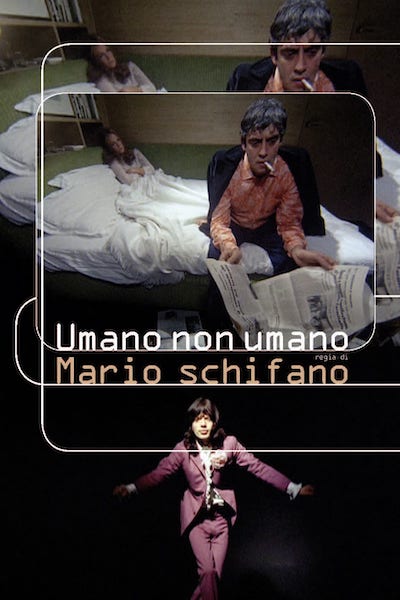
  • Mario Schifano – Umano non umano AKA Human, Not Human (1972)

    1971-1980DocumentaryItalyMario Schifano

    Human not human is not only the best Italian “experimental” film of the 60’s, but also one of the richest and most involving documents of “cinema of protest”. – Lino Miccichè

    Schifano’s cinema is, as his paintings, spontaneous and gesture-based, quickly objectifying the world, and at the same time deeply thougth-out, and progresses by building up pictures and sounds.
    Dissolves and pulsing images of television broadcasts plunge us in a completely unstable state of vision, allowing the author to avoid choosing, including in the same space different visions and distant, fragmentary, expanded timeframes.
    If anything, the choice is left to the viewer and, from this point of view, “Human not human” becomes almost an interactive film, one that needs to be mentally rebuilt.Read More »

Back to top button