

A crafty ronin comes to a town divided by two criminal gangs and decides to play them against each other to free the town.Read More »
A crafty ronin comes to a town divided by two criminal gangs and decides to play them against each other to free the town.Read More »

Nikkatsu’s big prestige film of the year, however, was Kiriro Uryama’s Foundry Town – a drama about the troubled family life of a bright, spunky teenage girl in a rough factory town. Urayama’s first film, w/ a script by Shohei Imamura, Foundry Town was ranked 2nd in the Kinema Jumpo magazine’s annual critics poll. Sayuri Yoshinaga, who played the lead, became a major Nikkatsu star, appearing in a series of teen romances with Mitsuo Hamada.Read More »
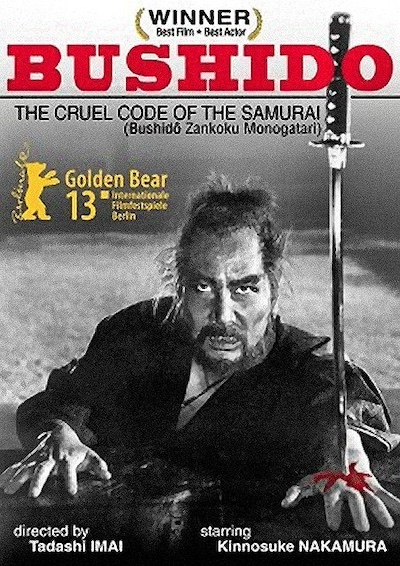
PLOT:
The attempted suicide of his fiancée prompts a Japanese salary-man to read his family chronicles and look back at the life of his ancestors. They were samurai, the military nobility caste who carried out acts of violence at the behest of feudal lords, but suffered even more so under their cruelty, often forced into ritual suicide (seppuku). The women were under constant threat of kidnapping and rape, and the men subjected to arbitrary disfigurement and homosexual slavery … In a radical departure from the usual romanticisation of the samurai, director Tadashi Imai – using period sets and sometimes graphic images – made a film fundamentally critical of medieval Japan’s feudal system and the inhumane samurai code called bushido. In addition, the final two of the eight episodes in the film draw parallels between that and kamikaze pilots of World War II, as well as Japan’s modern achievement-oriented society. Bushido zankoku monogatari was awarded the Golden Bear at the 1963 Berlin International Film Festival.Read More »
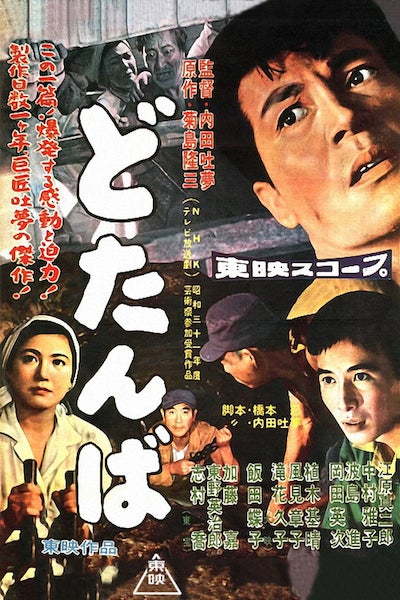
Quote:
Based on a 1956 television feature on Japan’s national network, NHK, this is one of Uchida’s rarest films. A socially conscious drama with a contemporary backdrop, Dotanba focuses on the attempts to rescue a group of trapped miners. The title is a figure of speech — (essentially “last minute” or “eleventh hour”) — that refers to a situation of peril. The film boasts a script co-written by Uchida and Akira Kurosawa’s frequent screenwriter, Shinobu Hashimoto, and stars Kurosawa’s frequent star Takashi Shimura.Read More »

Quote:
Eburi is a 36 year-old man. Nothing enthuses him any more. While being drunk, he promises to contribute a story to a magazine. When he sobers down, he decides to write about the life of a salaried employee like himself who is very ordinary, not particularly talented.
The following is his story:
In 1949, Eburi gets married to Natsuko. His monthly salary is 8,000 yen and hers 4,000 yen. Therefore, both have to work to support themselves. Eburi has developed a habituIl tendency to pester around when he gets drunk. One year after their marriage, son Shosuke is born. In 1959, Eburi’s mother dies in despair of her husband who has become listless due to the several ups and downs of gaining big profits and going bankrupt. His father is still alive and Eburi is enable to find a way to pay his father’s debts.Read More »

Quote:
Everyday, 12 April 2006
Author: sharptongue from Sydney, Australia
The style is equivalent to the kitchen sink dramas which came to prominence in the 1950s. No kitchen sinks here, but plenty of the gritty (or, more accurately, muddy) details of everyday life on rice farms and fishing boats, where the only labour-saving device is a cow to pull a rotary hoe – and the cow is only on hire. Much screen time is devoted to planting and harvesting the rice, and catching fish and eels on the lake. Punishing work, liked by no-one.Read More »

Director Satsuo Yamamoto wields his sarcastic scalpel in this message movie that takes jabs at the practices of the medical profession. Zaizen Goro may only be an assistant professor but he has already made a name for himself. His superior, however, does not approve of his attitude towards their profession, and is at odds over who to nominate as his successor. The selection of the new professor reveals a rich and complex political world inside Naniwa University.Read More »

Quote:
Kinnosuke Nakamura plays seven roles in consecutive generations of Iikukuras: (Jirozaemon, Sajiemon, Kyutaro, Shuzo, Shingo, Osamu, Susumu), from medieval warrior Jirozaemon to modern day salary-man Susumu.
He is essentially playing his own descendants, each generation bound by a glorious ancestor’s oath of vassalage for himself & his family to a castle lord.Read More »