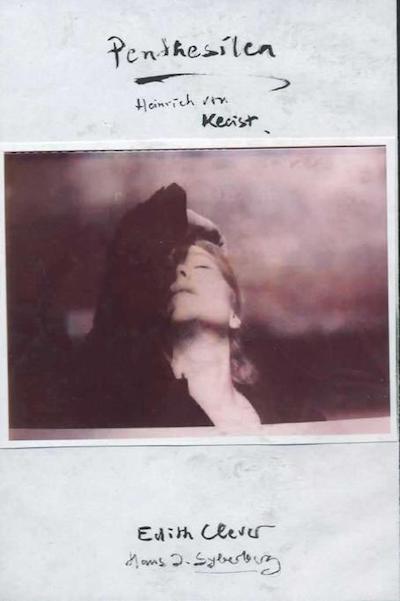
Edith Clever

  • Hans-Jürgen Syberberg – Penthesilea (1988)

    1981-1990DramaGermanyHans-Jürgen SyberbergTV

    monologue
    Kleist’s Penthesilea is certainly one of the most extraordinary plays in the German of the German dramatic repertoire. It is about the the wild and destructive passion that seizes the Queen of the Amazons and Achilles, the Achilles, the Greek hero, under the walls of Troy. Revulsed by its violence and strangeness -only in the 20th century did people realise the extent of this work – Goethe was and condemned it. Edith Clever brings out the full power of this of this feverish text.Read More »

  • Hans-Jürgen Syberberg – Die Nacht (1985)

    1981-1990ExperimentalGermanyHans-Jürgen Syberberg

    Quote:
    Die Nacht – a gigantic dramatic monologue in four parts like Wagner’s Ring – was produced as a film after first performances at the Theâtre des Amandiers in Paris in autumn 1984. Throughout six hours, Edith Clever plays poems, prose texts, letters, speeches, and dramatic roles invoking grief and farewell, doom and the nearness of death. The montage of poetic subject matter spans from Goethe and Kleist, Platon and Hölderlin, Novalis and Jean Paul to the Indian chief Seattle’s speech and texts by Hans Jürgen Syberberg.Read More »

  • Eric Rohmer – Die Marquise von O… AKA The Marquise of O (1976)

    1971-1980ArthouseDramaEric RohmerGermany

    Plot:
    The costume drama Die Marquise von O is French director Eric Rohmer’s first feature-length theatrical release after a four-year break from filmmaking. Based on a novella by Henrich von Kleist, the dialogue is spoken in the original German language and the story is set in Italy during the 18th century. Edith Clever plays the widowed Marquise, who is sexually assaulted by Russian soldiers and rescued by a Count (Bruno Ganz). Some time later, she has to explain to her parents (Peter Lühr and Edda Seippel) and brother (Otto Sander) why she’s pregnant. Die Marquise von O won the Grand Jury Prize in the 1976 Cannes Film Festival. At least one of the home video releases and several capsule reviews erroneously state the film (and its parent novella) as unfolding during the Franco-Prussian wars, but both are actually set during the Napoleonic Wars, hence the presence of Russian troops.Read More »

  • Peter Stein – Sommergäste (1976)

    Drama1971-1980ArthouseGermanyPeter Stein

    Peter Stein’s production of Gorki´s SOMMERGÄSTE at the Schaubühne in December 1974 became one of the greatest theatre successes in Germany and beyond. “That’s how theatre should always be. That’s how actors should always play,” wrote Le Monde, while in England the Daily Telegraph only had a simple title: “Director of genius”. In 1975 Stein filmed the play in a new adaptation by Botho Strauß.Read More »

  • Peter Handke – Die Linkshändige Frau AKA The Left-Handed Woman (1978)

    Drama1971-1980ArthouseGermanyPeter Handke


    29f7c043f76a2bde437fd0d52a185152

    S y n o p s i s
    A woman living in the Paris suburbs struggles with a loveless marriage and apathy toward her family and friends as she spends her days quietly wandering about her house. Austrian playwright and novelist Peter Handke contributed screenplays to a number of films by director Wim Wenders (Wings of Desire, The Goalie’s Anxiety at the Penalty Kick). Here (in a film that Wenders produced), he provides both the scenario (adapting his novel of the same name) and direction for this meditative examination of domestic ennui.Read More »

Back to top button