

Quote:
… explores Claude Lanzmann’s dedication to his film Shoah. It uses Lanzmann’s own words and previously unseen footage to provide new insights into his groundbreaking work.Read More »
Quote:
… explores Claude Lanzmann’s dedication to his film Shoah. It uses Lanzmann’s own words and previously unseen footage to provide new insights into his groundbreaking work.Read More »

Quote:
Klaus Barbie, also known as the butcher of Lyon was implicated in 4,000 deaths and the deportation of 7,000 Jews from occupied France, before he inexplicably vanished. This Oscar winning documentary, from visionary director Marcel Ophuls, traces the 40-year hunt for Barbie, initiated by the same governments that would later hide him and protect his family.Read More »
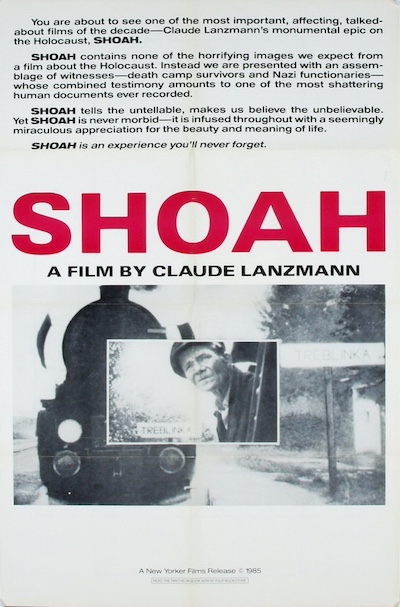
A 1985 French documentary film directed by Claude Lanzmann about the Holocaust (also known as the Shoah). The film primarily consists of his interviews with survivors and persons who had experience of the war, and visits to key Holocaust sites across Poland, including three extermination camps. He presents testimony from survivors, witnesses and bystanders, and perpetrators, including some rare interviews with German personnel.
As Claude Lanzmann does not speak Polish, Hebrew or Yiddish, he depended on translators to work with most of his interviewees. This process enlarged the scale of the documentary, which is nine hours and twenty-three minutes long.Read More »

Quote:
Using interviews and other footage shot especially for this documentary, French director Claude Lanzmann investigates the state of Israel in 1972. This movie concentrates on Israelis going about their business of everyday living. One interview shows the reactions of a concentration camp survivor, now a police chief, to being called a “Nazi” by demonstrators. Another segment follows the experiences of a Russian Jewish immigrant, beginning with his first visit to the Wailing Wall and continuing to his disturbing perception that he is welcomed more by virtue of his being Russian than for the fact that he is Jewish.Read More »

Quote:
1975. In Rome, Claude Lanzmann filmed Benjamin Murmelstein, the last President of the Jewish Council in the Theresienstadt ghetto, the only “Elder of the Jews” not to have been killed during the war. A rabbi in Vienna, following the annexation of Austria by Germany in 1938, Murmelstein fought bitterly with Adolf Eichmann, week after week for seven years, managing to help around 121,000 Jews leave the country, and preventing the liquidation of the ghetto.Read More »

The Sobibor uprising in 1943 in Poland was investigated by Mr. Lanzmann many years ago when he was filming “Shoah” and his interviews with a participant named Lerner date from then. The director felt that the Sobibor uprising, which led to the closure of the extermination camp by the Nazis after many escaped, was too important to be a small part of his epic documentary. Now he has returned to this little known story.Read More »

Her consistently and relentlessly painful account during the shoot of Claude Lanzmann’s Shoah makes for an attempt at understanding how one can be part of a convoy which – with Eichmann’s agreement – saved hundreds of Hungarian Jews while at the same time some 450.000 of their kin were either dying in the gas chambers of Birkenau, or burned alive in the open air in order to keep up with the pace the Nazis demanded.Read More »
Of the hundred ghettos that dotted the Polish countryside, the one in Lodz had existed for the longest. It was ruled with an iron fist by the president of the Jewish council of elders, Chaim Mordechai Rumkowski, known as “King Chaim” – a man convinced he could save part of the community by turning them into manpower to serve the Germans.Read More »
From MUBI:
Four Sisters, a quartet of Lanzmann documentaries that recently premiered at the New York Film Festival, avoids many of the pitfalls of the often-irascible documentarian’s lesser films by dint of its remarkable self-effacement. Devoted to the frequently jaw-dropping stories of four women who survived the Holocaust, the films—The Hippocratic Oath, Baluty, The Merry Flea, and Noah’s Ark— confirm that filmed oral history is Lanzmann’s métier. This seems particularly noteworthy in an era where the macro-historical approach of scholars such as Timothy Snyder has become embraced as the best conceptual tool for defining and explicating the Holocaust. Read More »