

To get ahead after he answers a newspaper ad for a business proposition, Passaguai borrows the more impressive apartment of a retired actor and arranges an elaborate luncheon there.Read More »
To get ahead after he answers a newspaper ad for a business proposition, Passaguai borrows the more impressive apartment of a retired actor and arranges an elaborate luncheon there.Read More »

Quote:
Another fine Italian neo-realist drama. Focussing on post-war poverty and the struggle for housing, this film has all the key elements: characters living in makeshift houses, lots of dirty infants, upheaval and total disinterest from the beaurocratic machine. Anna Magnani puts in a superb performance as the distraught, struggling and feisty mother, determined to make a better life for herself and those around her.
RosethornRead More »
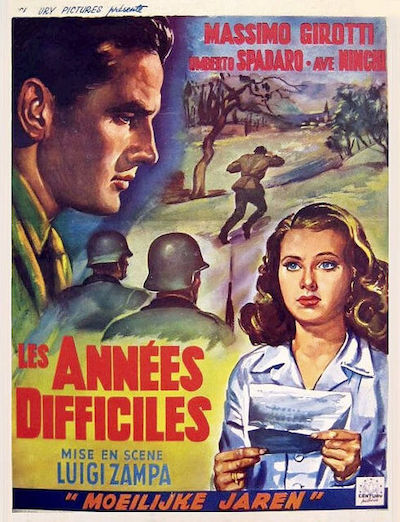
Aldo Piscitello, a minor government clerk, is forced in 1934 to join the Fascist party. When the war comes, he finds himself able only to talk ineffectually in secret against Mussolini, even as his own son Giovanni is sent into battle. By the end of the war, Aldo has found the courage to stand up for his beliefs, but by then it is too late.Read More »

Parigi e Sempre Parigi (Paris is Always Paris) was the second feature-length effort from famed Italian documentary director Luciano Emmer. Whereas Emmer’s first feature, Domenica d’Agosto (Sunday in August) was a warm-hearted study of the Italian middle class, Parigi concentrates on a gentle cultural clash between a band of Italian sports fans and the citizenry of Paris. The hero, DeAngelis (Aldo Fabrizi), has heard so much about “naughty Paree” that he’s determined to experience that naughtiness first hand. This plot device, of course, obliges the director to introduce several delectable French mademoiselles in the proceedings. Ultimately, DeAngelis realizes that reports of French libertinism have been grossly exaggerated, but he has a high old time finding this out.Read More »
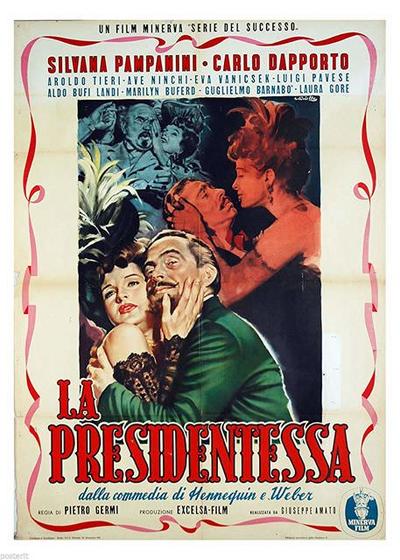
Based loosely on fact, La Presidentress stars Silvana Pampanini as a sexy nightclub singer with loftier aspirations. Posing as the wife of a judge, the singer manages to bed a high-ranking government official (Carlo Dapporto). As a result, the nonplused judge (Luigi Pavese) is given all sorts of promotions and special perks. When he finds out about the girl’s subterfuge, his first reaction is stark, raw terror: Wait till his real wife (Ave Ninchi) discovers what’s going on! When the judge’s former mistress (Marilyn Buferd) joins the fray, the fur really begins to fly.Read More »

In Rome, during the Americans with their Marshall plan helps, a thief Totò makes the life of a cop Aldo Fabrizi difficult. The cop has to chase the thief if he wants to recover his job, but both families, now, have become intimate friends.
Cops and Robbers (Italian: Guardie e ladri) is a 1951 Italian cult comedy film directed by Steno and Mario Monicelli. It stars a famous comedian Totó, and it was cinematographied by future film director Mario Bava. Its style is close to Italian neorealism. It had troubles with censorship because its view of clumsy police and smart thieves, but it was a great success. It was shown as part of a retrospective on Italian comedy at the 67th Venice International Film Festival.Read More »

PLOT SYNOPSIS:
From the comedy “Cabin 27”, by Anton Germano Rossi.
One Sunday at the beach of Ostia of cavalier Peppe Passaguai with his wife and three children.
A machine of Roman comicality that has its ascendency in the repertory of dialectal theater, of variety show, and in the humor of the Weekly Travaso of the ’30s, enriched by more cinematic gags and costume notations on the small bourgeoisie. Especially in the first half, there is no lack of good gags and colorful caricatures.
(Morandini)Read More »