

The 35-year-old ministry official Baron Leisenbohg had the stage career ten years ago as the cast of the “Queen of the Night”, opera that promoted singer Klare Hell. Klare shows no gratitude however.Read More »
The 35-year-old ministry official Baron Leisenbohg had the stage career ten years ago as the cast of the “Queen of the Night”, opera that promoted singer Klare Hell. Klare shows no gratitude however.Read More »

Government agent Richard Greene is sent to the French-Spanish border to round up smugglers and counterfeiters after his brother is murdered. He is helped by singer Anouk Aimée with whom he falls in love.Read More »

Quote:
Jacques Demy was arguably the greatest romantic of the French New Wave, and Lola was one film in which he proved how vital both sides of that equation were to his vision. While Lola exists within the same workaday France of Jean-Luc Godard and François Truffaut’s early films, Raoul Coutard’s cinematography allows Demy to find a beauty and poetry in the most ordinary circumstances; Coutard’s moving camera brings the grace of a dancer to the film’s visual proceedings, no matter how shabby some of the characters’ circumstances may be. The narrative is so fluffy it threatens to blow away at any moment, but Demy primarily uses it as a device to focus on the emotional lives of his characters, and it is their common search for love that moves the story and keeps the film compelling. Read More »

Liolà is a single father of three children, a free spirit wandering from city to city without wanting to commit to anyone.
An Alessandro Blasetti 1964 movie with Ugo Tognazzi, Giovanna Ralli, Pierre Brasseur and Anouk Aimée, from a Luigi Pirandello story.Read More »

With the desire to be rich gnawing at him, an arriviste pursues a golden real-estate opportunity at the expense of friends and family. Now, he has to renounce his dignity. What’s the good of chasing success when you are left all alone?Read More »

Another case rather isolated in the background of Italian cinema during 60s is Paolo Spinola, who made the best debut as a director in 1964: “La fuga”, a movie which Spinola shot aged 35 after a long activity as assistant director and scriptwriter. It’s the first Italian movie explicitly and fully based on a psychoanalytic plot. “La fuga” (which is also the best script written by Sergio Amidei during 60s and the best acting performance by Giovanna Ralli, who won the Nastro d’Argento prize as the best leading actress of that year thanks to this movie) suggests an attentive and meticulous investigation of a neurosis suffered by Piera, a typical woman from the Italian affluent society, wife of a successful engineer and living a ménage seemingly with no worries.Read More »

In his landmark 1948 essay Birth of a New Avant-Garde, filmmaker Alexandre Astruc advanced the notion of le caméra-stylo (camera pen) which imagined the cinema eventually breaking free of the concrete demands of narrative, where images become a means of writing just as flexible and subtle as written language. Greatly influenced by Astruc’s theory, it was only a few years later that in 1954 Francois Truffaut spoke of the director as an auteur, the cinematic equivalent of a novelist, cap able of expressing themselves through recurring thematic elements, distinctive ways of building characters, and, above all, through the deployment and movement of actors and objects within the time and space of the shot.Read More »
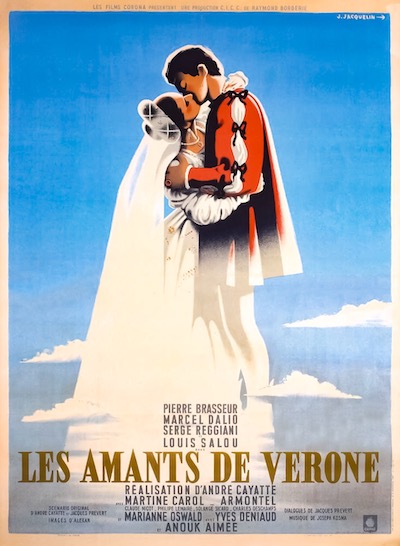
Synopsis:
A film crew is shooting an adaptation of Shakespeare’s Romeo and Juliet in Venice. Bettina Verdi, the leading actress, visits a glass factory in Murano with her guide Raffaele. One of the glassblowers, Angelo, is mesmerized by Bettina, so much so that he joins the cast as Romeo’s double just so that he can see her again. On the film set, Angelo meets Georgia, who is Juliet’s double. Georgia lives in a Venetian palace with her father Ettore and brother Amedeo. Both are hiding from justice after the fall of Fascism. Raffaele is in love with Georgia and does what he can to help her family. But when he realises that Georgia loves Angelo, Raffaele is outraged and decides to have his revenge. He will choose his moment carefully…Read More »

Synopsis
Agnès Varda travels around the world to meet friends, artists, and filmmakers for an expansive view of the global contemporary art scene.Read More »