

Ramu,eldest son a family of migrants to Calcutta,is a fresh graduate searching for a job like many others in post-Partition Calcutta.Read More »
Ramu,eldest son a family of migrants to Calcutta,is a fresh graduate searching for a job like many others in post-Partition Calcutta.Read More »

Synopsis
This bittersweet story is one of the last two films directed by acclaimed Bengali Satyajit Ray (1921-1992). In the story, Ananda Majumdar (Maradan Bannerjee) is the very moral and upright 70 year old patriarch of a family, with four grown sons. His father and one of his sons live at home with him, and his other three sons live elsewhere. When he collapses during a banquet being given in his honor, the sons and their families gather at his bedside at home. There, while their father lies for the most part comatose, the boys reveal to each other exactly what they’ve been up to without the sugar coating they’ve been giving their father. The oldest boy has been embezzling from the company he runs, another one is losing money for fun at the racetrack, and yet another has given up a decent job in order to become an actor.Read More »

Synopsis-
Nothing is common between the two men to ever meet and understand each other; neither the origin of the British administration of imperial time nor the primitive culture of the tribal from the jungle in central India. Nothing is common but the sharing of a common passion: hunting.
To both of them a big game is a game, a prey is a prey; this is probably why Ghinua, the young hunter and a loving husband, reacts like a terrible “hunter” when the usurer-landlord steals his wife. He slays him as the wild pigs have to be slain when they destroy harvest, or a tiger when he lifts a child. An avenged man, he brings his trophy, the head of the most mischievous game in his area, to the only man who will understand him, the English sahib, the other hunter.Read More »
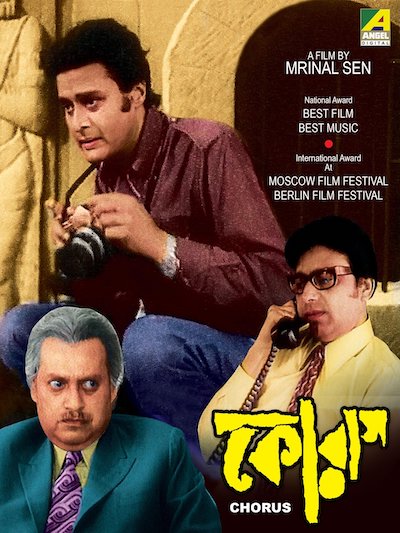
Synopsis:
Starting out as a fantasy mythological with the gods, entrenched in their fortress, deciding to create 100 jobs, the film becomes an exemplary fairy tale when 30,000 applicants start queuing up for work. The fairy tale then becomes a didactic tragedy with realist sequences (media men interviewing individuals in the crowd of applicants) when the people realise the job scheme is grossly inadequate and popular discontent grows into a desire to storm the citadel. Freely mixing different styles and modes of storytelling including direct address to the camera, with the chorus both as narrator and as political agitator (R. Ghosh, who also plays god and the sutradhara), Sen continues exploring the possibilities of a cinematic narrative that would be both enlightening and emotionally involving without descending into authoritarian sloganising. Having gone as far in this direction as he could, Sen deploys the lessons of his experiments with complex and stylistically diverse cinematic idioms in his next feature, Mrigaya (1976).Read More »