

An in-depth look at the history of the krautrock scene, including the most successful band Kraftwerk.Read More »
An in-depth look at the history of the krautrock scene, including the most successful band Kraftwerk.Read More »

Quote:
Ever wonder about the ancestors of the murderous jocks in Funny Games? In the Palme d’Or-winning The White Ribbon, Michael Haneke time travels to rural Germany on the cusp of WWI to find the answer—or, rather, to make the audience’s collective skin crawl at the question. The setting is the small village of Eichwald, a bucolic commune that, presided over by such stern patriarchs as the landowning baron (Ulrich Tukur) and the pastor (Burghart Klaussner), is presented as a 19th-century holdover inexorably giving way to the darkening modernity of new times. Not that Haneke displays much nostalgia for the town’s traditions: Life here is dismal, oppressive, and rigidly hierarchical, erected on puritanical morals and reinforced with ritualized punishment. Hitler—the “bitter flower of German irrationalism,” as Hans-Jürgen Syberberg once put it—may still lurk beyond the horizon, but the seeds of fascism have already been sown in society’s unquestioning adherence to power structures.Read More »

Synopsis
Shotaro and Minako are arguing. Minako has confessed her infidelity to her husband and informs him of her intention to leave him. She has ceased to enjoy living with a submissive husband. Minako, who works for a construction company, loves her job and is progressing in her successful career, while her husband eagerly takes care of the house and the kids. He buys groceries, he cooks, he does the laundry – constantly. The couple’s arguing intensifies until Minaka files for divorce. Their older daughter Mari isn’t that upset by her parent’s problems as she’s more interested in the piano piece she’s got to play with her mother at a concert organized by her music school; admittedly, she’s also rather interested in her music teacher. But her younger brother Toru feels betrayed by his mother and can’t manage to reconcile himself to his father’s role as a housewife. A partial reconciliation occurs at Minako and Mari’s concert, where their entrance on stage is met with loud applause.Read More »

In 1939, the author Annemarie Schwarzenbach and the ethnologist Ella Maillart travel together by car to Kabul, but each is in pursuit of her own project. Annemarie Schwarzenbach, who was among Erika and Klaus Mann’s circle of friends in the 30s, is searching for a place of refuge in the Near East to discover her own self. Ella Maillart justifies her restlessness, her need for movement and travel, with a scientific pretext: she would like to explore the mysterious Kafiristan Valley and make a name for herself with publications on the archaic life of the nomads living there. Both women are on the run, but political developments and their own biographies catch up with them again and again. Their mutual journey through the outside world, which runs from Geneva via the Balkans and Turkey to Persia, is compounded by the inner world of emotions with a tender love story.Read More »

Quote:
54 high school girls throw themselves in front of a subway train. This appears to be only the beginning of a string of suicides around the country. Does the new all-girl group Desert have anything to do with it? Detective Kuroda tries to find the answer, which isn’t as simple as one could hope.Read More »

imdb:
surreal, dreamlike, unorthodox…see it., 10 June 2003
Author: idc22 from Philadelphia, PA
This film was shown as “Every Day God Kisses Us On The Mouth” at the Philadelphia Film Festival this year to a surprisingly large crowd; it was met with more than its share of confused silence. I think the audience expected something different then what was on screen…Personally I went in expecting a film about a serial killer and his pet goose, something akin to a Romanian twist on Gaspar Noe’s utterly brilliant “Seul Contre Tous”. Sure, that’s perhaps a fraction of it, but as the film moves forth, it reveals itself to be a highly surreal, unorthodox, and sad film.Read More »

SYNOPSIS
In leaps of physical color and sound, Cornelia Geiser recites verses from two of Pierre Corneille’s Roman plays, Horace and Othon (“As for the school of dialectics, well Corneille is nevertheless the greatest…” said Straub), followed by a reading of Bertolt Brecht’s 1939 radio play The Trial of Lucullus, a powerful recitative on war-crimes in fourteen short pieces (never broadcast; later turned into an opera by Brecht and Paul Dessau in East Germany).Read More »
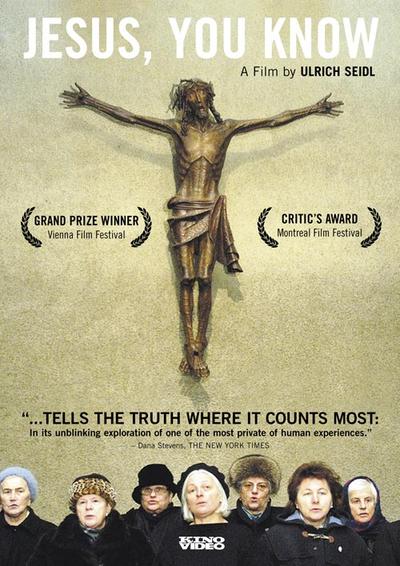
Quote:
Six Catholics share their thoughts and problems with Jesus in different churches. The camera accompanies them.
Great, uncompromising semi-documentary about six people who tell Jesus any given detail that is on their mind. They practice in such detailed manner that not seldomly you won’t manage to keep serious. For instance Elfriede who while cleaning the church’s floor and dusting the crucifixes starts her whining soliloquy about her Muslim husband’s behavior after sickness, his TV habits which appear to have taken influence on their relationship. Read More »

Synopsis
Alberte a une liaison passionnée avec Mathias, son médecin. Il la traite sous narco-analyse pour pouvoir déceler un symptôme plus profond. Il s’introduit en elle à son insu et prend possession de son être afin de lire ce qui le pourchasse lui, pourquoi on lui en veut, quelle est la maladie étrange qui l’habite.Read More »