1980s

  • Samuel Beckett – Quadrat 1+2 (1982)

    1981-1990ArthouseFranceSamuel BeckettTV

    Quote:
    ‘Quad’, the first in a series of minimalist experimental television plays made by Beckett in the 1980s for the broadcaster Süddeutscher Rundfunk, operates with a serial game involving the motional pattern of four actors, but equally accommodating four soloists, six duos, and four trios. Four actors, whose coloured hoods make them identifiable yet anonymous, accomplish a relentless closed-circuit drama. Once inside the square, they are condemned to monotonously and synchronously pace the respectively six steps of the lengthwise and diagonal lines it contains, in part accompanied by varying drumbeat rhythms.Read More »

  • David Hugh Jones – Betrayal (1983)

    1981-1990ArthouseDavid Hugh JonesDramaUnited Kingdom

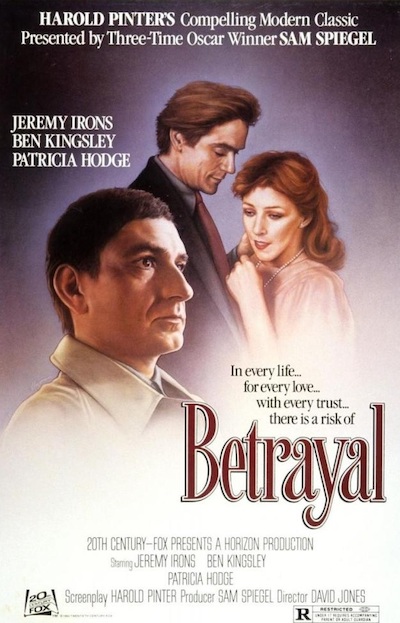
    The film version of what is widely regarded as one of Nobel Prizewinner Harold Pinter’s greatest plays. Betrayal traces a seven year affair played out in reverse – from its poignant end to its illicit first kiss. This version is from it’s first British TV screening and is upped to celebrate 50 years of Harold Pinter plays. In 1958 Harold Pinter wrote the following:
    “There are no hard distinctions between what is real and what is unreal, nor between what is true and what is false. A thing is not necessarily either true or false; it can be both true and false.” The film is little more than the stage play on celluloid and has great performances from Ben Kingsley, Patricia Hodge and Jeremy Irons. The silence after the opening credits is intentional.Read More »

  • David Hugh Jones – The Merry Wives of Windsor (1982)

    1981-1990BBCDavid Hugh JonesDramaTVUnited KingdomWilliam Shakespeare

    29f7c043f76a2bde437fd0d52a185152

    Making its debut with Romeo and Juliet on 3 December 1978, and concluding nearly seven years later with Titus Andronicus on 27 April 1985, the BBC Television Shakespeare project was the single most ambitious attempt at bringing the Bard of Avon to the small screen, both at the time and to date.

    Producer Cedric Messina was already an experienced producer of one-off television Shakespeare presentations, and was thus ideally qualified to present the BBC with a daunting but nonetheless enticingly simple proposition: a series of adaptations, staged specifically for television, of all 36 First Folio plays, plus Pericles (The Two Noble Kinsmen was considered primarily John Fletcher’s work, and the legitimacy of Edward III was still being debated).

    The scale of Messina’s proposal, far greater than that of previous multi-part Shakespeare series such as An Age of Kings (BBC, 1960) and Spread of the Eagle (BBC, 1963), required an American partner in order to guarantee access to the US market, deemed essential for the series to recoup its costs. Time-Life Television agreed to participate, but under certain controversial conditions – that the productions be traditional interpretations of the plays in appropriately Shakespearean period costumes and sets, designed to fit a two-and-a-half-hour time slot.Read More »

  • Theodoros Angelopoulos – Topio stin omichli aka Landscape in the Mist (1988)

    Drama1981-1990ArthouseGreeceTheodoros Angelopoulos

    Synopsis:
    The movie portrays the journey of two children in search of their father, whom they believe lives in Germany. On the way they meet many people, including a troupe of actors (a reference to Angelopoulos’ early movie The Travelling Players), and encounter dangers.Read More »

  • Robert J. Rosenthal – Zapped! (1982)

    USA1981-1990ComedyExploitationRobert J. Rosenthal

    Peyton and Barney are fun loving high school students working on a science project with white mice. When one of the mice begins to move food toward itself with out touching it, Barney finds he has accidently discovered a formula for telekinetic powers. Now, how much trouble can a high school boy who can move things with just his mind get into? Written by John Vogel Read More »

  • Alain Robbe-Grillet – La belle captive AKA The Beautiful Prisoner (1983)

    Drama1981-1990Alain Robbe-GrilletArthouseFrance

    Quote:
    Robbe-Grillet turned once again to painting and literature for inspiration in his next film. In 1976 he had written a ‘picto-novel’, La Belle Captive, which reprinted some of Magrittes’s paintings including La Belle Captive itself. His 1983 film of the same name used paintings by both Magritte and Edouard Manet as a launching pad, each painting a ‘generation cell’ for the film’s ideas and narrative. Magritte’s Belle Captive is a great painting – formal, poetic, mysterious, it hints at all sorts of possibilities. The drawn curtains open onto a beach and sky. In the stony foreground there is an easel and a painting that visually links the world behind the curtain with the vista in the distance. It’s an audacious, inspiring work that’s a self-conscious reflection on the process of painting, but is also eerie and enigmatic, exuding a strange beauty.Read More »

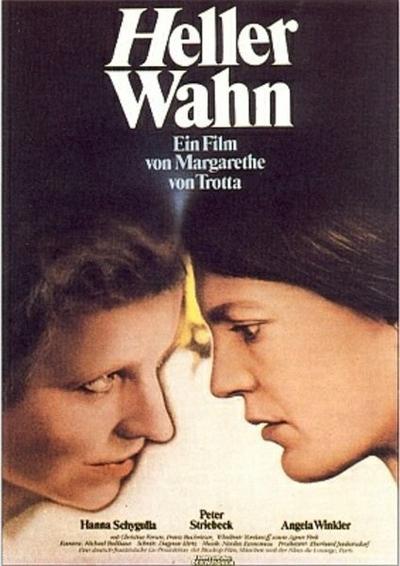
  • Margarethe von Trotta – Heller Wahn AKA Sheer Madness (1983)

    1981-1990ArthouseClassicsGermanyMargarethe von Trotta

    29f7c043f76a2bde437fd0d52a185152

    Olga and Ruth become friends. Olga is independent, separated from her husband, living with an immigrant pianist… Read More »

  • Thomas Brasch – Domino (1982)

    1981-1990ArthouseGermanyThomas Brasch

    Image Hosted by ImageShack.us

    29f7c043f76a2bde437fd0d52a185152

    “Thomas Brasch’s Domino opens with glimpses of the Kurfürstendamm shrouded in snow, scenes of Christmas bustle. Lisa, a successful actress at the Schiller Theater, drops off her daughter at the Bahnhof Zoo and faces the presentiment of holidays to be spent alone. In the week to come, her life will come unraveled, her taken-for-granted security called into question. An undercurrent of the inexplicable and the unexpected will grip the artiste and ultimately sweep her into oblivion. Domino focuses on a woman living in abeyance…. Everywhere she turns the past seems to be on her trail: she confronts visions of her deceased mother (also an actress) while thinking of her own daughter. She learns that the director Lehrter, who seeks to engage her to star in his comeback production of Goethe’s Stella, may very well be her father [and learns also] of his internment in a concentration camp. Encounters on the street irritate and befuddle her. Passersby speak of mass unemployment, worry about pending war, and wander about sobbing, disoriented and confused….Read More »

  • Yuli Raizman – Chastnaya Zhizn AKA Private Life (1982)

    1981-1990DramaUSSRYuli Raizman

    A man gets fired from his cooshie government job. He thinks its the end of the world but slowly finds things to live for. Nominated for Oscar in the foreign language movie category.Read More »

Back to top button