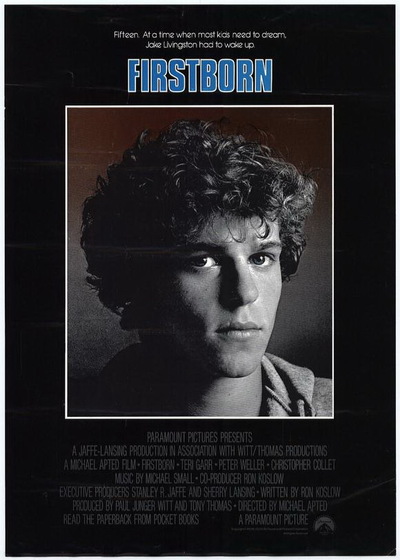

Firstborn (1984)
A teen must protect his family when his mother’s sinister new boyfriend begins exerting his authority in their home.Read More »
Firstborn (1984)
A teen must protect his family when his mother’s sinister new boyfriend begins exerting his authority in their home.Read More »

Black Venus (1983)
Spanish actor Jose Antonio Ceinos stars as a down-and-out sculptor, whose inspiration returns with the strange appearance of a beautiful, mysterious black muse.Read More »

Tasio (1984)
Wonderful, simple story of a young lad growing up in his rural surroundings, more or less in the line of `El Sur’, Erice’s little masterpiece produced just two years earlier. Armendáriz achieves an intense and intimate portrait of Tasio and the people around him without any over-dramatization, using simple but effective dialogue, careful characterization, and of course the brilliant photography. Tasio learns to eke out a living making coal, really charcoal-making for domestic use. Wood is piled up into a great heap, maybe three or four metres high and up to eight metres diameter, and set alight in the inside so that it burns very slowly. The `carbonero’ – Tasio – must attend this smouldering heap by climbing up on it and poking and prodding holes deep into it so that there is a minimum of ventilation. You can still find some examples of this old craft in rural parts of Spain even today.Read More »

Castaway (1986)
A sexy, stimulating, often brilliant film, with wild edges and dangerous poetry… LA TimesRead More »

Violin Fase (1986)
Quote:
In Violin Fase, Eric Pauwels twirls the camera around the body of dancer and choreographer Anne Teresa de Keersmaeker. Through this process, Pauwels creates a new relationship between camera and dancer, but also between body and dance, dance and cinema. Consisting of a geometrical and minimalist choreographic structure filmed in four uninterrupted takes, the artist’s camera captures a woman dedicated to exploring the boundaries of physical exhaustion.Read More »

Bruxelles-transit (1982)
Fictional re-enactments about the early years in Belgium of the director’s parents, Jewish immigrants from Poland, and scenes taken in modern Brussels in this elliptical experimental feature.
Quote:
“This is the threnody of rootlessness and marginality, set in the neighbourhood of the Brussels Midi Station. ‘their area, their burrow, their kingdom – today I still have the impression that they are camping there’ (S. Szlingerbaum). The 80 minutes of the film avidly probe this past of his mother’s memories via the voice-over, songs, whispered confidences and a handful of fictional scenes also in Yiddish, ‘a language which is dying out as its last speakers are lost in the city,’ in the words of the director.” – René Michelems.Read More »

Synopsis Tian xia di yi (1983):
It’s the 10th century BC, the emperor is not well, and the medicines he is receiving from con artist “Immortal Li” are in reality only making him worse.Read More »

SYNOPSIS:
A film about news, life, love and death. Four days in Vienna, four days in world news.
At home children are born, the dead are washed, or people simply wait for the bus. At the same time television broadcasts very different images. A ferry sinks off the Philippines, Sadam Hussein decorates his soldiers with medals, and in Vienna a war breaks out that in reality never took place. With news reports from: Argentina, Austria, China, Cuba, Finland, France, Great Britain, Greece, Hong Kong, Indonesia, Irak, Italy, Japan, Libya, Luxemburg, Monaco, Poland, Senegal, South Africa, South Korea, Spain, Switzerland, Syria, West Germany, USA, Yugoslavia, Zaire, Zambia.Read More »

Kamata kôshinkyoku (1982)
Quote:
The English title Fall Guy is fitting – this is a film about a stuntman who takes several plunges for his movie star friend – but there’s a clever touch of subversion in the less obvious Japanese title. Kamata Koshin-Kyoku refers to Shochiku studio’s theme song. But this film about the production of a samurai epic on the Toei studio lot in Kyoto is hardly a fawning tribute to the world of cinema. It’s a film by Kinji Fukasaku. Like the director’s masterpiece, Battles Without Honor and Humanity, Fall Guy exposes the injustices visited on honest, hard-working men serving corrupt and undeserving bosses; all he has done is change the setting. In the place of low-ranking yakuza are stuntmen, the foot soldiers of the entertainment industry. In the place of Japan’s criminal underground is a movie set.Read More »