Although allusions to François Truffaut’s Jules and Jim and Jean-Luc Godard’s Breathless suggest José María Nunes’s affection for French New Wave, Sexperiencias finds greater kinship with Nagisa Oshima’s fractured, interconnected themes of sexual and social revolution. In a way, young hitchhiker, María (María Quadreny) is also a stand-in for accidental revolutionary, Motoki in The Man Who Left His Will on Film, a cipher who, in trying to capture the rhythms of everyday life (albeit through photography rather than filmmaking), is politicized by an atmosphere of unrest. Finding momentary connection with an outspoken activist, Antonio (Antonio Betancourt), María’s life is upended when her lover is imprisoned for dissent. Restless and adrift, she embarks on an affair with a nurturing, middle-aged engraver, Carlos (Carlos Otero), only to find her newfound life of comfort and stability at odds with the chaos of the world around her. But while Oshima’s melding of fact and fiction captures the spirit of an internal revolution, Nunes’s revolution is a distant one – a reminder of an empowered other reality that can be turned inward to incite change – galvanized by geopolitical headlines that dominated the local newspapers of 1968: Prague Spring and the Soviet invasion of Czechoslovakia, the assassinations of Martin Luther King Jr. and Robert Kennedy, May 68 protest, the coup in Panama, the turning of the tide in the Vietnam War with Lyndon Johnson’s decision not to seek re-election. Incorporating an incongruous soundtrack of nature sounds, assorted music, and ambient noise, Nunes creates a disorienting environment that is literally out of sync – the separation between image and sound implicitly reflecting the disconnection between the reality of Franco-era Spain and its projected image. Framed against the bookending reference to the U.N.’s adoption of the nonbinding Universal Declaration of Human Rights in 1968, the question of enforcement becomes an ironic coda to the problem of inaction, where the struggle is not in the ability to speak, but in an unwillingness to listen.Read More »
1960s
-
José María Nunes – Sexperiencias (1968)
1961-1970ArthouseExperimentalJosé María NunesSpainSpanish cinema under Franco -
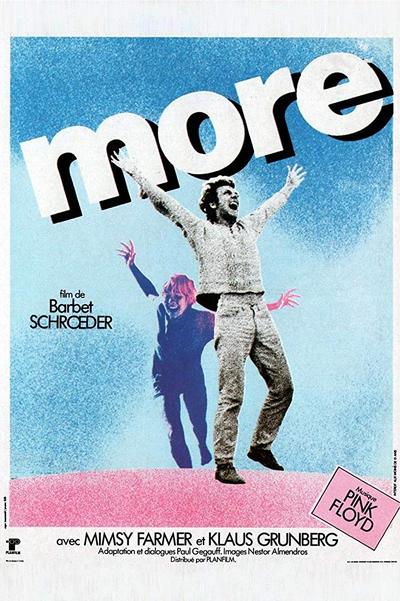
Barbet Schroeder – More (1969) (HD)
1961-1970Barbet SchroederCultGermanyStefan (Klaus Grünberg) hitchhikes to Paris and there at a party meets Estelle (Mimsy Farmer), a beautiful but elusive American. Soon afterwards, she leaves for Ibiza and an already smitten Stefan vows to follow her, but he has to help out in a robbery to raise the cash to do so. Finally, he meets up again with Estelle and the two become lovers. In an atmosphere of easy sex, nude sunbathing and lots of drugs, Stefan\’s hold on his life begins to crumble.
More was Barbet Schroeder\’s directorial debut and it set the Iranian-born, French-national writer, director, producer and occasional actor on a fascinatingly wayward career. He has made films all over the world, often tackling \’difficult\’ subject matter (drugs here, sadomasochism in Maitresse, also available as a DVD from the BFI). Unfortunately the last decade or so has been spent making increasingly routine material in Hollywood.Read More » -
Costa-Gavras – Z [+Extras] (1969)
1961-1970AlgeriaCosta-GavrasPoliticsThrillerQuote:
A pulse-pounding political thriller, Greek expatriate director Costa-Gavras’s Z was one of the cinematic sensations of the late sixties, and remains among the most vital dispatches from that hallowed era of filmmaking. This Academy Award winner—loosely based on the 1963 assassination of Greek left-wing activist Gregoris Lambrakis—stars Yves Montand as a prominent politician and doctor whose public murder amid a violent demonstration is covered up by military and government officials; Jean-Louis Trintignant is the tenacious magistrate who’s determined not to let them get away with it. Featuring kinetic, rhythmic editing, Raoul Coutard’s expressive vérité photography, and Mikis Theodorakis’s unforgettable, propulsive score, Z is a technically audacious and emotionally gripping masterpiece.Read More » -
Franco Giraldi – La bambolona aka Baby Doll (1968)
1961-1970ComedyEroticaFranco GiraldiItalySynopsis:
A bachelor attorney with a roving eye for beautiful women stets his sights on a 17-year-old student for his next amorous conquest. He meets with her parents, an economically troubled couple who soon give their consent for the couple to date. Using an engagement ring as an enticing lure to initiate sex, the lawyer gets more than he bargained for with the wily female who is wise far beyond her years. The tables are turned on the lawyer as she withholds her affections, feigns a pregnancy and ends up holding all the cards in the relationship with the older, “more experienced” attorney.Read More » -
Jean-Gabriel Albicocco – Le rat d’Amérique (1963)
1961-1970DramaFranceJean-Gabriel AlbicoccoThis South American adventure drama finds Charles (Charles Aznavour), a youthful
Frenchman traveling to Paraguay to start a new life. Seeking out a rich uncle, the
idealistic nephew is rejected by his miserly relation, and he goes on to get involved with
a shady woman and a band of gun runners who supply arms for the revolution of the
week. Charles and his new girlfriend head for the border after a shootout with federal
troops, and a kindly railroad worker hides the couple in an abandoned copper mine.
Charles is later thrown in prison while the girl becomes a concubine, but her violator is
killed when Charles escapes to rescue her and exact revenge. A pretty harrowing
composition could be written by the young couple on “How I Spent My Summer
Vacation.” ~ Dan Pavlides, RoviRead More » -
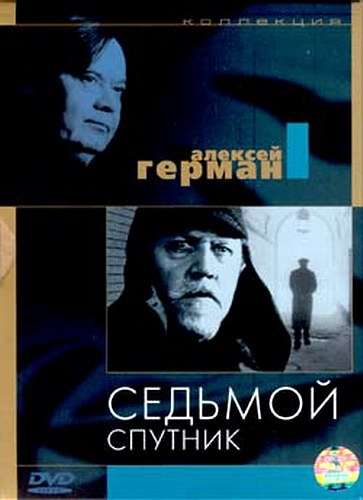
Grigori Aronov & Aleksey German – Sedmoy sputnik aka The Seventh Companion (1968)
1961-1970Aleksey GermanDramaGrigori Aronov and Aleksei GermanUSSR
From imdb:
The film is set in St. Petersburg, Russia after the Russian revolution of 1917. Based on the eponymous book by Boris Lavrenev. Maj. General Yevgeni Pavlovich Adamov (Popov) was a lawyer in the Tzar\’s Army and a professor of law at the Military Academy before the Russian Revolution. In the fall of 1918 he was arrested on false accusations and suffered the loss of all his property and honors. During the turbulent times of Revolution he managed to use all his experience and professionalism to prove his innocence. He was released from prison and all charges against him were dropped. He became a free man, but the reality is changed, and his adaptation to the post-revolutionary life was not easy. Written by Steve Shelokhonov
The film is based on a novel by Boris Lavrenev.Read More »
-
John Llewellyn Moxey – Foxhole in Cairo (1960)
1951-1960DramaJohn Llewellyn MoxeyUSAWarIn 1942, Rommel halts his victorious Afrika Korps and sends German agent John Eppler
and radio operator Sandy to Cairo. Their mission is to learn where the British plan to
launch their counteroffensive. Eppler immediately communicates with Amina, an Egyptian
cabaret dancer and his former mistress, who agrees to help him. Unknown to them,
British counterespionage chief Captain Robertson has learned of Eppler’s presence in
Cairo and is working with the leader of Cairo’s Jewish underground, Radek. Amina lures
an ineffectual British officer, Major Wilson, to her houseboat and has him drugged and
robbed of his briefcase containing British counteroffensive details. While Eppler and
Sandy relay the information to Rommel that the battle will take place at Alam Halfa,
Yvette, a member of the Jewish underground, sneaks aboard the boat and revives the
unconscious Wilson. They are interrupted by Amina, who shoots Wilson but is herself
stabbed to death by Yvette. Eppler arrives and is about to kill Yvette when Robertson
and Radek appear and arrest Eppler. Eppler’s satisfaction at having already informed
Rommel that the counteroffensive will take place at Alam Halfa is short-lived. Robertson
had seen to it that the plans in Wilson’s briefcase were false–the real battle will take
place at El Alamein.Read More » -
Bernardo Bertolucci – Prima della rivoluzione AKA Before the Revolution (1964)
Drama1961-1970ArthouseBernardo BertolucciItalyQuote:
The study of a youth on the edge of adulthood and his aunt, ten years older. Fabrizio is passionate, idealistic, influenced by Cesare, a teacher and Marxist, engaged to the lovely but bourgeois Clelia, and stung by the drowning of his mercurial friend Agostino, a possible suicide. Gina is herself a bundle of nervous energy, alternately sweet, seductive, poetic, distracted, and unhinged. They begin a love affair after Agostino’s funeral, then Gina confuses Fabrizio by sleeping with a stranger. Their visits to Cesare and then to Puck, one of Gina’s older friends, a landowner losing his land, dramatize contrasting images of Italy’s future. Their own futures are bleak.Read More » -
Bruce Baillie – Castro Street / Mr. Hayashi / All My Life (1961 – 1966)
1961-1970ArthouseBruce BaillieExperimentalShort FilmUSA
Three short movies by Bruce Baillie.
1. Castro Street (1966)
Quote:
Inspired by a lesson from Erik Satie; a film in the form of a street – Castro Street running by the Standard Oil Refinery in Richmond, California … switch engines on one side and refinery tanks, stacks and buildings on the other – the street and film, ending at a red lumber company. All visual and sound elements from the street, progressing from the beginning to the end of the street, one side is black-and-white (secondary), and one side is colour – like male and female elements. The emergence of a long switch-engine shot (black-and-white solo) is to the filmmaker the essential of consciousness.Read More »