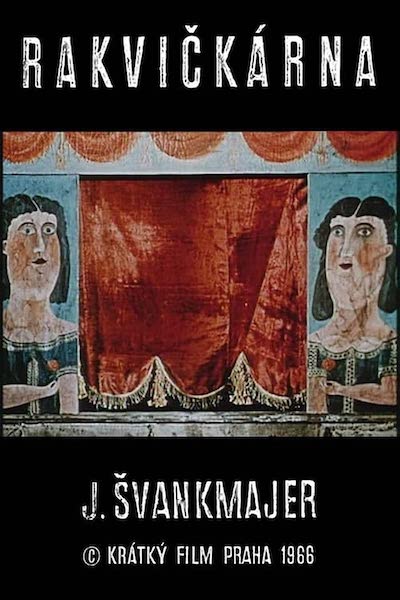

Two puppets, Punch and Joey, do battle to the death over the custody of a live guinea pig.Read More »
Two puppets, Punch and Joey, do battle to the death over the custody of a live guinea pig.Read More »

A man plays the Bach piece of the title on the organ, accompanied by images of stone walls with cracks and holes that grow and shrink, intercut with images of doors and wire-meshed windows.Read More »

Two magicians, Mr.Schwarzwald and Mr.Edgar, try to outdo each other in performing elaborate magic tricks, leading to a violent ending.Read More »

A photographer tired of the jaded milieu of an early advertising age under socialism romances a young ballerina. The Triple Bridge, fountains and rooftops of the Slovenian capital, Ljubljana, and the ski resorts of the Slovenian Alps are the dreamy 1960s backdrops for this great love story. Disarmingly believable as the inexperienced naif, Snežana Nikšić, as the ballerina, steals the show.
Quote:
Jean-Marie Straub: But all the same there is something very different. For example, there’s a Yugoslav filmmaker I like very much, whose called Matjaž Klopčič. He makes films which are … I don’t know, somewhere between Cocteau and Mallarme. Well, he did one, at first, which was called A Story that Doesn’t Exist, and then a second, called On Paper Wings (1967). The first was a total failure, but all the same he was able to do the second straight away, and I think he’s just finished shooting a third. You can’t say his films are suitable for a mass audience – you can’t say they’d be successful. Although the first film was unsuccessful he was able to do his second without making any concessions to the myth of the mass public which doesn’t exist. This sort of thing can’t happen in Western Europe.
Source: There’s Nothing More International Than a Pack of Pimps – A Conversation between Pierre Clémenti, Miklos Janscó, Glauber Rocha and Jean-Marie Straub convened by Simon Hartog in Rome, February 1970.Read More »
Plot :
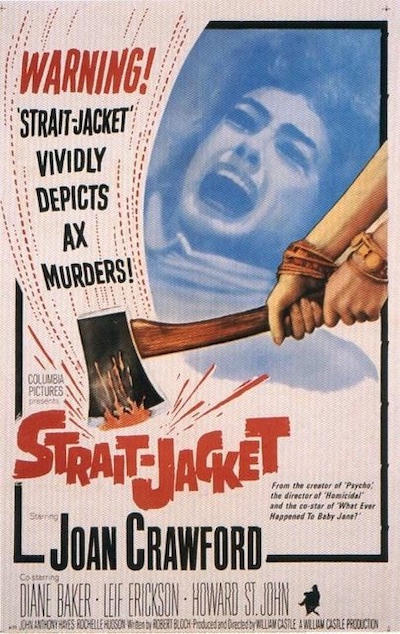
Lucy Harbin has spent 20-years in a psychiatric hospital for the decapitation axe-murder of her husband (Lee Majors) and his mistress, after catching him cheating on her. After she is released, she takes up residence at the farm of her brother Bill Cutler and sister-in-law Emily.Read More »

There are two versions of this film: the Italian theater version, and the extended version presented at Cannes 1960, both in Italian. This is the latter.
PLOT SYNOPSIS:
In keeping with his previous film Generale Della Rovere, filmmaker Robert Rossellini pursues a wartime theme in his “personal epic” Era Notte a Roma.
The story concerns three Allied POWS, who escape from their camp and hide out in Rome. The trio is given shelter by a beautiful young woman. With something tangible to fight over, the three prisoners’ national chauvinism (one is Russian, one English, one American) simmers to a boil.
For reasons which remain obscure, Era Notte a Roma was never given a widespread American release.
(Wikipedia)Read More »

SYNOPSIS
The master of the French New Wave indicts consumerism and elaborates on his personal vision of Hell with this raucous, biting satire. A nasty, scheming bourgeois Parisian couple embarks on a journey through the countryside to her father’s house, where they pray for his death and a subsequent inheritance. Their trip is at first delayed, and later it is distracted by several outrageous events and characters including an apocalyptic traffic jam, a group of fictional philosophers, a couple of violent carjackers, and eventually, a gross display of cannibalism. By the time the film concludes, their seemingly simple journey has deteriorated into a freewheeling philosophical diatribe that leaves no topic unscathed. With Week End, Jean-Luc Godard reaches an impressive plateau of film originality, incorporating inter-titles, extended tracking shots, and music to add an entirely new grammar to film language. The result is a deeply challenging work that will most certainly invigorate some viewers just as much as it will as frustrate others. Standout highlights include a jarring, sexually graphic opening monologue shot with a roaming camera and blaring musical accompaniment, and the infamous traffic jam scene, where an endless parade of cars sit bumper to bumper amidst burning cars, picnics, and honking horns. The work of a true artist and pioneer, Godard’s Week End is a landmark film that hasn’t aged or lessened in impact over time.
(Taken from Rotten Tomatoes)Read More »

Quote:
The work of painter, musician, mystic and filmmaker Sergei Paradjanov (1924-1990) constantly defies categorisation. His films are notable for their lyrical inspiration and great aesthetic beauty, but riled the Soviet authorities to such an extent that Paradjanov faced constant harrassment throughout his life. Like his earlier film, Shadows of Our Forgotten Ancestors (1965), The Colour of Pomegranates was banned…
Ostensibly a biopic of rebellious 18th century Armenian poet Sayat Nova, The Colour of Pomegranates follows the poet’s path from his childhood wool-dying days to his role as a courtier and finally his life as a monk. But Armenian director Sergei Paradjanov warns us from the start that this is no ordinary biopic: “This is not a true biography,” he has his narrator state during the opening credits.Read More »
