Quote:
In 1958, Rogosin tackled the subject of Apartheid by filming the pioneering “Come Back Africa” on location in Johannesburg, unbeknownst to South African authorities who believed Rogosin was filming a benign musical travelogue. The film focuses on the tragic story of a Zulu family trying desperately to stay together and survive. Instead, they are caught up in the contradictory laws of Apartheid. Bringing together some of South Africa’s best known radical intellectuals Rogosin shot the film combining documentary footage and fiction. Come Back Africa is an indictment on the brutality which the system created. It was selected by Time Magazine as” one of the Ten Best Pictures of 1960” and launched the career of the unknown Miriam Makeba. “I’m a political filmmaker, and the effect of the film on people who see it is still strong today as when I made it” said Rogosin.Read More »
1950s
-
Lionel Rogosin – Come back, Africa [+Extras] (1959)
1951-1960DocumentaryLionel RogosinUSA -
David Miller – The Opposite Sex (1956)
USA1951-1960ComedyDavid MillerMusical

Kay Hilliard, a former nightclub singer, married ten years and mother of a young daughter, is informed that her husband Steve is having an affair with chorus girl Crystal, so she goes to Reno for a divorce. After that, Steve marries Crystal, but Crystal isn’t true. When Kay hears about this, she starts fighting to win her ex-husband back.Read More »
-
Edward L. Cahn – Hong Kong Confidential (1958)
1951-1960DramaEdward L. CahnThrillerUSASecret agent Casey Reed (Gene Barry) goes undercover as a smarmy lounge singer (replete with cheezy white jacket!) in Hong Kong to find a missing arab prince.
Quote:
Director Edward L. Cahn always knew how to make lemonade from a lemon; his B pictures of the late 1950s displayed a raw energy that many of his higher-budgeted films of the 1930s lacked. Hong Kong Confidential is a backlot cheapie starring Gene Barry and second-feature stalwarts Beverly Tyler and Allison Hayes. Barry plays a secret agent, in Hong Kong to rescue an Arabian prince from his kidnappers. The villains, of course, are Soviet spies, easily recognizable by their baggy suits and flabby accents. Also in the cast of Hong Kong Confidential is Ed Kemmer, who’d once starred in that baby-boomer favorite Space Patrol.Read More » -
René Clément – Monsieur Ripois aka Knave of hearts (1954)
1951-1960ComedyDramaFranceRené Clément

The Italian neo-realist influence that is so evident in René Clément’s Oscar-winning 1949 film Au-delà des grilles is also felt in this quirky romantic comedy, through its use of real locations (mostly in the bustling centre of London) and fluid, documentary-style photography. Along with some of his contemporaries (notably Georges Franju and Jean-Pierre Melville) René Clément had started to trail-blaze a new kind of cinema, departing from the conventions of the quality tradition that had grown stale and predictable by the early 1950s, and laying the groundwork for the French New Wave. If you did not know that Clément had directed Monsieur Ripois, you might easily mistake it for an early offering from one of the Nouvelle Vague filmmakers – Jean-Luc Godard, Eric Rohmer, Jacques Rivette, Louis Malle or François Truffaut.Read More »
-
Roberto Rossellini – India: Matri Bhumi [French version] (1959)
1951-1960ClassicsDocumentaryFranceRoberto RosselliniQuote:
India runs counter to all usual cinema: here the image is only the complement of the idea that provokes it. India is a film of absolute logic, more Socratic than Socrates. Each image is beautiful not because it is beautiful in itself, like a shot in [Eisenstein’s] Que viva Mexico!, but because it is the splendor of the true and because Rossellini starts with the truth. There where the others won’t arrive except in twenty years perhaps, he has already gone on from.India embraces world cinema, as the theories of Riemann and Planck embrace geometry and classical physics. In a coming issue [of Cahiers du Cinéma], I shall prove why India is the creation of the world.
Jean-Luc GodardRead More » -
Alfred Hitchcock – I Confess (1953)
USA1951-1960Alfred HitchcockClassicsThriller

Synopsis: Based on the turn-of-the-century play Our Two Consciences by Paul Anthelme, Hitchcock’s I Confess is set in Quebec. Montgomery Clift plays a priest who hears the confession of church sexton O.E. Hasse. “I…killed…a man” whispers Hasse in tight closeup–and, bound by the laws of the Confessional, Clift is unable to turn Hasse over to the police. But police-inspector Karl Malden has a pretty good idea who the guilty party is: all evidence points to Clift. It seems that the dead man had been blackmailing Anne Baxter, who was once in a factually innocent, but seemingly exploitable compromising position with Clift. Tried for murder, Clift is released due to lack of evidence, but he is ruined in the eyes of the community. Then it is Hasse’s turn to make that One Fatal Error. I Confess is frequently dismissed as a lesser Hitchcock, due mainly to the quirky performance of Montgomery Clift (who, it is said, steadfastly refused to take direction). Today, four decades removed from its on-set intrigues, the film has taken its place as one of the best of Hitchcock’s “between the classics” efforts. — Hal EricksonRead More »
-
Vittorio Cottafavi – Una donna ha ucciso (1952)
Drama1951-1960ItalyVittorio CottafaviIn 1951, two years after the “scandal” of the Fiamma che non si spegne, Cottafavi got the opportunity to work on a film with a small production company, Novissima Film. With little means, a number of technical and financial problems and working Sundays with the pieces of film given to him bit by bit, Cottafavi shot Una donna ha ucciso, a minor film that marked his comeback to directing. Followed by Traviata ’53 (1953), In amore si pecca in due (1953), Nel gorgo del peccato (1954) and Una donna libera (1954), Una donna ha ucciso was also the first of a pentalogy of melodramatic movies about the condition of women in contemporary society and the moral and social problems related to it. The film is based on a real crime story that took place immediately after the war. An Italian woman killed her English wartime lover for the sake of love. The story was reformulated by Cottafavi with the help of Siro Angeli and Giorgio Capitani. It was the producer who had the idea to make it a film; in fact, he had just gotten the rights to the autobiography of this woman who had been recently pardoned and released from jail. They planned to exploit the melodramatic and passionate elements of the story at a time when, for example, Raffaello Matarazzo’s films were enjoying enormous success. Gianni RondolinoRead More »
-
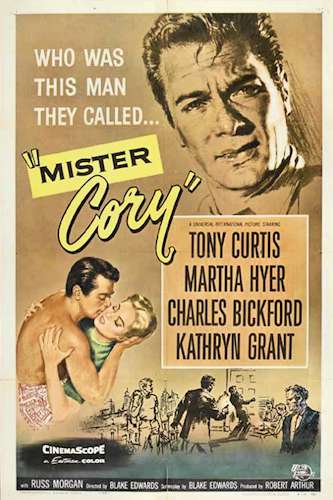
Blake Edwards – Mister Cory (1957)
1951-1960Blake EdwardsComedyRomanceUSA
Quote:
Cory, an ambitious Chicago slum kid with a knack for gambling, gets a busboy job at a posh Wisconsin resort…where his real purpose is to gamble with the staff and guests and romance rich young ladies. Setbacks follow, but Cory eventually rises to a high position in the world of professional gambling. But he just can’t forget the glamorous Vollard sisters. And now he has even farther to fall…Read More » -
Ishirô Honda – Chikyu Boeigun AKA The Mysterians (1957)
Japan1951-1960AsianIshirô HondaKaiju-eigaSci-Fi
Chikyû Bôeigun (1957) 
Aliens arrive on Earth and ask permission to be given a certain tract of land for their people to live on. But when they are discovered to be invaders, responsible for the giant robot that is destroying cities, the armed forces attempt to stop them with every weapon available. -imdbRead More »