

A local couple stroll past Pheasant Island. They see two people swimming across the river to try to reach the other side. Days later, a dead body appears during the exchange of sovereignty of the island. Who is responsible?Read More »
A local couple stroll past Pheasant Island. They see two people swimming across the river to try to reach the other side. Days later, a dead body appears during the exchange of sovereignty of the island. Who is responsible?Read More »

During the 2020 lockdown, Lucrecia Martel returns to her home in Salta, Argentina’s most conservative region. Here she follows Julieta Laso who, like a muse, introduces her to a group of female artists and defiant people who exchange glances and opinions around a fire. Perfectly attuned to a body of work that constructs stories from an amalgam of people and places and, four years after the beautiful Zama, Terminal norte marks the return to the screen of Argentina’s greatest filmmaker. Once again, there is a sense of being on the periphery of the world in a way that is simultaneously real, symbolic and political. Now working in a documentary format, Martel immerses herself and gets lost in Julieta Laso’s hoarse, seductive voice. And then, in a progression that has now become familiar to us, the “I” of the protagonist opens up to encounter a plethora of voices and bodies which the camera never tires of following. The result is a gripping tribute to a community that, temporary though it may be, serves as a magnificent antidote to the pandemic.Read More »

Two couples are on a boating trip when they come across an uncharted island. The four investigate and find themselves in the clutches of Dr. Albert Balleau, whose hobby is hunting both animals and humans… The group tries to escape only to be thwarted by Dr. Balleau and his henchmen.Read More »

In the summer of 1977, a political prisoner, living in exile, recounts the circumstances of his escape to a journalist: in April 76, a group of ETA members planned to escape from prison, but the project fails when, due to a tip-off, the guards discover the tunnel they are digging. The inmates, far from being discouraged, start a second tunnel.Read More »

An innocent crush propels fourteen year old Lalo’s descent into the criminal underworld of illegal gasoline extraction. What begins as a fast track for the latest smartphone quickly veers into a deadly fight for his life.Read More »

A pair of young siblings live in an imaginary world of their creation, hidden from the eyes of their mother. When she finally catches a glimpse of their universe, it faces the threat of collapsing. The two of them must decide to either surrender or resist.Read More »

Quote:
Yuri Illyenko, the master Ukrainian cinematographer who shot Sergei Paradjanov’s Shadows of Our Forgotten Ancestors (1965) and directed the long-banned A Spring for the Thirsty (1965) and The Eve of Ivan Kupalo (1968), based this striking 1990 allegorical film on stories by Paradjanov that were inspired by his long sojourns in prison. The film was shot at the prison where Paradjanov was confined, using contemporary prisoners as extras, and it might be said that the documentary and poetic-symbolic aspects of this movie are equally germane to its overall impact. Three days before his sentence is to end, a prisoner (Victor Solovyov) escapes and hides out inside a giant hammer and sickle that borders the prison grounds, where he is discovered and nursed back to health by a beautiful woman (Liudmyla Yefymenko, Illyenko’s wife) who becomes his lover. One of the first independent Soviet productions, partially financed in Sweden and Canada, the film tells its story with a minimum of dialogue and very striking imagery. – Jonathan Rosenbaum, Chicago ReaderRead More »
Quote:
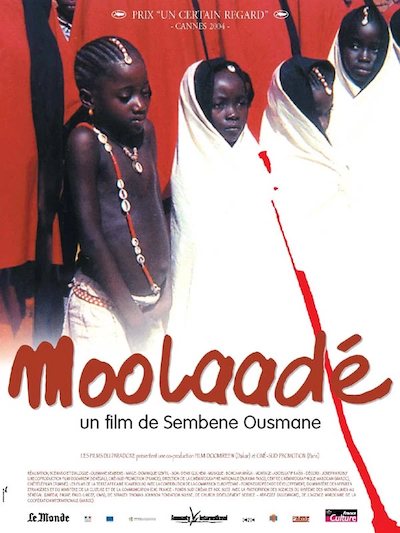
Set in a small African village, four young girls face a ritual “purification” flee to the household of Colle’ Ardo Gallo Sy, a strong-willed woman who has managed to shield her own teenage daughter from mutilation.
Colle’ invokes the time-honored custom of moolaade (sanctuary) to protect the fugitives, and tension mounts as the ensuing stand-off pits Colle’ against a village traditionalists (both male and female) and endangers the prospective marriage of her daughter to the heir-apparent to the tribal throne.Read More »

Synopsis wrote:
Like a fairy tale, King Henry and King Good-thought decided long ago that their only children should marry and so prevent war arising between their kingdoms ever again. But the young prince is wary of marrying anyone he doesn’t know.Read More »