

Jonathan Harker is a successful real estate agent now living with Mina Murray in Budapest…Read More »
Jonathan Harker is a successful real estate agent now living with Mina Murray in Budapest…Read More »

Quote:
A&B IN ONTARIO was completed eighteen years after the original material was shot. After Frampton’s death, the film was assembled by Wieland into a cinematic dialogue in which the collaborators (in the spirit of the sixties) shoot each other with cameras.Read More »

A companion piece to the earlier Stone Wedding. Using the same structure of two loosely interlinked stories, the film is a darkly humorous study of greed in a small prospecting town where everyone is obsessed with, and motivated by, gold. Exceptionally beautiful, the film is full of extraordinary set design and photography, making inventive use of focus and composition (with characters frequently framed within frames).Read More »

“What interests me is the hypnotic trance into which a viewer can be plunged. When you make a film and it works, you’re like a shaman, a hypnotist.” – Gaspar NoéRead More »

Producer Joe Pasternak was making “Deanna Durbin pictures” long before he’d discovered Durbin – and indeed, long before he’d left Hungary. Pasternak’s 1935 musical “Peter” stars Franciska Gaal as Eva, a 17-year-old gamine who ekes out a living as a street singer. While wandering past an open courtyard, Eva confronts a young burglar, who orders her to change clothes with him so he can make a quick getaway. With nothing but her newfound male garb to her name, our heroine poses as a boy named Peter so that she can obtain a job selling newspapers. In this guise, she experiences all manner of hilarious misadventures, and even finds true love in the form of a handsome doctor (Hans Jaray). Peter was directed by Herman Kosterlitz, who as Henry Koster would later helm several of Joe Pasternak’s Hollywood musicals. (Hal Erickson, Rovi)Read More »
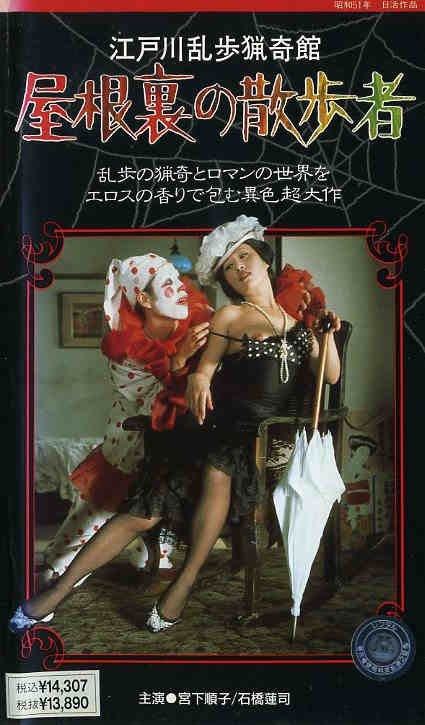
A perverted loner roams the rafters of a boarding house in 1920s Tokyo in Watcher in the Attic, directed by one of the Nikkatsu‘s top Roman Porno filmmaking talents, Noboru Tanaka, peeping on the unusual sexual antics of its residents in this dreamlike tale of voyeurism, obsession and murder drawn from the “erotic grotesque” literature of Japan’s foremost master of mystery and the macabre, Edogawa Rampo.Read More »

A documentary about Wenceslau de Morais, in Japan. A Portuguese writer from the beginning of the 20th century.Read More »

The May 1961 premiere of The Song of the Gray Dove (Piesen o sivom holubovi, 1960) directed by Stanislav Barabas (1924-1994) marked the start of filmmakers’ use of ideologically unassailable themes (in this case, the Slovak National Uprising) to tell stories that were true-to-life and yet were filmed creatively. The Song of the Gray Dove rejected the narrative topics loved by Palo Bielik, who was the most creative member of the founding generation of filmmakers. By using boys as his heroes, Barabas was able to concentrate more on children’s fears, games, and happiness, which had not vanished even during the war years, rather than on reeducating viewers. Critics took notice of the film (it won the 1961 Czechoslovak Film Critics’ Award together with the Czech film People Live Here Too [Vsude zijí lidé; dir. Jirí Hanibal and Stepán Skalsky, 1960) because of its intimate storytelling—six stories loosely connected by child-heroes—and its premise that children’s distorted reality can be more truthful than a so-called objective reconstruction of history.Read More »

Vanitas is the new feature film by veteran Portuguese director Paulo Rocha. With a script by Regina Guimarães, the film brings together actresses Isabel Ruth and Joana Bárcia – no strangers to this director’s world – in a story about a depressed fashion designer who falls in love with the daughter of one her tailors.Read More »