• Harutyun Khachatryan – Sahman AKA The Border (2009)

    2001-2010ArmeniaArthouseDocumentaryHarutyun Khachatryan

    29f7c043f76a2bde437fd0d52a185152

    A poetic docu-drama based on real events witnessed by Armenian master Khachatryan. He reflects on the tragedy that befell his people during the conflict between Armenia and Azerbaijan in the 1990s, after the Soviet Union fell apart. He does so without words or indeed human protagonists, through the story of a buffalo who is found stuck in a ditch in the countryside. He is brought to a nearby farm where animals, farmers and refugees are gathered to hide and recover from the conflict. All regard him with great suspicion. We follow life on the farm and in the surrounding villages through the eyes of the buffalo over the course of a year, with the changing of the seasons and the slow rhythm of the place. (WARSAW FILM FESTIVAL)Read More »

  • Vladimir Motyl – Zvezda plenitelnogo schastya aka The Captivating star of happiness (1975)

    1971-1980DramaRomanceUSSRVladimir Motyl

    Description: On December 14, 1825 the military units of the Russian army were supposed to swear their allegiance to the new czar, Nicholas I. But the young officers, the most liberal-minded people of their time, who abhorred the terrors of serfdom, decided to raise their regiments against the autocracy and bring democracy to the country. That was a great heroic feat of the best sons of Russia. However, the revolt had been brutally crushed. Some of its inspirators were executed, many sent to hard labor in Siberia. Following the convicted officers to Siberia were their wives who had left their aristocratic families and comfortable lifestyles. The film is dedicated to those remarkable Russian women.Read More »

  • Raoul Ruiz – Poetics of Cinema 1 (1996)

    1991-2000BooksRaoul Ruiz

    From the article linked to above:

    Quote:
    Ruiz’s Poetics of Cinema must be one of the strangest and most interesting works on the cinema ever to be written. While addressing many contemporary issues around the politics of the entertainment industry, globalisation and the powers of audiovisual images, this work also draws on discourses as untimely as ancient treatises on Chinese painting and the 16th century occult theories of Ramon Lull. But perhaps what is most striking about Poetics of Cinema is its composition in which not only diverse theories and reflections are combined but that they are done so frequently in the form of theoretical fictions as delirious as Ruiz’s cinema itself, that completely blur the boundaries between the real and the imaginary, the true and the false. This has led several critics, notably, Christine Buci-Glucksman to make direct links between Ruiz’s aesthetics and the Baroque, rather than more contemporary aesthetic movements such as Surrealism (Buci-Glucksmann, 9-41). As Laleen Jayamanne has pointed out, Ruiz may use the “decorative and stereotypical aspects of Surrealism” but he rejects its underlying metaphysics in favour of a Baroque “allegorical system” (224). The crucial difference between the Baroque, as Ruiz understands and employs it and the ethos of cinematic Surrealism, is the replacement of the motto “everything is fundamentally simple” with its opposite “everything is fundamentally complex”. Jayamanne emphasises that cinema, for Ruiz, is an allegorical system inhabited by ghosts, zombies and the dead, which operates by a “perverse logic” (224) or a “baroque […] multiplication of points of view, of an object, of a space, [of] a body” (225). Already this affinity between the complexity of the Baroque and perversion is apparent: for Ruiz, Surrealism is inferior to the Baroque because it remains too French, or in other words, fails to be complex or perverse enough.Read More »

  • Sohrab Shahid Saless – Der Weidenbaum AKA The Willow Tree (1984)

    1981-1990DramaGermanySohrab Shahid Saless

    http://img7.imageshack.us/img7/16/19840000derweidenbaumth.jpg

    29f7c043f76a2bde437fd0d52a185152

    Synopsis

    One of Sohrab Shahid Saless final TV-productions made in Germany/Czechoslovakia and based on various short stories by the Russian writer Anton Chekhov.Read More »

  • Damiano Damiani – L’inchiesta (1986)

    1981-1990Damiano DamianiDramaItaly

    29f7c043f76a2bde437fd0d52a185152

    Tito Valerio Tauro is sent by the emperor Tiberius in Galilee to investigate the disappearance of the body of Jesus. Tito thinks quickly attend to his duties and return to Rome, but meets Claudia Procula, Pilate’s wife, fascinated by the personality of Jesus, who reveals that Mary Magdalene was a witness to the resurrection of Jesus. Tito became convinced that Jesus is still alive and that is in place and a conspiracy to hide it, pretending to be Christian, begins to search for Mary Magdalene.Read More »

  • Kei Kumai – Umi to dokuyaku aka The Sea and Poison (1986)

    Arthouse1981-1990AsianJapanKei Kumai

    29f7c043f76a2bde437fd0d52a185152

    Uni to Dokuyaku (1987)
    July 22, 1987
    FILM: ‘SEA AND POISON,’ FROM JAPAN
    By Walter Goodman
    Published: July 22, 1987

    LEAD: EARLY in ”The Sea and Poison,” the harrowing Japanese movie now at Film Forum 1, a surgical team performs a lung operation on a young woman. It is probably the most graphic view that most of its audience will ever have had of the scalpel and forceps doing their work, and you may find yourself joining the young intern Suguro, who confesses, ”Today in the operating room, I had to close my eyes.

    EARLY in ”The Sea and Poison,” the harrowing Japanese movie now at Film Forum 1, a surgical team performs a lung operation on a young woman. It is probably the most graphic view that most of its audience will ever have had of the scalpel and forceps doing their work, and you may find yourself joining the young intern Suguro, who confesses, ”Today in the operating room, I had to close my eyes.”Read More »

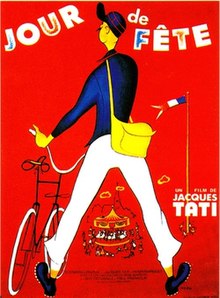
  • Jacques Tati – Jour de fête [Full Colour] (1949)

    1941-1950ComedyFranceJacques Tati

    http://upload.wikimedia.org/wikipedia/en/thumb/9/96/Jour_de_fete-poster.jpg/220px-Jour_de_fete-poster.jpg

    29f7c043f76a2bde437fd0d52a185152

    In Jacques Tati’s charming – and essentially plotless – pre-Hulot first feature, Tati is Francois, a contented and happy postman in a small, unhurried French village. Francois is at ease with his job and leisurely performs his duties, peddling away on his rounds upon his beloved bicycle. Things perk up when a traveling carnival arrives in town. One of the attractions at the carnival is a film depicting the United States Postal Service’s fast and efficient postal delivery system. The narrator in the film exhorts, “Rapidite, rapidite.” Francois takes up the call, and attempts to Americanize his work style.Read More »

  • Francis Veber – Les fugitifs AKA The Fugitives (1986)

    1981-1990ComedyCrimeFranceFrancis Veber

    29f7c043f76a2bde437fd0d52a185152

    Francis Veber directs this hilarious comedy about François (Pierre Richard), a desperate, novice, bumbling bank robber who takes an ex-con hostage during his attempted hold-up. They are both chased by the police. Jean (Gérard Depardieu) plays the convicted bank robber just released from jail and forced to escape with François. Anaïs Bret portrays François’ 6-year-old autistic daughter, and is the reason why he needed money so badly that he would steal for it. An inventive series of farcical situations and witty dialogue keeps the two men moving one step and several missteps ahead of the police. This comedy was so successful that Veber repeated it in 1989 for English-speaking audiences as Three Fugitives, starring Nick Nolte and Martin Short.

    — Eleanor Mannikka, All Movie GuideRead More »

  • Petr Václav – Marian (1996)

    1991-2000ArthouseCzech RepublicDramaPetr Václav

    29f7c043f76a2bde437fd0d52a185152

    Václav started his career as a director of film documentaries, first attracted critical attention with his graduation film, Paní Le Murie (Madame Le Murie, 1993) and consolidated his reputation with his first feature Marián (1996), which testified to the problems of social and racial determination and more generally also the theme of human freedom and humiliation.Read More »

Back to top button