• Kenji Mizoguchi – Sanshô dayû AKA Sansho the Bailiff (1954) (HD)

    1951-1960ClassicsDramaJapanKenji Mizoguchi

    29f7c043f76a2bde437fd0d52a185152

    Sansho Dayu… is the triumphant summation of Mizoguchi’s style and themes, as well as the most compassionate response imaginable to those atrocities which had been committed in then very recent years, in Japan and all over the world. It is the most humanist of films, but it asserts that humanism is powerless without politics, just as politics is purposeless without humanism. The last sequence is the most perfect ending in cinema, so broad in implication, so exquisite in form. The reunion of mother and son – the revelation of human love – is at once the most important thing in the world, and an event insignificant against the panorama of human suffering. The double perspective – never to see things in isolation, always in context – is assured by Mizoguchi’s style, and defines his art. Sansho Dayu is, in Gilbert Adair’s words, “one of those films for whose sake the cinema exists”.
    Alexander Jacoby, Senses Of Cinema.comRead More »

  • Wim Wenders – Bis ans Ende der Welt AKA Until the End of the World (1991)

    1991-2000DramaGermanySci-FiWim Wenders

    Quote:
    Conceived as the ultimate road movie, this decades-in-the-making science-fiction epic from Wim Wenders follows the restless Claire Tourneur (Solveig Dommartin) across continents as she pursues a mysterious stranger (William Hurt) in possession of a device that can make the blind see and bring dream images to waking life. With an eclectic soundtrack that gathers a host of the director’s favorite musicians, along with gorgeous cinematography by Robby Müller, this breathless adventure in the shadow of Armageddon takes its heroes to the ends of the earth and into the oneiric depths of their own souls. Presented here in its triumphant 287-minute director’s cut, Until the End of the World assumes its rightful place as Wenders’ magnum opus, a cosmic ode to the pleasures and perils of the image and a prescient meditation on cinema’s digital future.Read More »

  • Wim Wenders – Die Angst des Tormanns beim Elfmeter AKA The Goalkeeper’s Fear of the Penalty Kick (1972)

    1971-1980ArthouseDramaGermanyWim Wenders

    29f7c043f76a2bde437fd0d52a185152

    IMDB User Comments (Frank from Iceland):

    The Goalie s Anxiety at the Penalty Kick is the first collaboration of
    Wim Wenders and Peter Handke, a collaboration which produced Wings of
    Desire in 1987. In The Goalie, Handke and Wenders explore patterns of
    thought and their relation to reality.

    The main action of the film occurs in the first minute, where we get
    one view of how the Goalie misses blocking a penalty kick and loses
    the game for his team.

    Later, we get to hear him describe the action and we also get a view
    of the way it really happened, the videotaped highlights on the tv
    news. They are three wonderfully different plausible representations
    which each explain the result just as well. While only one explains
    the goalie’s anxiety before the penalty kick, all three allow for his
    anxiety afterwards.Read More »

  • Wim Wenders – Land of Plenty (2004)

    2001-2010DramaPoliticsUSAWim Wenders

    After years of living abroad with her American missionary father, Lana (Michelle Williams) returns to the United States to begin her studies. But instead of focusing on her education, Lana sets out to find her only other living relative – her uncle Paul, her deceased mother’s brother. A Vietnam veteran, Paul is a reclusive vagabond with deep emotional war wounds. A tragic event witnessed by the two unites them in a common goal to rectify a wrong, and takes them on a journey of healing, discovery, and kinship.Read More »

  • Wim Wenders – Summer in the City (1970)

    1961-1970ArthouseDramaGermanyWim Wenders

    Image Hosted by ImageShack.us

    29f7c043f76a2bde437fd0d52a185152

    Prison discharges Hans into a freedom as inhospitable as the winter weather. As a stranger, he strays in familiar streets, bars, flies to a friend in Berlin.

    Always fleeing from invisible enemies.
    Always on the way to an indeterminate goal.

    Wenders’ graduation film for the Academy of Film and Television marked out Wenders’ innovative and individual style, which was to become such a recognizable characteristic of his later films.

    This is very rare VHS -rip.Low quality..Read More »

  • Wim Wenders – Aufzeichnungen zu Kleidern und Städten AKA A Notebook on Clothes and Cities (1989)

    1981-1990ArthouseDocumentaryGermanyWim Wenders

    From tankmagazine
    “Fashion, I’ll have nothing of it,” announces Wim Wenders in the opening to his 1990 fashion documentary Notebook on Cities and Clothes. It was the year after the Berlin Wall fell, and there is a sense in his introduction, of the German film-maker defending a subject his critics might view as superficial. In a voiceover, Wenders explains that he had been invited to make a short film about the fashion industry by the Centre Pompidou. And while initially dismissive, he found that the idea grew on him – “After all, why not examine fashion… Maybe fashion and cinema had something in common.”Read More »

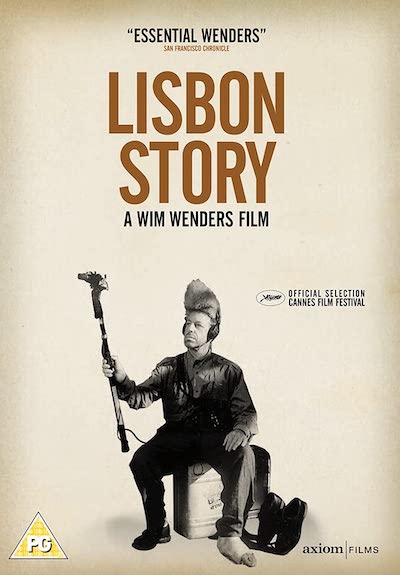
  • Wim Wenders – Lisbon Story (1994)

    1991-2000ArthousePhilosophyPortugalWim Wenders

    Quote:
    Lisbon Story is more dream than story – and this, I think, defines and justifies it most effectively. There is no clear structure, no consistently cohesive or progressive dialogue. Wim Wenders subtly reveals some form of portrait of the city, but not in the way one might expect. The film is largely made up of sounds, scattered pieces of Lisbon, strange children, a mysterious filmmaker and Wenders’ protagonist, the sound engineer, Philip Winter. In Philip Winter’s efforts to understand his friend Friedrich’s disappearance, in his enchantment with Portuguese band Madredeus, the singer Teresa Salgueiro and his search for the sounds that would accompany Friedrich’s film about Lisbon, Wender’s self-proclaimed “most entertaining film” emerges.Read More »

  • Wim Wenders – Falsche Bewegung AKA The Wrong Movement (1975)

    1971-1980DramaGermanyWim Wenders

    Quote:
    A loose contemporary adaptation of Goethe’s Wilhelm Meister’s Apprenticeship, the middle installment of Wim Wenders’ “road movie trilogy” opens with a scene that’s pure Wenders — a young man gazes out his window while American rock rollicks out of the LP player, until he suddenly puts both fists through the glass, quietly sobbing. That’s Wilhelm (Rudiger Vogler), who grudgingly accepts that, if he’s ever to become the writer he wants to be, he has to overcome his dislike for people and venture out to accumulate experiences. In place of inspiration, the journey hooks him up with a group of fellow loners, the “dead souls of Germany”: an apathetic actress (Hanna Schygulla), an aged ex-Nazi whose nose bleeds from “remembering” (Hans Christian Blech), his mute street-performer travelling companion (a teenage, almost tomboyish Nastassja Kinski), a pudgy poet (Peter Kern), and a suicidally bereft industrialist (Ivan Desny). Read More »

  • Wim Wenders – Palermo Shooting (2008)

    2001-2010GermanyPhilosophySci-FiWim Wenders

    Wim Wenders muses on love, death and his perennial bugbear, the ‘Crisis of the Image’ in The Palermo Shooting, a metaphysical thriller cum philosophical essay that marks another step on the downwards slope for this once-vital film-maker. Unwisely cast, leadenly written and ultimately farcical in its earnestness, The Palermo Shooting is a glossy travelogue-thriller with metaphysical pretentions, and one of the low points of this year’s Cannes Competition. Unlikely to fare well in the market, the film may also find festivals preferring to tactfully take a rain check.Read More »

Back to top button