

Plot:
As a documentarian cleans out the flat that belonged to his grandparents – both immigrants from Nazi Germany – he uncovers clues pointing to a complicated and shocking story.Read More »
Plot:
As a documentarian cleans out the flat that belonged to his grandparents – both immigrants from Nazi Germany – he uncovers clues pointing to a complicated and shocking story.Read More »

IMDB:
Nina, an end-of-teenage orphan with mental problems, starts a new job as a garden cleaner when she meets Toni. They fell in love with each other, but soon Toni starts betraying Nina. In the meantime, Francoise is picked up at a psychic department of a Berlin hospital by her husband, Pierre. After seeing Nina, Francoise believes that she has found her kidnapped daughter Marie, but neither Toni nor Pierre believe her. Nina is unsure about what to think… Read More »

The Naked Island
Filmed on the virtually deserted Setonaikai archipelago in south-west Japan, The Naked Island was made — in the words of its director — “as a ‘cinematic poem’ to try and capture the life of human beings struggling like ants against the forces of nature”. Kaneto Shindô (Onibaba, Kuroneko) made the film with his own production company, Kindai Eiga Kyôkai, who were facing financial ruin at the time. Using a tenth of the average budget, Shindô took one last impassioned risk to make this film. With his small crew, they relocated to an inn on the island of Mihari where, for two months in early 1960, they would make what they considered to be their last film.Read More »

synopsis
Pastorale won the International Critics’ Prize from the 1982 Berlin Film Festival. Director Otar Ioseliani was something of an outsider in the Soviet system and now lives and works in France. This film, made in 1976, was not released in the West until 1982. Iosseliani’s films show a characteristically Georgian film style; focusing more on character and mood than narrative coherence, they exhibit a characteristically whimsical humor. Pastorale explores what is truly valuable in human relationships, when one cuts away the non-essentials. The story shows what happens when a highly cultured group of musicians from a string quartet spend the summer rehearsing in a small village in the Georgian countryside. In this contemplative, idiosyncratic and somewhat humorous film, they get embroiled in local controversies, and share their gusto for living, loving and drinking with the villagers, to whom they are otherwise incomprehensible, while they rehearse and bicker among themselves.Read More »

« I was thinking about light and its relation to water and to life, and also its opposite – darkness or the night and death. I thought about how we have built entire cities of artificial light as refuge from the dark. »
Video treats light like water – it becomes a fluid on the video tube.
Water supports the fish like light supports man. Land is the death of the fish. Darkness is the death of man. »
Bill Viola, 1981
Hatsu-Yume (First Dream) is Bill Viola’s masterpiece, the greatest work by one of the most important video artists in the world. A spiritual allegory equating light and dark with life and death. Hatsu-Yume was produced in Japan in 1981 while Viola was artist-in-residence at the Sony Corporation. The title refers to Japanese folklore, wherein things done on the first day of a new year are significant. But the tape is not to be taken literally as a dream. For Viola, it’s more like the aboriginal concept of dreamtime, the creation of the world. That’s why, as a whole and in its parts, Hatsu-Yume progresses from darkness to light, stillness to motion, silence to sound, simplicity to complexity, nature to civilization. There are two interwoven themes: the dark water world of fish, and Buddhist rituals invoking the souls of dead ancestors. As in a dream, we frequently can’t tell if these wordless streams of image and sound are unfolding in real time, slow-motion or time-lapse. A work of extravagant pictorial beauty, Hatsu-Yume represents the most painterly use of light in the history of video. Form is content: the light that lures fish to their death protects human life. At once ominous, majestic, mystical and deeply spiritual, Hatsu-Yume is the work of a visionary poet of image and sound.Read More »

Plot:
Northern Lawyer John Reynolds (John Wayne) goes up against the lottery racket in 1880 corrupt Louisiana.
While on the riverboat to New Orleans, he meets and falls in love with Southern Belle, Julie (Ona Munson), General Anatole Mirbeau’s beautiful daughter. The General (Henry Stephenson) and his right-hand man Blackburn ‘Blackie’ Williams (Ray Middleton) run the popular Louisiana State Lottery Company, which support illegal activities and brothels while corrupting judges and other city officials. The battle between the men are complicated with Reynolds’ love for the General’s daughter and interrupted by torrential rain storms that breaks the levees, floods the city and threatens to destroy the city of New Orleans.
Stylishly directed by Bernard Vorhaus who had previously directed John Wayne in the memorable drama, Three Faces West. Includes an early performance by Dorothy Dandridge (Carmen Jones). Read More »

Nhum is a construction foreman working in Bangkok. The political instability in Thailand has made its presence felt in all business sectors. Nhum suddenly finds himself out of jobs. He decides to leave Bangkok to go back to his hometown in the northeast of Thailand to attend his high school friend’s wedding during the Thai New Year in April — which also happens to be the hottest month of the year.Read More »
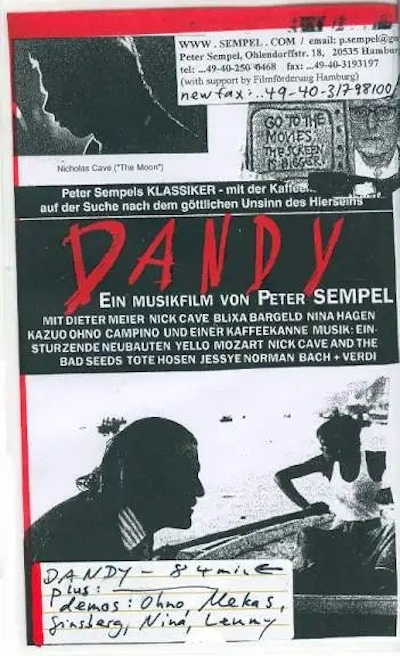
– “What would you do if you had only ten days to live”?
– “Just get very stoned.”
DANDY (1988 )- a Voltaire-inspired anti-fairytale by Peter Sempel – Featuring Blixa Bargeld, Nick Cave, Kazuo Ohno & Nina Hagen.Read More »

The Hawks and the Sparrows (Italian: Uccellacci e uccellini, literally Bad Birds and Little Birds) is a 1966 Italian film directed by Pier Paolo Pasolini. It was entered into the 1966 Cannes Film Festival.
The movie is a post-neorealist story about Totò, the beloved stone-faced clown of Italian folk-stories.
Originally Uccellacci e Uccellini, The Hawks and the Sparrows was adapted by director Pier Paolo Pasolini from his own novel. Italian comedian Toto plays a dual role, as “himself” and 12th century monk Brother Ciccillo. In modern times, Toto and his son Ninetto Davoli come across a talking crow who insists upon asking them where they’re going. The answer, it turns out, is eight centuries into the past, where Toto and Davoli become monks, employed by Francis of Assisi to convert the birds of the world to Christianity. Unfortunately, every sparrow that they win over to God is devoured by a hawk. Back in the present, Toto and Davoli face a similar situation when their landlord threatens them with eviction. After various and sundry misadventures, the two human protagonists, growing weary of the philosophical crow’s loquaciousness, eat the bird and move on, prepared to face whatever life brings them without the “help” of their feathered friend. The symbolism in The Hawks and the Sparrows is so obvious as to be funny, which was Pasolini’s intention all along.
Hal EricksonRead More »