

A woman married to the brutal and infertile owner of a dye mill in rural China conceives a boy with her husband’s nephew but is forced to raise her son as her husband’s heir without revealing his parentage in this circular tragedy.Read More »
A woman married to the brutal and infertile owner of a dye mill in rural China conceives a boy with her husband’s nephew but is forced to raise her son as her husband’s heir without revealing his parentage in this circular tragedy.Read More »

A Vietnam vet moves into an apartment and views in other people’s windows across the street, meets one of the women, and discovers black theater.Read More »

Synopsis:
Katina, an impoverished Greek woman, tries to arrange the marriage of her shepherd son, Thanos, to Despina, the daughter of a wealthy landowner. But when Despina’s father, Vlahopoulos refuses to give his blessings and wants Despina to marry a more wealthy gentleman, named Yankos. The wealthy and spoiled Yankos plots to break up the romantic union between Thanos and Despina any way possible while the young lovers plot to run away in a futile attempt to being a new life for themselves.Read More »

Quote:
A boldly conceived assemblage of diverse and seemingly random fictional materials, Athina Rachel Tsangari’s Attenberg is concerned with nothing less than those hardy perennials: sex, death, and modernity. And coming of age a little too late. Ariane Labed stars as Marina, a twentysomething naïf living in a small Greek city whose inexperience in all matters sexual is mirrored by her disgust for the act. In the film’s semi-notorious, heavily stylized opening sequence, Marina’s only friend, the sexually frivolous Bella (Evangelia Randou), teaches her how to kiss. As Tsangari frames the pair perpendicular to the camera against an abstract background, the two engage in a display of excessive tonguing so comically exaggerated that it only furthers Marina’s disgust. “You’re all slobbery. I’m going to throw up,” she says, before the young women give in to a round of improvised and manic play, spitting and blowing raspberries at each other, then squaring off in a mime of feral cats.Read More »
Quote:
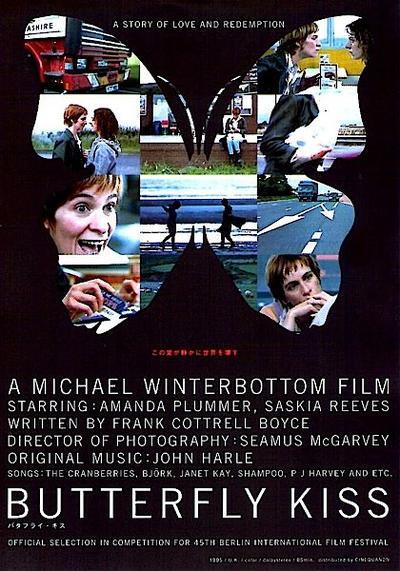
Winterbottom’s theatrical feature debut Butterfly Kiss was released into UK theatres in August 1995. Set in a dystopian environment limited almost entirely to motorways, service stations and motels, it charted the dysfunctional lesbian relationship between the violent and erratic Eunice (Amanda Plummer) and the credulous Miriam (Saskia Reeves). In so doing it offered up a portrayal of Britain that had not previously been seen on its cinema screens. Although the film garnered mixed responses, a couple of reviewers such as Derek Malcolm seized on it as heralding the arrival of a remarkable new talent in British cinema (2). Indeed, the film was to lay out many of the themes and techniques that would come to define Winterbottom’s oeuvre.Read More »

Paulina is a young lawyer with a promising career in Buenos Aires, who chooses to go back to her home town. Her father, Fernando, is a well known judge. Against his will, Paulina decides to teach in a suburban high school as part of an inclusion program. One night, after the second week working there, she’s brutally assaulted by a gang. With the disapproval of the people around her, she decides to go back to work, in the neighborhood where she was attacked, without realizing that her attackers may be even closer than she thoughtRead More »

Quote:
Vera Chytilova’s fascinating 1962 film-school thesis is a protofeminist meditation on the fashion industry that draws on Chytilova’s experience as a model. The storytelling is a bit clumsy, arbitrarily juxtaposing scenes of the protagonist posing at a photo shoot and awkwardly interacting with some young men in a cafe. But many of the images ring emotionally true, even those that have since become cliches—like the sequence in which she wanders the street at night staring at shop window mannequins. The film’s best scene—of the model standing on the runway while the audience whirls vertiginously about—evokes the vacuous instability of a self that exists only in the gaze of others.Read More »
Quote:
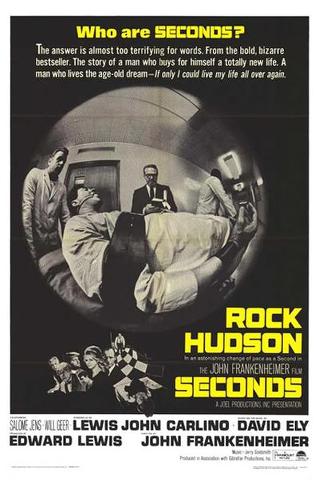
Have you ever suffered from a bout of insomnia, and ended up channel hopping into the small hours of the morning as a result? And having done so, have you ever came across a film that you’ve never heard of, yet it exerts a near hypnotic pull over you, digging itself under your skin ensuring that you’ll be thinking about it for days afterwards? If so, then you’ll recognise the kind of film that Seconds is.
The opening credits are stark black and white close-ups of various facial parts, pulled into weird and twisted shapes by the camera focus, while Jerry Goldsmith’s harsh and brooding score booms out over the top. Even from the credits, it is clear that Seconds is going to be a hallucinatory and powerful experience.Read More »

The title Lingchi refers to a photograph taken by an unidentified western anthropologist according to some, and by a French soldier at the beginning of the 20th century, according to others by others. It shows the execution of a condemned man by Lingchi, a slow torture involving more than a thousand cuts made on the body of the condemned person before death. If he died earlier the executioner was himself put to death. This punishment was practiced in China for thousands of years and was not finally abolished until 1905. A large crowd would gather for the execution, not only to witness the extraordinary spectacle but also to collect blood and strips of flesh from the body, to be used for medical purposes. The photo immediately started to be circulated, especially amongst westerners passing through China and in particular in a set of postcards Les supplices chinois. It was later published in France in Louis Carpeaux’s Pekin qui s’en va in 1913, and then by Georges Dumas in his Traité ! de psychologie in 1923. It was, however, Georges Bataille, who came into possession of a copy in 1925 and for whom, according to his own statement, it was of decisive importance in his life, who introduced it with greater authority into the imagery of western culture when he used it at the conclusion of his last study of eroticism, Les larmes d’eros, published a year before his death in 1961, to demonstrate the identical nature of contraries and in particular of religious ecstasy and extreme horror.Read More »