A 15-year-old girl in a black gang in Brussels must choose between loyalty and love when she falls for a Moroccan boy from a rival gang. The city of Brussels, plagued by high rates of youth unemployment, is home to nearly forty street gangs, and the number of young people drawn into the city’s gang culture increases each year. It’s in this criminal milieu that directing duo Adil El Arbi and Bilall Fallah set Black, a pulse-pounding contemporary take on a Shakespearean tragedy. Worlds collide when Mavela (Martha Canga Antonio), a teenage girl with ties to Brussels’ Black Bronx gang, meets Marwan (Aboubakr Bensaihi), a member of a rival Moroccan gang, at a police station. Keenly aware of the consequences of getting involved with someone from another gang, they at first resist their attraction to one another, but they can only resist for so long. Read More »
-
Adil El Arbi & Bilall Fallah – Black (2015)
2011-2020Adil El Arbi and Bilall FallahBelgiumCrimeDrama -
Kostas Manoussakis – O fovos AKA The fear (1966)
1961-1970CrimeDramaGreeceKostas ManoussakisPlot:
A socially isolated young man (Anestis Vlachos) attacks the family’s deaf-mute adopted daughter, whom he abuses sexually and then kills. His parents, even though they discover his crime and are enraged, decide to hide the truth and throw the body into the lake to make it disappear. From that moment on, Anestis lives in fear, and all his actions are now defined by the crime he committed.Read More » -
Hideo Sekigawa – Hiroshima (1953)
1951-1960AsianDramaHideo SekigawaHiroshima at 75Japan“Hiroshima” is a feature film directed by Hideo Sekigawa and was independently produced outside of major studio system in 1953. In fact the film was supported by the Teacher’s Union of Hiroshima who helped finance the production and organized about 90,000 Hiroshima citizens who acted in the film.
The film begins with Hiroshima in the early 1950s and flashes back to scenes of the horrific aftermath following the detonation of an atomic bomb on humans for the first time in history. Read More »
-
Marguerite Duras – Nathalie Granger [+Extras] (1972)
Drama1971-1980ArthouseFranceMarguerite DurasThe most insidious thing about the nouveau movie, which is a polite way of describing Marguerite Duras’s newest, most minimal film, “Nathalie Granger,” is that it traps you in its own time, unlike the nouveau roman, which can be skipped through or read at leisure in an afternoon or a year. You can’t skip through “Nathalie Granger.” To see it you are forced to watch it for as long as it lasts, while, in turn, it watches its characters, rather as if the camera were a Siamese cat whose feelings had been hurt. Without betraying the slightest interest, the camera records the physical appearance of two expressionless women who look a lot like Jeanne Moreau and Lucia Bose. They share a house with their two children, one of whom, Nathalie, is apparently a problem. “She wants to kill everyone,” says one of the women, who seem to be interchangeable. “She wants to be an orphan, or a Portuguese maid.” Nathalie, however, remains docile—this being a minimal movie.Read More »
-
Wes Anderson – The Royal Tenenbaums (2001)
2001-2010ComedyDramaUSAWes AndersonQuote:
Wes Anderson, like so many now-New Yorkers (myself included), grew up far away from the city, and so came to an idealized vision of the metropolis and its sophisticated, complicated residents through literature and movies. His new movie, The Royal Tenenbaums offers up clan of overeducated, old-money, East Coast eccentrics who occupy a house far too grand to have survived the ’80s and ’90s real estate booms without having been turned into multiple condominiums. These magnificent Tenenbaums, however, barely survive the ’00s.Read More » -
Zach Clark – Little Sister (2016)
2011-2020ComedyDramaUSAZach ClarkYoung nun Colleen is avoiding all contact from her family, returning to her childhood home in Asheville NC, she finds her old room exactly how she left it: painted black and covered in goth/metal posters.Read More »
-
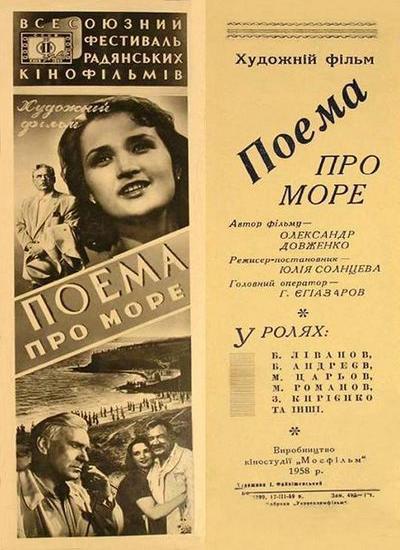
Yuliya Solntseva & Aleksandr Dovzhenko – Poema o more AKA The Poem of the Sea (1959)
1951-1960Aleksandr DovzhenkoDramaUSSRYuliya SolntsevaSummary:
This is a movie-poem with philosophic and lyric contemplations about the construction of Kakhovskaya hydroelectric power station, closure of the Dnieper, creation of Kakhovskoye Sea and also about human destinies involved in this great overturn of the region’s life. The action takes place in 1956-57. To the farm chairman’s call the people born in the village located near the Dniepr river that is to be flooded come to say good-buy to their birthplace. It is very hard for the senior generation to destroy their native houses and demolish the gardens as their memories of happy peaceful life and of the dreadful war are associated with them. The young people on the contrary smash down everything old with enthusiasm being sure that it brings nearer the bright future. Spring waters of the Dniepr are out and the Ukrainian village sinks to the bottom of the new Kakhovskoye Sea…
Source : www.mosfilm.ruRead More » -
Marguerite Duras – India Song (1975)
1971-1980ArthouseCultFranceMarguerite DurasQuote:
Poetical tale of Anne-Marie Stretter, the wife of a French diplomat in India in the 1930s. At 18 she had married a French colonial administrator and went with him on posting to Savannakhet, Laos. There she met her second husband who took her away and for 17 years they lived in various locations in Asia. Now in Calcutta, she takes lovers to relieve the boredom in her life. Told in a highly visual style with little dialogue but a constant voice-over narrative by the different characters.Read More » -
Benoît Jacquot & Marguerite Duras – La mort du jeune aviateur anglais AKA The Death of the Young English Aviator (1993)
1991-2000ArthouseBenoît JacquotBenoît Jacquot AND Marguerite DurasDocumentaryFranceMarguerite DurasLa mort du jeune aviateur anglais tells the story of a British airman whose grave Marguerite Duras discovered near Deauville. Although we don’t know where fiction begins, Duras’ narrative has a remarkable authenticity. A veritable manifesto of spontaneous writing, brilliantly directed by Benoît Jacquot, where the “direct writing” of Duras meshes perfectly with the unpretentious approach of the filmmaker. (Allocine)Read More »