Don’t we all feel the same longing for German films that break ranks, that are wild and sensual, that possess a true physicality? Dominik Graf’s thrillers, the articles he’s written on cinema and his new documentary all tell of this longing. What happened to this section of our film tradition, which in the 1970s and 80s brought forth a genre cinema that showed a very different Germany, one looking into the abyss?
Even before Martin Scorsese’s Taxi Driver, there were reflections of neon signs in nocturnal streets and a dark angel who wanted to rescue a prostitute in Roland Klick’s Supermarkt (1973). Klaus Lemke and Roland Klick sit before Graf’s camera as nonchalantly as their heroes and rave about how actors who make full use of their bodies. At first, post-war Germany did not want maimed bodies sweaty with exertion, until Mario Adorf and Klaus Kinski brought back the need for the physical. Suddenly, there was space for violent, bloody and dirty stories, with the RAF’s first department store bomb reverberating through films such as Blutiger Freitag (1972). This is another way of telling German history. [Berlinale.de]Read More »
-
Dominik Graf & Johannes Sievert – Verfluchte Liebe deutscher Film (2016)
Dominik Graf2011-2020DocumentaryGermanyJohannes Sievert -
Dominik Graf & Johannes Sievert – Offene Wunde deutscher Film (2017)
Johannes Sievert2011-2020DocumentaryDominik GrafGermany

We already know just how wild, unpredictable, sensual, audacious and bursting with life German cinema can be from the film essay Verfluchte Liebe deutscher Film. Now Dominik Graf and Johannes Sievert continue their archaeological adventure tour to the margins, the underbelly, but also to the heart of German film and television, posing some valid questions along the way: why does public television no longer commission such prescient science fiction films as Smog (1973)? Why isn’t German cinema able to establish a more audacious relationship to genre? As in Carl Schenkel’s Abwärts (1984), for example, all it takes is a lift that gets stuck in an office building to make a claustrophobic psycho-thriller. Why do young directors not follow in the footsteps of the unruly Klaus Lemke, who simply shoots his films from the hip? And why do those who do get denied funding? The excerpts from these film and television marvels – such as Slavers – Die Sklavenjäger or Liebling – Ich muss dich erschießen – certainly make one want to run out and see them at once. Sadly, in many cases all that’s left of these lost treasures are the trailers or posters.[Berlinale.de]Read More »
-
Alex Ross Perry – Golden Exits (2017)
Alex Ross Perry2011-2020ArthouseComedyUSAQuote:
An intersectional narrative of two families in Brooklyn and the unraveling of unspoken unhappiness that occurs when a young foreign girl spending time abroad upsets the balance on both sides.Read More » -
Wen Jiang – Rang Zi Dan Fei AKA Let the Bullets Fly (2010)
Wen Jiang2001-2010ActionChinaComedyIn 1920s China, a bandit arrives in a remote provincial town posing as its new mayor, where he faces off against a tyrannical local nobleman.Read More »
-
Walter Hugo Khouri – Noite Vazia AKA Eros [+Extras] (1964)
Walter Hugo Khouri1961-1970ArthouseBrazilDrama

Synopsis:
Two friends take two prostitutes for a night of pleasure. But the night turns out to be frustrating for all involved, as much bitterness is revealed in their conversation and attitudes, uncovering their anguish and deeper feelings, and the emptiness of their lives.Read More » -
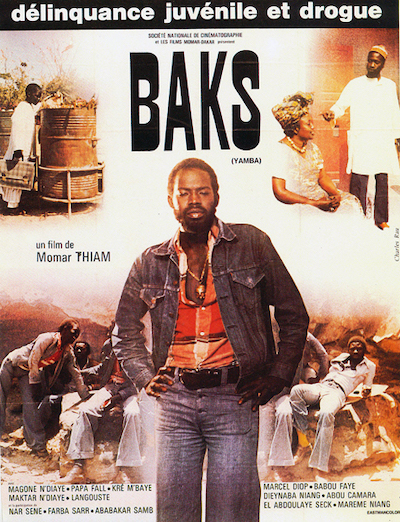
Momar Thiam – Baks (1974)
1961-1970African CinemaDramaMomar ThiamSenegal

Quote:
This is certainly the first African film to tackle the problem of street children and drugs. Idrissa is a rebellious little boy who drops out of school and joins a gang of hooligans that live on the beaches of Dakar. He gradually becomes detached from his family and adopted by his new friends who initiate him into the art of theft and the pleasures of yamba, marijuana. In his new role as a “tough guy”, Idrissa becomes Boy Idi and begins to push joints. Everybody seems to smoke in Dakar. “Even respectable people do it”, says one of the small drug pushers. Whilst Idrissa’s father loses interest in the fate of his son, his mother decides to go to the police and an inspector sets off to hunt down the gang.Read More » -
Manuel Octavio Gómez – La primera carga al machete AKA The First Charge of the Machete (1969)
1961-1970Amos Vogel: Film as a Subversive ArtArthouseCubaManuel Octavio GómezPolitics

From Amos Vogel’s Film as a Subversive Art:
Possibly the most ‘aesthetic’ and ‘experimental’ of revolutionary Cuba’s films, this outstanding work utilizes high-contrast photography, over-exposure, and solarization to create the faded chiaroscuro and poetic authenticity of the period it depicts. The film deals with an 1870 uprising against the Spanish occupation troops in Cuba, in which the machete, originally used to cut sugar cane, becomes a weapon of the people’s warfare. The portrayals of decadent upper classes and heroic peasants are sharp and incisive, and distancing devices – such as characters addressing the camera – are used to induce attitudes of analysis instead of involvement. The emergence of such a strongly poetic work within the Cuban film industry testifies to the divergent aesthetic tendencies permitted expression within the revolution.Read More » -
Leonardo Mouramateus – António Um Dois Três AKA Antonio One Two Three (2017)
Leonardo Mouramateus2011-2020DramaPortugalQuote:
António runs away from home and tries to spend the night at his ex-girlfriend’s apartment. There he finds a Brazilian girl, an unexpected guest. Johnny is struggling to stage his first theater play in Lisbon. His friendship with the young light technician will make him face his real problems. Débora is passing by, finally returning home. When she goes to the theater, she falls asleep, and is awaken by the protagonist. Three dimensions of the same story.Read More » -
Michael Snow – Puccini conservato (2008)
Michael Snow2001-2010CanadaExperimentalShort Film

Puccini Conservato was commissioned by the Lucca Film Festival for the 150th anniversary of the famous Italian composer’s birth. In this delightful video, the Canadian master offers a witty visual and sonic commentary to Puccini’s La Bohème.Read More »