Early Yugoslavian cinema, great and popular comedy produced by Jadran film, Zagreb. It is based on Simo Matavulj’s novel of the same name.
Plot: A film about the fate of the village lad named Ivo who goes into monastery to become a friar, and so to help his family in the difficult economic situation.Read More »
Young teacher first experience in their profession acquired in a remote mountain village, which has no school building. Life of a farmer, a clash between two warring race, then the conflict between the government and farmers for cutting the national forests needed to build new schools and the presence of a young teacher who doubt the search for truth, that will lead to major conflicts and tragedies.Read More »
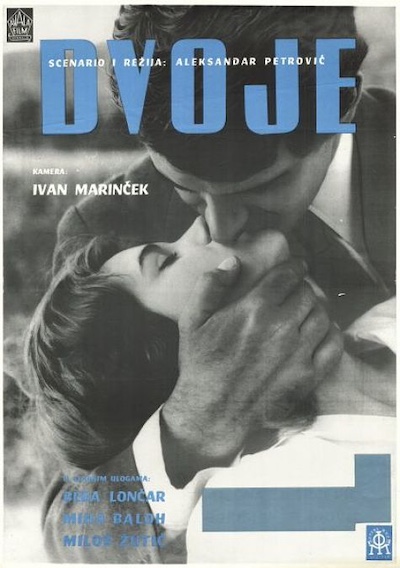
Dvoje was Petrovic’s first full-length feature film and obviously quite influenced by the French new wave. The film was in competiotion at 1962 Cannes festival. As Daniel Goulding puts it: “…It is an antioptimistic manifesto exploring a failed love relationship, played out in an alienated urban environment. An intimate film, it explored new possibilities for film language by replacing traditional narrative structures with intricate visual metaphors. “Read More »
The war has ended leaving a deep trace in people. Going trough a different conflicts in the first days of peace – dealing with a former enemy’s collaborators and executing traitors – a former soldier continues with killing even in peace.Read More »
User Reviews: Outstanding story for the time and place where was written An excellent social drama that won first prize on the international festival held in Hollywood, California in 1971. It’s displaying real workers life of the social era in seventies Yugoslavia. Remarkable, straight forward, heart touching story, Honestly brave for the time when it was written and shot. Branko Reljic is outstanding writer. He wrote a lot of excellent stories that were unfortunately not published because of his radical democratic criticism of the countries inner politics. They were not suitable for the communist regime at the time. I had pleasure to know this wonderful man that never cared for material things but fought to give the world honest true vision of love and compassion that we are rapidly loosing. Mr. Branko Reljic has dedicated his life to his beliefs, and he stayed true to all the people around him. I had that privilege to read some of his novellas and I can happily recommend them.Read More »
Professor Herceg struggling with difficulties, it is not easy to determine how students conveyed knowledge, and even harder to avoid the hatred of the disciples, and sympathy for the students. Arrival of television in school, a poll about the new school, students’ imaginations and similar conditions will not relieve his problem.Read More »
Tito’s break-up with Stalin in 1948 marked the beginning of not only confusing, but also very dangerous years for many hard-core Yugoslav communists. A careless remark about the newspaper cartoon is enough for Mesha to join many arrested unfortunates. His family is now forced to cope with the situation and wait for his release from prison. The story is told from the perspective of Malik, his young son who believes the mother’s story about father being “away on business”.Read More »
Quote: Screen adaptation of the popular novel of the same name by Bora Ćosić, published in 1969, for which he won the NIN Award for Novel of the Year in the same year. The film was screened at the Pula Film Festival and was later banned.
An ironic and parodic view of the revolution, the war, the great historical events are described from the boy’s perspective. His story, abbreviated and simple, reveals all the absurdity and lies of the world “outside the family”. It is a story about the revolution that happened in 1945, together with the national liberation. With the National Revolution, there was a smaller one – a revolution within the family. The film tells what is left of one family that enters a revolution and what is left of a revolution that enters one family.Read More »