Storyline:
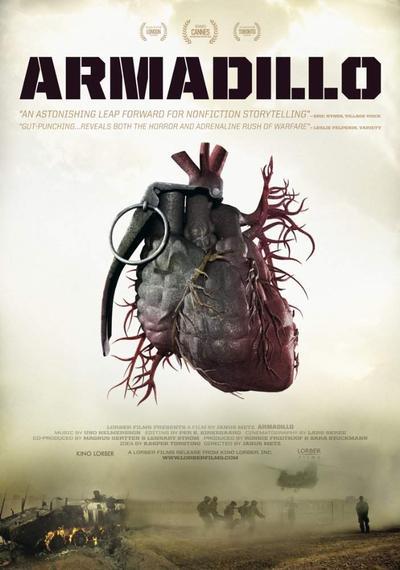
In February 2009 a group of Danish soldiers accompanied by documentary filmmaker Janus Metz arrived at Armadillo, an army base in the southern Afghan province of Helmand. Metz and cameraman Lars Skree spent six months following the lives of young soldiers situated less than a kilometer away from Taliban positions. The outcome of their work is a gripping and highly authentic war drama that was justly awarded the Grand Prix de la Semaine de la Critique at this year’s Cannes film festival. But it also provoked furious debate in Denmark concerning the controversial behavior of certain Danish soldiers during a shootout with Taliban fighters. The filmmakers repeatedly risked their lives shooting this tense, brilliantly edited, and visually sophisticated probe into the psychology of young men in the midst of a senseless war whose victims are primarily local villagers. Yet more disturbing than scenes in which Taliban bullets whiz past their cameras is the footage of the young soldiers as each tries, in his own way, to come to terms with putting his life constantly on the lineRead More »
War
-
Janus Metz Pedersen – Armadillo (2010)
2001-2010DenmarkDocumentaryJanus Metz PedersenWar -
Liliana Cavani – La pelle aka The Skin [+Extras] (1981)
1981-1990DramaItalyLiliana CavaniThe Female GazeWarBased on the short stories of Curzio Malaparte, The Skin is Liliana Cavani s controversial look at the aftermath of the German occupation of Italy during WWII and the equally difficult results of life during the Allied liberation. Marcello Mastroianni stars as writer Malaparte, who chronicled the desperate measures taken by his countrymen in order to survive. Burt Lancaster co-stars as the liberating American General unable to understand the devastation around him.Read More »
-
Pierre Granier-Deferre – Le train AKA The Last Train (1973)
1971-1980DramaFrancePierre Granier-DeferreWarSynopsis:
May 1940. Germany invades Europe, people panic and try to flee by any means possible. In France, Julien, a radio repairman, boards a train with his wife and child. As the men are placed in cattle cars with only the women and elderly allowed in the passenger cars, events begin their fateful turning as the insignificant repairman encounters an attractive fugitive and love begins – a doomed love.Read More »
-
Yuri Ilyenko – Bilyy ptakh z chornoyu vidznakoyu AKA The White Bird Marked with Black (1971)
1971-1980DramaUSSRWarYuri Ilyenko

Quote:
Colourful ‘optimistic tragedy’ of a poor family in Ukraine, living in the Carpathian mountains near the Romanian border, during the Second World War. Five sons of the family make up the village band, but as the battles between the Nazi-supported Ukranian nationalists and the Soviets go on, their band loses one player after another.Read More » -
Ahmad Reza Darvish – Kimia AKA Alchemy (1995)
1991-2000Ahmad Reza DarvishDramaIranWarDuring the Iran-Iraq war, Reza’s wife gives birth, and dies soon afterward. Reza is taken as POW. Shokooh finds Reza’s baby and raises her as her own. Many years later, Reza find’s his daughter again….Read More »
-
Rasool Mollagholi Poor – Safar be Chazabeh AKA Journey to Ghazabeh (1995)
1991-2000ExperimentalIranRasool Mollagholi PoorWar
Experimental war film about two friends who travel back in time to the front lines of the Iran-Iraq War.Read More »
-
John Boorman – Hell in the Pacific (1968)
1961-1970ClassicsJohn BoormanUSAWarA shot-down American pilot finds his way to a small, unpopulated island where he hopes to find provisions. He soon discovers that he is not alone; there is a Japanese officer marooned on the island also. Will they continue to fight each other to the death, or will they reach a modus vivendi?
Lone Japanese soldier Toshiro Mifune diligently scans the ocean from his island lookout as he must have thousands of times before, but this time he spies an abandoned life raft resting on a rocky bluff. Within minutes he’s face to face with American sea-wreck survivor Lee Marvin and the two begin an elaborate game of cat and mouse. Director John Boorman presents this two-man war as a deadly game between a pair of overgrown children, who finally tire of it (as kids will) and settle into tolerated co-existence and then even something resembling a friendship. With impressionistic strokes, Boorman paints a lush tropical paradise in colors you can drink from the screen, capturing the texture of their experience as refracted through the cinema: the look of the island as seen through the haze of smoke, the sound of a sudden rainstorm as it hushes the island in a calming roar, the timelessness of life outside of civilization.Read More »
-
Roberto Rossellini – La Nave Bianca aka The White Ship (1941)
Drama1941-1950Italian Cinema under FascismItalyRoberto RosselliniWarQuote:
La Nave Bianca is a movie about a group of firemen on a Italian battleship, that takes part in a sea battle. During the battle one of the heaters is wounded and brought to the hospital ship, where he meets a nurse…
The film is intercut with documentary scenes from the movie La battaglia dello Jonio and the cast is completely non-professional. There has been an argument ever since about who directed the movie (Rossellini or de Robertis). A dissertation from 2002 (here on the tracker torrent) seems to decide this question finally in favour of Francesco de Robertis, who is most likely the writer of the script, main director and supervisor, whereas Rossellini merely took part in the production as learning assistant director. Read More » -
Helmut Käutner – In jenen Tagen aka Seven Journeys (1947)
1941-1950DramaGermanyHelmut KäutnerWarSynopsis:
Told in seven chapters, Käutner’s first postwar film portrays the lives of average people overwhelmed and traumatized by the impact of fascism. Käutner uses the framing device of an automobile whose various owners serve as the film’s protagonists and initiate its episodic structure. The characters represent an interesting cross-section of the German people including a deserting soldier, a Jewish couple and a composer who has been labeled as subversive. During a time when most Germans wanted to forget the past, Käutner eschewed the controlled setting of the UFA studios and chose to film in the bombed out streets of Berlin, crafting a humanistic rendering of recent history.Read More »


