A radio, a warning repeated in a loop, intuition of a catastrophe that slowly approaches through the ruins and houses of a tropical rainforest. A natural disaster is coming, a natural disaster is coming, a natural disaster is coming… The paradox and its danger are served: a warning endlessly repeated may become a strange peace message. Read More »
Video Art
-
Guillermo Moncayo – Echo Chamber (2014)
2011-2020ExperimentalFranceGuillermo MoncayoVideo Art -
Christopher Petit – Content (2010)
2001-2010Christopher PetitDocumentaryUnited KingdomVideo ArtQuote:
At one point in Chris Petit’s haunting new film Content, we drive through Felixstowe container port. It was an uncanny moment for me, since Felixstowe is only a couple of miles from where I live – what Petit filmed could have been shot from our car window. What made it all the more uncanny was the fact that Petit never mentions that he is in Felixstowe; the hangars and looming cranes are so generic that I began to wonder if this might not be a doppelgänger container port somewhere else in the world. All of this somehow underlined the way Petit’s text describes these “blind buildings” while his camera tracks along them: “non-places”, “prosaic sheds”, “the first buildings of a new age” which render “architecture redundant”.Read More » -
Bill Viola – Hatsu Yume (1981)
1981-1990Bill ViolaExperimentalUSAVideo Art« I was thinking about light and its relation to water and to life, and also its opposite – darkness or the night and death. I thought about how we have built entire cities of artificial light as refuge from the dark. »
Video treats light like water – it becomes a fluid on the video tube.
Water supports the fish like light supports man. Land is the death of the fish. Darkness is the death of man. »
Bill Viola, 1981Hatsu-Yume (First Dream) is Bill Viola’s masterpiece, the greatest work by one of the most important video artists in the world. A spiritual allegory equating light and dark with life and death. Hatsu-Yume was produced in Japan in 1981 while Viola was artist-in-residence at the Sony Corporation. The title refers to Japanese folklore, wherein things done on the first day of a new year are significant. But the tape is not to be taken literally as a dream. For Viola, it’s more like the aboriginal concept of dreamtime, the creation of the world. That’s why, as a whole and in its parts, Hatsu-Yume progresses from darkness to light, stillness to motion, silence to sound, simplicity to complexity, nature to civilization. There are two interwoven themes: the dark water world of fish, and Buddhist rituals invoking the souls of dead ancestors. As in a dream, we frequently can’t tell if these wordless streams of image and sound are unfolding in real time, slow-motion or time-lapse. A work of extravagant pictorial beauty, Hatsu-Yume represents the most painterly use of light in the history of video. Form is content: the light that lures fish to their death protects human life. At once ominous, majestic, mystical and deeply spiritual, Hatsu-Yume is the work of a visionary poet of image and sound.Read More »
-
Chris Marker – Pictures at an Exhibition (2008)
2001-2010Chris MarkerFranceShort FilmVideo Art
Pictures at an Exhibition by Chris Marker. Its title, like Sans Soleil, is taken from a piece by Modest Mussorgsky.Read More »
-
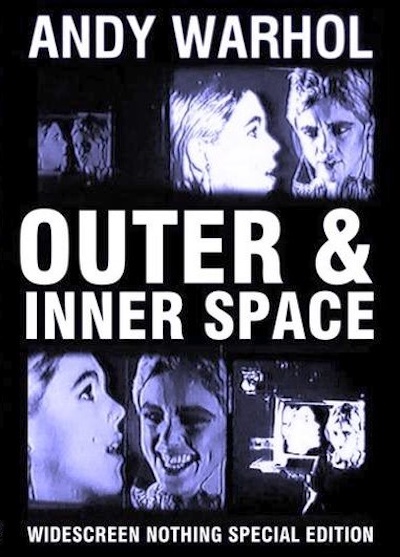
Andy Warhol – Outer and Inner Space (1965)
USA1961-1970Andy WarholExperimentalVideo Art

FILM; A Pioneering Dialogue Between Actress and Image
By J. HOBERMANANDY WARHOL has so become his own trademark — and is so much a one-name synonym for the culture of celebrity — that it can be a shock to realize just how brilliantly original he was as a visual artist. A case in point: The double-screen video-based film installation ”Outer and Inner Space” at the Whitney Museum (through Nov. 30), which places his glamorous, doomed superstar Edie Sedgwick in a dialogue with her own video-taped image.Read More »
-
Marcel Broodthaers – Le corbeau et le renard (1967)
1961-1970BelgiumExperimentalMarcel BroodthaersVideo ArtQuote:
Marcel Broodthaers (January 28, 1924 – January 28, 1976) was a Belgian poet, filmmaker and artist with a highly literate and often witty approach to creating art works.He was born in Brussels, Belgium, where he was associated with the Groupe Surréaliste-revolutionaire from 1945 and dabbled in journalism, film, and poetry. After spending 20 years in poverty as a struggling poet[1], he performed the symbolic act of embedding fifty unsold copies of his book of poems Pense-Bête in plaster, creating his first art object. That same year, 1964, for his first exhibition, he wrote a famous preface for the exhibition catalogue;Read More »
-
Gregg Bordowitz – Habit (2001)
2001-2010DocumentaryGregg BordowitUSAVideo ArtQuote:
Habit is an autobiographical documentary that follows the current history of the AIDS epidemic along dual trajectories: the efforts of South Africa’s leading AIDS activist group, the Treatment Action Campaign, struggling to gain access to AIDS drugs and the daily routine of the videomaker, a veteran AIDS activist in the U.S. who has been living with AIDS for more than ten years. The videomaker moves through his day, attending to mundane errands, eating, taking pills, having conversations with friends (some of whom have diseases such as AIDS and Breast Cancer, and others of whom are healthy), as recurring memories of a recent trip to South Africa interrupt the routine. Habit presents a rigorous working-through of ideas concerning privilege, ethics, responsibility, futility, solidarity, hope, and struggle.Read More » -
Werner Nekes & Dore O. – Beuys (1981)
1981-1990ExperimentalGermanyVideo ArtWerner NekesWerner Nekes and Dore O.Beuys 1981
11 min.
Format 16 mm colourThe term ‘visual arts’ that is prevailing in modernity is really a symptom for the reduction of perceptional categories within the human creativity as a whole. An anthropological conception of art – and I have proved for instance in sculptural theory that you hear a sculpture before you see it, that consequently the auditive element is not just an equal part, but a constituent of the perception of plastic art – confronts you with the task of exploring the conception of creativity in all directions, of spreading it out and substantiating it anthropologically. So for instance, the human creativity potential as a whole doesn’t only comprise the recognition criteria in thought, but it also comprises the sensational categories in the middle of the soul, that is, the moving element, and it positively comprises the will potential in human will. It is this interpretation of human creativity potential, beginning with the triple position, the connections of will, sense, and thought categories, which will get you to the more differentiated position of considering the perception, too, and thus the connection of human senses, discovering that for example seeing, the visual sense, the auditory sense, the static sense, the architectonic sense, the haptic sense, can be thought forward into the sense of feeling, the sense of will, the sense of thinking, and many other still to be developed senses.Read More »