“Iris (2014).IRIS pairs legendary 87-year-old documentarian Albert Maysles with Iris Apfel, the quick-witted, flamboyantly dressed 93-year-old style maven who has had an outsized presence on the New York fashion scene for decades. More than a fashion film, the documentary is a story about creativity and how, even in Iris’ dotage, a soaring free spirit continues to inspire. IRIS portrays a singular woman whose enthusiasm for fashion, art and people are life’s sustenance and reminds us that dressing, and indeed life, is nothing but an experiment. Despite the abundance of glamour in her current life, she continues to embrace the values and work ethic established during a middle-class Queens upbringing during the Great Depression. “I feel lucky to be working. If you’re lucky enough to do something you love, everything else follows.”Read More »
USA
-
Albert Maysles – Iris (2014)
2011-2020Albert MayslesDocumentaryUSA -
Tony Conrad – The Flicker (1965) DVD
1961-1970Amos Vogel: Film as a Subversive ArtExperimentalTony ConradUSAQuote:
The film starts with a warning message, which reads:WARNING. The producer, distributor, and exhibitors waive all liability for physical or mental injury possibly caused by the motion picture “The Flicker.” Since this film may induce epileptic seizures or produce mild symptoms of shock treatment in certain persons, you are cautioned to remain in the theatre only at your own risk. A physician should be in attendance.
The film then goes on to a frame that says “Tony Conrad Presents,” and then to a frame that says “The Flicker,” at which point it starts. The screen goes blank, then after a short while, the screen flickers with a single black frame. This is repeated again and again until it creates a strobe effect, for which the film is titled. This continues until the film stops abruptlyRead More »
-
Doris Wishman – Let Me Die a Woman (1978)
1971-1980DocumentaryDoris WishmanExploitationUSAChristopher J. Jarmick wrote:
A fairly serious pseudo-documentary, which captures the lifestyles of several transsexuals in various stages of changing their gender. Dr Leo Wollman M.D. was a legitimate practicing doctor who is our guide through this one of a kind, once shocking film that features some footage of operations that are not completely revealing but not for the squeamish. There are some scenes of probing of a constructed vagina and shots of men with artificially developed breasts. Then there are several staged soft-core scenes thrown into the film to add to the hodgepodge. Dr Wollman occasionally makes statements like “not all dildos are used for medical purposes.” Note: actual on screen credits were not available to verify credits. From the advertisements: “All True! All Real! See a man become a woman before your eyes!”, “Born a Man . . . Let Me Die A Woman”, “Torn from Today’s Headlines.”Read More » -
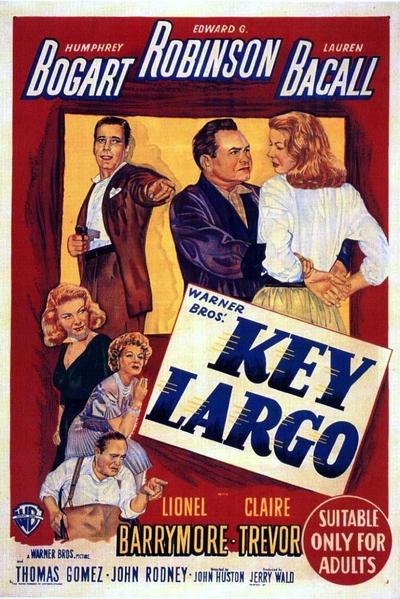
John Huston – Key Largo (1948)
1941-1950ClassicsFilm NoirJohn HustonUSAQuote:
Frank McCloud travels to a run-down hotel on Key Largo to honor the memory of a friend who died bravely in his unit during WW II. His friend’s widow, Nora Temple, and wheelchair bound father, James Temple manage the hotel and receive him warmly, but the three of them soon find themselves virtual prisoners when the hotel is taken over by a mob of gangsters led by Johnny Rocco who hole up there to await the passing of a hurricane. Mr. Temple strongly reviles Rocco but due to his infirmities can only confront him verbally. Having become disillusioned by the violence of war, Frank is reluctant to act, but Rocco’s demeaning treatment of his alcoholic moll, Gaye Dawn, and his complicity in the deaths of some innocent Seminole Indians and a deputy sheriff start to motivate McCloud to overcome his Hamlet-like inaction.Read More » -
Thom Andersen & Noël Burch – Red Hollywood (1996)
USA1991-2000DocumentaryPoliticsThom Andersen and Noël BurchThom Andersen and Noël Burch’s provocative documentary looks with fresh eyes at “Red” Hollywood—films by screenwriters and directors who were communists, ex-communists, or sympathizers and who were in some way implicated by the Hollywood investigations of the House Committee on Un-American Activities. Drawing on their extensive research and an array of arresting film clips, as well as on the reminiscences of blacklisted artists Paul Jarrico, Ring Lardner, Jr., Alfred Levitt, and Abraham Polonsky, the video reveals the degree to which the Hollywood left was able to tint movies with its political convictions. Taking issue with Billy Wilder’s oft-quoted put-down, “Of the Unfriendly Ten, only two had talent, the other eight were just unfriendly,” Red Hollywood reveals a largely neglected Hollywood legacy: films committed to raising questions regarding class, gender, and racism. Films that questioned the System itself—whether capitalism or the studio—and were answered with the blacklist. —Pacific Film Archive Read More »
-
John Korty – The People (1972)
1971-1980John KortySci-FiTVUSAShy, introverted eager-beaver young school teacher Melodye Amerson (sweetly played by the adorable Kim Darby of Don’t Be Afraid of the Dark fame) takes a job at a remote, quiet rural farming community that’s isolated from the rest of the world. The job proves to be far more difficult and challenging than she initially figured: the students are extremely terse, reserved and uncommunicative, the other townspeople are every bit as reticent, mysterious and unapproachable, and everyone lives by a strict code which leaves Melodye feeling confused and alienated. Read More »
-
Peter Yates – The Friends of Eddie Coyle (1973)
USA1971-1980CrimePeter YatesThrillerQuote:
Throughout Peter Yates’ masterful The Friends of Eddie Coyle, crooks, thieves and the occasional police officer use terms of complacent endearment — friend, nice guy, good man — but the words never seem to carry any meaning. All of them tend to agree that Eddie Coyle (Robert Mitchum), a career criminal at 51, is a nice guy, but that doesn’t mean they aren’t willing to put him in the dirt if it makes their lives easier. Coyle can’t really blame them for it; he knows the way of the world.As its title points out, Friends has a very marginal interest in Eddie himself. In his first scene, Coyle goes about telling a gun dealer (Steven Keats) about how some associates of other associates slammed his fingers after a deal went sour. A low-level hood since God-knows-when, Eddie speaks about the situation congenially before telling the dealer that he needs 30 guns. Coyle has been supplying guns to a pack of bank robbers, the head of which is played by Alex Rocco. The money he’s making is to support his wife and kids before he reports for a two-year stint in a New Hampshire prison; he doesn’t feel his family should be scraping by on welfare.Read More »
-
Max Ophüls, Stuart Heisler, Mel Ferrer, Preston Sturges, Paul Weatherwax – Vendetta (1950)
1941-1950DramaMax OphülsPreston SturgesRomanceStuart HeislerUSAMax Ophuls’ first American film. Fired by Howard Hughes after falling behind schedule, Ophuls was replaced by Preston Sturges, who had written the script. Sturges was then fired also. Over the next four years, Hughes tinkered incessantly with the project, and an array of writers and directors had their way with it. Finally editor Don Siegel attempted to put the thing together and make sense of it.
So the movie is messy but with stunning sequences. Most sources credit Mel Ferrer with directing the ending, but it’s clear he only shot the leaden coda. The actual climax is a beautifully orchestrated, stunningly lit stalking scene with the principal characters hunting each other through a misty wood. Absolutely beautiful, and if this is what made Ophuls go over schedule, as seems likely, he was right to take the time to get it looking this amazing.Read More »
-
Bob Rafelson – Head (1968)
1961-1970Bob RafelsonCultMusicalRock n' Roll MusicalsUSARunning in from seemingly nowhere, Micky Dolenz, Davy Jones, Michael Nesmith & Peter Tork – better known collectively as The Monkees – disrupt a bridge opening ceremony. From where and why did they come to disrupt the proceedings? They were filming a series of vignettes in several different genres, including a wild west sequence, a desert war sequence, a Confederate war sequence, and a science fiction sequence. They disagree with much of what is happening around them, and try to figure out how to escape the oppression they feel – symbolized by a big black box in which they are seemingly imprisoned – by the forces around. That oppression is often shown in the form of “The Big Victor Mature”.Read More »