Quote:
While the City Sleeps (1954) was Fritz Lang’s last fully successful film, one of a pair of movies that he made with independent producer Bert E. Friedlob (the other was Beyond a Reasonable Doubt). Additionally, it has proved to be one of his more enduring successes over the decades, due to the combination of its virtues as a thriller and also as a snapshot of American mores circa 1954. It may not be as respected as, say, M (1931) or Fury (1936), but it might be the Lang film that Americans of the baby-boom generation know best, through countless television showings in the 1960s and ’70s, and like most for its sinister subtext. Strangely enough, While the City Sleeps was not a story that Lang that set out to tell — producer Bert E. Friedlob rejected several of the director’s proposed subjects and imposed the story on Lang, as he had already bought the rights to Charles Einstein’s novel The Bloody Spur. That book was based on the criminal career of William Heirens, who had terrorized that city with a string of burglaries, sexual assaults, and murders during the mid-’40s. Heirens was identified as the “Lipstick Killer” when he left a message, scrawled in lipstick, at one of his crime scenes, asking the police to stop him. He was later caught, and he confessed and was given a life sentence (which he was still serving as of 2003). Read More »
USA
-
Fritz Lang – While the City Sleeps (1956)
1951-1960DramaFilm NoirFritz LangUSA -
Gregory Ratoff – Wife, Husband and Friend (1939)
1931-1940ClassicsComedyGregory RatoffScrewball ComedyUSA20th Century-Fox evidently adored “triangle” comedies like Wife, Husband and Friend; apparently so did Loretta Young, who appeared in most of these films. Young plays the wife of businessman Warner Baxter, while “friend” Cesar Romero is an amorous singing teacher who convinces Young that she has a future in opera. To show up his wife, Baxter takes lessons from diva Binnie Barnes–and as it turns out, he’s the one with the ideal operatic voice. The romantic quadrangle is resolved when Baxter makes a disastrous stage debut, whereupon Romero and Barnes exit and Baxter and Young realize the error of their ways. Wife, Husband and Friend was remade in 1949 as Everybody Does It, with Paul Douglas (of all people) as the would-be Caruso. ~ Hal Erickson, All Movie GuideRead More »
-
Paul Morrissey – Flesh (1968)
1961-1970CultDramaPaul MorrisseyQueer Cinema(s)USAQuote:
Flesh was filmmaker Paul Morrissey’s first production for Andy Warhol. The story concerns a bisexual hustler (Joe Dallesandro) who does tricks so that he can pay for his wife’s lover’s abortion. The film made headlines when it was confiscated by the police during one of its earliest showings in 1970. Though this event is unlikely to repeat itself, Flesh is still explicit enough to elicit gasps from even the most jaded of underground-film enthusiasts. — Hal EricksonRead More » -
Sidney Lumet – 12 Angry Men (1957) (HD)
1951-1960DramaSidney LumetUSASYNOPSIS
A Puerto Rican youth is on trial for murder, accused of knifing his father to death. The twelve jurors retire to the jury room, having been admonished that the defendant is innocent until proven guilty beyond a reasonable doubt. Eleven of the jurors vote for conviction, each for reasons of his own. The sole holdout is Juror #8, played by Henry Fonda. As Fonda persuades the weary jurors to re-examine the evidence, we learn the backstory of each man. Juror #3 (Lee J. Cobb), a bullying self-made man, has estranged himself from his own son. Juror #7 (Jack Warden) has an ingrained mistrust of foreigners; so, to a lesser extent, does Juror #6 (Edward Binns). Jurors #10 (Ed Begley) and #11 (George Voskovec), so certain of the infallibility of the Law, assume that if the boy was arrested, he must be guilty. Juror #4 (E.G. Marshall) is an advocate of dispassionate deductive reasoning. Juror #5 (Jack Klugman), like the defendant a product of “the streets,” hopes that his guilty vote will distance himself from his past. Juror #12 (Robert Webber), an advertising man, doesn’t understand anything that he can’t package and market. And Jurors #1 (Martin Balsam), #2 (John Fiedler) and #9 (Joseph Sweeney), anxious not to make waves, “go with the flow.” The excruciatingly hot day drags into an even hotter night; still, Fonda chips away at the guilty verdict, insisting that his fellow jurors bear in mind those words “reasonable doubt.” A pet project of Henry Fonda’s, Twelve Angry Men was his only foray into film production; the actor’s partner in this venture was Reginald Rose, who wrote the 1954 television play on which the film was based. Carried over from the TV version was director Sidney Lumet, here making his feature-film debut. A flop when it first came out (surprisingly, since it cost almost nothing to make), Twelve Angry Men holds up beautifully when seen today. It was remade for television in 1997 by director William Friedkin with Jack Lemmon and George C. Scott.
Hal Erickson on All Movie GuideRead More » -
Dennis Hopper – Colors (1988)
1981-1990ActionCrimeDennis HopperUSAColors is a 1988 American police procedural crime film starring Sean Penn and Robert Duvall, and directed by Dennis Hopper. The story takes place in South Central, North West and East Los Angeles, and centers on Bob Hodges (Duvall), an experienced Los Angeles Police Department CRASH Police Officer III, and his rookie partner, Danny McGavin (Penn) who try to mitigate the gang violence between the Bloods, the Crips, and the Hispanic street gangs. Colors relaunched Hopper as a director 18 years after Easy Rider and inspired discussion over its depiction of gang life and gang violence.Read More »
-
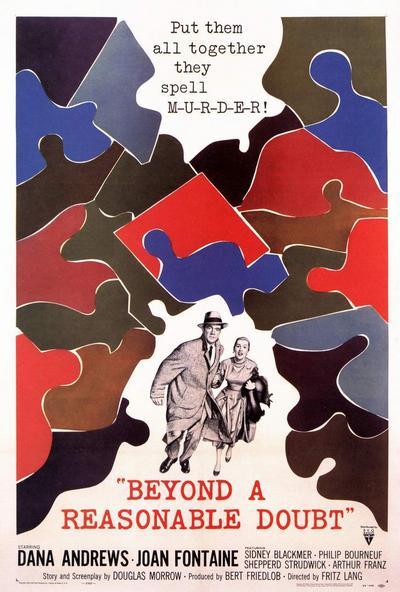
Fritz Lang – Beyond a Reasonable Doubt (1956)
1951-1960CrimeFilm NoirFritz LangUSAQuote:
Crusading publisher Austin Spenser (Sidney Blackmer) wants to prove a point about the insufficiency of circumstantial evidence. Spencer talks his prospective son-in-law Tom Garrett (Dana Andrews) into participating in a hoax, the better to expose the alleged ineptitude of conviction-happy DA (Philip Bourneuf). Tom will plant clues indicating that he is the murderer of a nightclub dancer, then stand trial for murder; just as the jury reaches its inevitable guilty verdict, Spencer will step forth to reveal the set-up and humiliate the DA. Somewhat surprisingly, Tom eagerly agrees to this subterfuge. Unfortunately, an unforeseen event renders their perfectly formed scheme useless. Beyond a Reasonable Doubt was the last American film of director Fritz Lang.Read More » -
Jordan Belson – Re-entry (1964)
1961-1970ExperimentalJordan BelsonShort FilmUSAQuote:
“In Re-entry he successfully synthesizes the Yogic and the cosmological elements in his art for the first time by forcefully abstracting and playing down both of them…” P. Adams SitneyRead More » -
Samuel Fuller – Underworld U.S.A. (1961)
1961-1970CrimeFilm NoirSamuel FullerUSA

A teenager who witnesses the murder of his father vows to exact revenge on the four mobsters involved in the killing.
Letterboxd reviews
★★★★★ Watched by Joe 14 Jun 2017CLEAN SPORTS MAKE FOR A CLEAN AMERICA
Peak Fuller nightmare-noir, with a plot that’s jagged and fast like a lightning bolt. The straight world is a million miles away from everything that happens in this movie.Read More »
-
Sidney Lumet – Long Day’s Journey Into Night (1962)
1961-1970ClassicsDramaSidney LumetUSAPlot:
Based on Eugene O’Neill’s autobiographical play, this magnificent screen adaptation was directed by the great Sidney Lumet and starred Katharine Hepburn, Ralph Richardson, Jason Robards and Dean Stockwell.Read More »