

Plot:
Joe Weber is an anthropologist who takes his son on a trip to the New England town of Salem’s Lot unaware that it is populated by vampires. When the inhabitants reveal their secret, they ask Joe to write a bible for them.Read More »
Plot:
Joe Weber is an anthropologist who takes his son on a trip to the New England town of Salem’s Lot unaware that it is populated by vampires. When the inhabitants reveal their secret, they ask Joe to write a bible for them.Read More »
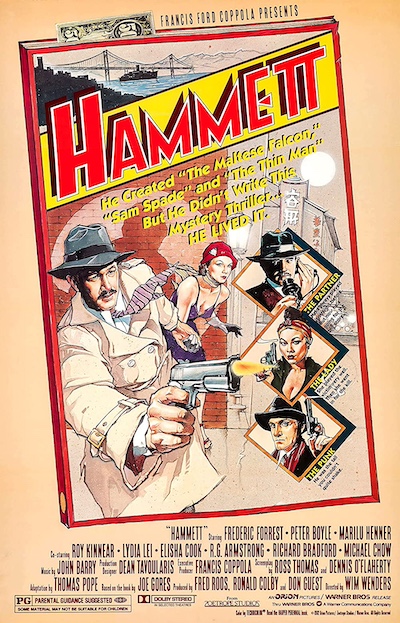
The plot
Based in part on detective-fiction writer Dashiell Hammett’s early experiences as a Pinkerton detective, this moderately-noir film has Hammett (using his little-known first name, Sam) involved in an elaborate extortion plot by his former detective agency mentor, Jimmy Ryan. Ryan shows up at Hammett’s San Francisco digs searching for a mysterious Chinese girl, Crystal Ling. He calls in a marker from Hammett’s days at the detective agency to get his help in finding the girl, who turns out to be a very sexy and shrewd former prostitute and porn star. She has photographs of San Francisco’s most influential citizens engaged in sexual fantasy with her and she means to turn them into a million-dollar payday. The tubercular Hammett must cope with an unfriendly police force, a mysterious gunsel intent on inflicting serious harm, and betrayal by supposed friends; to save the reputations of the powerful while tweaking their collective noses
Written by Joe Jurca, imdb.comRead More »
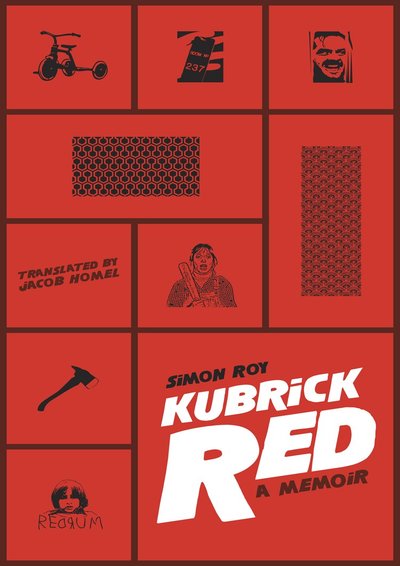
from amazon.com
The Shining by Stanley Kubrick – that strange story in which a writer and his wife and young son with ESP stay in a mysterious hotel in low season – has been fascinating viewers since its release in 1980.
Simon Roy first saw the film when he was 10 and was mesmerized by a particular line: “How’d you like some ice cream, Doc?” He has since seen the movie at least 42 times, because “it encompasses the tragic symptoms of a deep-seated defect that has haunted [it] for generations.” The painstaking bond he has knitted with this story of evil has enabled him to absorb the disquieting traits of its “macabre lineage” and fully reveal its power over him. This is an unusual and astonishing book.Read More »

Quote:
A half-forgotten, half-legendary pioneer in American abstract and animated filmmaking, Mary Ellen Bute, late in her career as an artist, created this adaptation of James Joyce, her only feature. In the transformation from Joyce’s polyglot prose to the necessarily concrete imagery of actors and sets, Passages discovers a truly oneiric film style, a weirdly post-New Wave rediscovery of Surrealism, and in her panoply of allusion – 1950s dance crazes, atomic weaponry, ICBMs, and television all make appearances – she finds a cinematic approximation of the novel’s nearly impenetrable vertically compressed structure.Read More »

‘Guns’ Donovan prefers carousing with his pals Doc Dedham and ‘Boats’ Gilhooley, until Dedham’s high-society daughter Amelia shows up in their South Seas paradise.Read More »
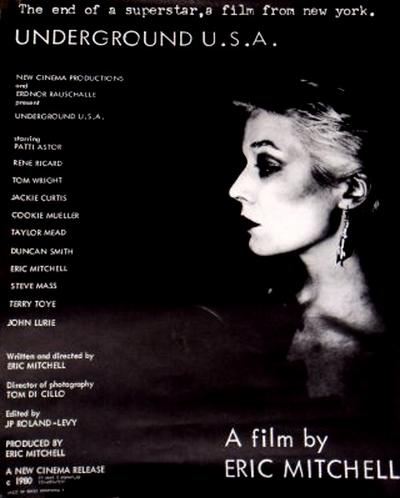
In June 1980, (Eric) Mitchell released a sixteen-millimeter feature that was specifically designed to be shown at midnight and was called Underground U.S.A. More Morrissey than Warhol (with a cameo appearance by Taylor Mead), the film is Sunset Boulevard out of Heat, transposed to no-wave haute monde. The Gloria Swanson character, here a faded underground underground superstar obviously modeled on Edie Segdwick, is played with convincing self-absorption by platinum-haired Patti Astor, another Poe graduate. Mitchell, whose emotional affect makes Joe Dallesandro seem like a Jack Lemmon hysteric, is the hustler who manages to briefly install himself in her foredoomed life; while, in a witty bit of casting, Factory juvenile René Ricard enacts the von Stroheim-like protector whom Mitchell nudges aside but fails to replace. Underground U.S.A. is well acted and handsomely shot, but never redeems the comic potential of its first twenty minutes, inexorably going vague over the punk-underground art-world milieu that it sets out to lampoon. Nevertheless, due in large part to Mitchell’s skill as a self-promoter, the film ran at midnight for twenty weekends at the St. Marks until midnight October 1980.
J. Hoberman, Midnight MoviesRead More »
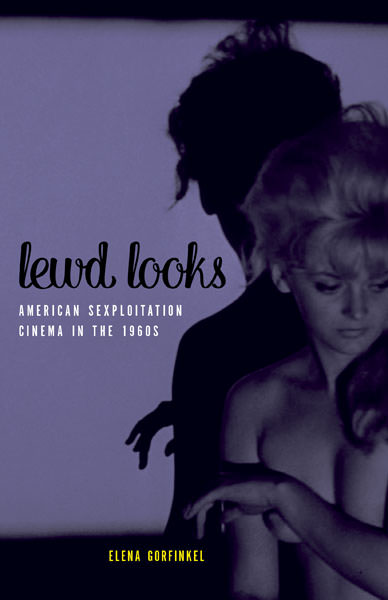
Lewd Looks: American Sexploitation Cinema in the 1960’s
by Elena Gorfinkel
Paperback: 352 pages
Publisher: University Of Minnesota Press; 1st edition (Oct. 15 2017)
Language: English
ISBN-10: 1517900174
ISBN-13: 978-1517900175
The untold story of the American sexploitation film—a major development in screen sex in the decade before “porno chic”
Read More »
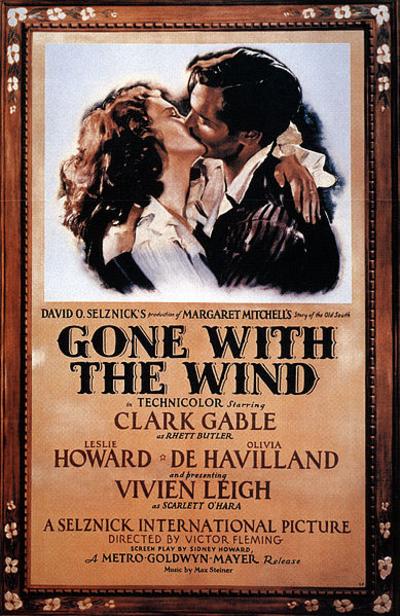
Gone With the Wind boils down to a story about a spoiled Southern girl’s hopeless love for a married man. Producer David O. Selznick managed to expand this concept, and Margaret Mitchell’s best-selling novel, into nearly four hours’ worth of screen time, on a then-astronomical 3.7-million-dollar budget, creating what would become one of the most beloved movies of all time. Gone With the Wind opens in April of 1861, at the palatial Southern estate of Tara, where Scarlett O’Hara (Vivien Leigh) hears that her casual beau Ashley Wilkes (Leslie Howard) plans to marry “mealy mouthed” Melanie Hamilton (Olivia de Havilland). Despite warnings from her father (Thomas Mitchell) and her faithful servant Mammy (Hattie McDaniel), Scarlett intends to throw herself at Ashley at an upcoming barbecue at Twelve Oaks. Alone with Ashley, she goes into a fit of histrionics, all of which is witnessed by roguish Rhett Butler (Clark Gable), the black sheep of a wealthy Charleston family, who is instantly fascinated by the feisty, thoroughly self-centered Scarlett: “We’re bad lots, both of us.” The movie’s famous action continues from the burning of Atlanta (actually the destruction of a huge wall left over from King Kong) through the now-classic closing line, “Frankly, my dear, I don’t give a damn.” Holding its own against stiff competition (many consider 1939 to be the greatest year of the classical Hollywood studios), Gone With the Wind won ten Academy Awards, including Best Picture, Best Director, Best Screenplay, Best Actress (Vivien Leigh), and Best Supporting Actress (Hattie McDaniel, the first African-American to win an Oscar). The film grossed nearly 192 million dollars, assuring that, just as he predicted, Selznick’s epitaph would be “The Man Who Made Gone With the Wind.” (AMG)Read More »

Joseph McBride wrote:
Wee Willie Winkie provides a case study of how Ford approached what could have been another pot-boiler and infused it with his own artistic sensibilty. If there were any real justice in Hollywood, Ford would have won an Oscar for a film such as this one, whose truly superior craftsmanship is all the more impressive for seeming so effortless. With larger-than-life romanticism, Ford deflty creates a child’s storybook vision of the world, then introduces unexpectedly touching moments as reality impinges on the consciousness of the innocent protaganist. This stylised feeling was heightened in the film’s original release by tiniting the daytime scenes sepia and the nighttime scenes blue, reviving a practice from the silent cinema.Read More »