Spain

  • José María Nunes – Sexperiencias (1968)

    1961-1970ArthouseExperimentalJosé María NunesSpainSpanish cinema under Franco

    Free Image Hosting at www.ImageShack.us

    29f7c043f76a2bde437fd0d52a185152

    Although allusions to François Truffaut’s Jules and Jim and Jean-Luc Godard’s Breathless suggest José María Nunes’s affection for French New Wave, Sexperiencias finds greater kinship with Nagisa Oshima’s fractured, interconnected themes of sexual and social revolution. In a way, young hitchhiker, María (María Quadreny) is also a stand-in for accidental revolutionary, Motoki in The Man Who Left His Will on Film, a cipher who, in trying to capture the rhythms of everyday life (albeit through photography rather than filmmaking), is politicized by an atmosphere of unrest. Finding momentary connection with an outspoken activist, Antonio (Antonio Betancourt), María’s life is upended when her lover is imprisoned for dissent. Restless and adrift, she embarks on an affair with a nurturing, middle-aged engraver, Carlos (Carlos Otero), only to find her newfound life of comfort and stability at odds with the chaos of the world around her. But while Oshima’s melding of fact and fiction captures the spirit of an internal revolution, Nunes’s revolution is a distant one – a reminder of an empowered other reality that can be turned inward to incite change – galvanized by geopolitical headlines that dominated the local newspapers of 1968: Prague Spring and the Soviet invasion of Czechoslovakia, the assassinations of Martin Luther King Jr. and Robert Kennedy, May 68 protest, the coup in Panama, the turning of the tide in the Vietnam War with Lyndon Johnson’s decision not to seek re-election. Incorporating an incongruous soundtrack of nature sounds, assorted music, and ambient noise, Nunes creates a disorienting environment that is literally out of sync – the separation between image and sound implicitly reflecting the disconnection between the reality of Franco-era Spain and its projected image. Framed against the bookending reference to the U.N.’s adoption of the nonbinding Universal Declaration of Human Rights in 1968, the question of enforcement becomes an ironic coda to the problem of inaction, where the struggle is not in the ability to speak, but in an unwillingness to listen.Read More »

  • Christian Molina – Diario de una ninfómana aka Diary of a Sex Addict (2008)

    2001-2010Christian MolinaDramaEroticaSpain

    29f7c043f76a2bde437fd0d52a185152

    Quote:
    A chronicle of the life of a middle-class French girl’s sexual adventures, her then fall into prostitution, and her ultimate redemption

    Quote:
    Val is an attractive, well educated and well off 28 year old. Whats more shes very sexually liberated and constantly on the hunt for new encounters to satisfy her endless sexual curiosity and desire. She sleeps with whoever she wants, whenever she wants to, ending up making sex into a lifestyle; a lifestyle that leads her to find both love and a career in prostitution. In both she experiences the extreme.Read More »

  • José Luis Guerín – Innisfree (1990)

    1981-1990DocumentaryJosé Luis GuerínSpain

    29f7c043f76a2bde437fd0d52a185152

    Description:
    A documentary focused on the modern-day village of Innisfree, the location used by legendary director John Ford for his Irish romance The Quiet Man.

    Innisfree (from the Gaelic Inis Fraoich, the heather island) is the name of a tiny island in Lough Gill, to the south ­east of Sligo town, which was immortalised by Yeats in one of his best ­ known poems, ” The Lake lsle of Innisfree ” (The Rose, 1893). Written at a time when the poet lived in London with his family, and “felt very homesick” (Kirby, 1977: 46), “The Lake Isle of Innisfree” expresses a nostalgic longing for a simple country life apart from the stresses of urban life that places it within a pastoral tradition.Read More »

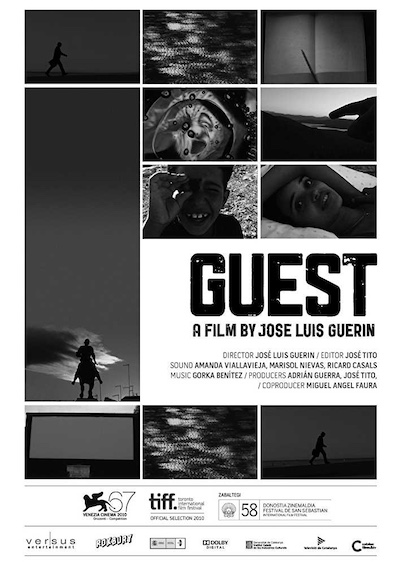
  • José Luis Guerín – Guest (2010)

    Arthouse2001-2010DocumentaryJosé Luis GuerínSpain
    Guest (2010)
    Guest (2010)

    Filmmaker Jose Luis Guerin documents his experience during a year of traveling as a guest of film festivals to present his previous film. What emerges is a wonderfully humane and sincere portrayal of the people that he meets when he goes off the beaten track in some of the world’s major cities. (IMDB Plot Summary)Read More »

  • José Val del Omar – Tríptico Elemental de España (1960)

    1951-1960ArthouseJosé Val del OmarSpain

    Free Image Hosting at www.ImageShack.us

    29f7c043f76a2bde437fd0d52a185152

    José Val del Omar (Granada 1904 – Madrid 1982)

    With an extraordinary artistic and technological talent, Val del Omar was a ”believer in cinema” inspired by new horizons that he formulated in the term PLAT – representing the totalizing concept of a ”Picto-Luminic-Audio-Tactile” art – apart from being a contemporary and a comrade of Lorca, Cernuda, Renau, Zambrano and other figures of a Silver Age of the Spanish culture, interrupted by the Civil War. In 1928 he anticipated various of his most characteristic techniques, including the ”apanoramic overflow of the image” beyond the limits of the screen, and the concept of ”tactile vision”. These techniques. and those of ”diaphonic sound” and other explorations in the field of electro-acoustics, would be applied in his Tríptico Elemental de España [Elementary Tryptich of Spain], begun in 1953 and only finished after his death. His work and tenacious research activity – quite against any tendency of misunderstanding and forgetfulness – did not begin to be rediscovered until shortly before his death, though it has constituted the beginning of a renaissance that continues to draw followers. ”Endless”, as he would put at the end of his films.Read More »

  • Daniel Sánchez Arévalo – Gordos AKA Fat People (2009)

    Drama2001-2010ComedyDaniel Sánchez ArévaloSpain
    Gordos (2009)

    A group of overweight people attend therapy sessions in an attempt to solve their weight and emotional problems.

    “GORDOS” is a comedy about life’s excesses and deficiencies; about our insecurities, phobias, obsessions, traumas, mistakes, fears, blame, desires, hopes, challenges, concessions, goals, relationships, love, sex, health, family… about survival in the widest and “largest” sense of the word.Read More »

  • Julio Medem – Los Amantes del Circulo Polar aka Lovers of the Arctic Circle (1998)

    1991-2000ArthouseDramaJulio MedemSpain

    29f7c043f76a2bde437fd0d52a185152

    Quote:
    As young children, Otto (Fele Martínez) and Ana (Najwa Nimri) become best friends, leading to the marriage of Ana’s mother, Olga (Maru Valdiviesio), to Otto’s father, Álvaro (Nancho Novo). When Otto and Ana become teenagers, they begin a sexual relationship, which they hide from their parents. The two fall deeply in love and seem destined to spend the rest of their lives together. However, their relationship is tested when Otto’s mother dies and the two are separated.Read More »

  • Pedro Almodóvar – Laberinto de pasiones aka Labyrinth of Passion (1982)

    Comedy1981-1990CampPedro AlmodóvarSpain
    Laberinto de pasiones (1982)

    A camp melodrama/comedy about Sexilia (a nymphomaniac), Sadec (a gay Islamic terrorist), Riza Niro (the son of the emperor of Tiran), and Queti (the daughter of a dry-cleaner). When Riza Niro discovers that Sadec and his colleagues are after him, he disguises himself as a punk rocker, and falls in love with the stunning Sexilia, his first straight relationship. Meanwhile Queti, Sexilia’s “biggest fan”, helps Sexilia come to terms with her new life-style.Read More »

  • Pedro Almodóvar – Salomé (1978)

    1971-1980CampPedro AlmodóvarShort FilmSpain

    29f7c043f76a2bde437fd0d52a185152

    From Almodovarlandia.com:

    As Almodóvar had already tried out different durations in Super 8, he decided to shoot a film in a greater format, in 16 mm. In Salomé the origin of veil is being dealt with.

    Abraham is walking across the countryside together with his son Isaac and meets Salomé, who is fully covered with combs and veils. Though Abraham was an upright and merciful person, he becomes crazy for her and asks her to dance for him. She starts to dance »The Wildcat«, while she takes off all her veils. Once Abraham has become absolutely crazy for her, Salomé asks him for the head of his son. Abraham who has promised to give her whatever she wants has no other choice but to agree. Hearing this Isaac decides to flee. But Salomé who has supersensory forces, appears in front of Isaac, hypnotizes him and brings him back to his father. Abraham lights a campfire, and when he prepares to kill his son he hears the voice of god telling him that everything was just a proof, that Salomé is only one of Gods representations, that Salomé was God, which sometimes appears in this form just for seducing men. And that he has done all this just for leading Abraham into temptation who was human and could sin. Because God has been a little bit disgruntled when he saw that Abraham did not sin ever. And that all the generations to come will remember this day and will celebrate it, Abraham should take all the veils that Salomé has taken off, that from that moment on all the women of his people should cover to signal their respect for the church.Read More »

Back to top button