It all began (as things Rivettian tend to do) auspiciously enough. There were to be four films in a series originally entitled Les Filles du Feu (after Gerard de Nerval) before the more expansive Scenes de la vie parallele replaced it. Each would center on a “non-existent myth” of a battle between goddesses of the sun and the moon for a mysterious blue diamond that has the power to make mortals immortal and vice versa. Each film was to be in a different genre: a film noir, a pirate adventure, a love story, and finally a musical – the last-mentioned of whose scenario particulars hadn’t been completely worked out when the four-film project went into production. Two films were ultimately completed – Duelle (the film noir) and Noroit (1976, the pirate adventure). But two days into the shooting of the third, Histoire de Marie et Julien the metteur en scène (as Rivette always chose to call himself, auteurism be damned) suffered a nervous breakdown, and the entire project fell apart – though traces of it linger in Merry-Go-Round (1981, a paranoid conspiracy jape that has everything but the goddesses) and the semi-demi-musical Haut/Bas/Fragile (1995).Read More »
Queer Cinema(s)
-
Jacques Rivette – Duelle (une quarantaine) AKA Twilight (A Quarantine) (1976)
1971-1980FantasyFranceJacques RivetteMysteryQueer Cinema(s) -
Kirby Dick – This Film Is Not Yet Rated (2006)
2001-2010DocumentaryKirby DickQueer Cinema(s)USASynopisis from RopeofSilicon.com
IFC Original Documentary This Film Is Not Yet Rated, the breakthrough film from Oscar-nominated director Kirby Dick (Twist of Faith) is an unprecedented investigation into the MPAA film ratings system and its profound impact on American culture.Read More »
-
Donald Cammell – Wild Side [Director’s Cut] (1995)
1991-2000Donald CammellEroticaQueer Cinema(s)ThrillerUnited KingdomQuote:
A bank accountant, whom moonlights as a high-priced call girl, becomes embroiled in the lives of a money launderer, his seductive wife, and his bodyguard whom blackmails her to help the FBI entrap him with his latest money laundering scheme.IMDB comment says:
Never have a Director’s cut and a released studio version been sodifferent . . .
I watched the Director’s Cut of this movie premiered August ’99, together with clips of the trash that the studio released. The studio movie is trash – completely and utterly and doesn’t even aspire to be anything better. The editing is flat and the performances look like rehearsals. The Director’s Cut (pieced together by the Editor after the Director’s suicide) is an outstanding piece of cinema. Not a frame wasted. The opening sequence shocks you into an awareness that this movie will be very different to anything you’ve seen before. Chris Walken gives one of the best performances of his career. This is exciting, original cinema that riveted my attention in every moment of its two hour authorised version. The script sparkles with wit and dry, unpretentious humour and you never quite know what is going to happen next. A sexy, stylish thriller that makes you laugh and also appreciate the beauty inside every villain. The tenacity and integrity of the Editor and Scriptwriter that saw it through to completion is a monument to the industry.Read More »
-
Andy Warhol – The Nude Restaurant (1967)
USA1961-1970Andy WarholExperimentalQueer Cinema(s)Quote:
At a New York City restaurant, the patrons are men, nude but for a G-string, waited on by one woman, also clad in a G-string (played by Viva) and a G-bestringed (bestrung?) waiter. Some of the “nude” patrons leave the establishment, their places taken by new customers, also nearly in the buff. There are numerous in-camera jump cuts (known as ‘strobe cuts’) and the camera weaves around a bit. The waiter and waitress move from table to table, talking to the customers. Taylor Mead sits smirking at the fountain, where eventually he partakes in a long conversation with Viva about her Catholic childhood. Viva, the waitress if not the actual person, seemingly is obsessed with the subject of lascivious priests. There is more strobe cutting and at one point, Viva turns to the camera and asks that it be turned off. The camera is turned off and, after an interlude, is turned back on again, after which Viva continues with her monologue. More patrons arrive while others go, perhaps thinking — if not speaking — of Michelangelo. Written by Tummy AuGratinRead More » -
Andy Warhol – Lonesome Cowboys (1968)
1961-1970Andy WarholCultQueer Cinema(s)USAWesternAn outrageously funny spoof on the Western film, Lonesome Cowboys is a synthesis of Warhol’s sorties into the New York underworld, but much more humorous and with closer adherence to a nonsensical plot. The film was photographed in Arizona, in a ghost town where (somehow) two of Warhol’s superstars are discovered. The incongruous montebanks happen to be Viva, as chic and sarcastic as she was in Bike Boy and resembling a displaced model for Hound and Horn, and Taylor Mead. Mr. Mead is the zany of our time, and when five mysterious cowhands saunter into town, the hilarity commences. The cowboys are an odd assortment, a bit androgynous and city-wise, and they interact with the two in varying attitudes of lust and indifference in set-pieces of inspired film comedy. Often, Lonesome Cowboys reaches the ultimate in surrealist imagery: cowboy-deputy Mead performing the Lupe Velez Twist, his own choreographic distortion; or one of the cowboys performing ballet exercises at the hitching post. Viva’s langorous seduction of the most innocent-looking among the cowboys is actually a satirical comment on sexual artifice. This erotic, sagebrush comedy has its cruel edge, and one feels that Andy Warhol attempts to make some statement about the nature of brotherly love and the impossibility of virtue rewarded in these times of fallen idols. Select just about any Warhol film from the mid-sixties and you’ll find a scandal tucked away. Lonesome Cowboys’s most notable run-in with the law was in Atlanta where it was seized after replacing Gone with the Wind in a mall theater.Read More »
-
Celestino Coronado – Hamlet (1976)
Drama1971-1980Celestino CoronadoExperimentalQueer Cinema(s)United KingdomQuote:
[A] radical reinvention of [Hamlet was] carried out by Celestino Coronado in a 16mm-and-video project made at the Royal College of Art in 1976. Taking its cue from Hamlet’s speech to Gertrude concerning “the counterfeit presentment of two brothers”, Coronado casts identical twins Anthony and David Meyer as not only twin Hamlets but also the Ghost, Laertes and the Player King, with Helen Mirren playing both Gertrude and Ophelia. Though the budget was admittedly tiny, this was not a money-saving device: this doubling served to emphasise the way the play’s characters frequently mirror each other in method and motivation.Read More » -
Joe Swanberg – The Zone (2011)
2011-2020ArthouseEroticaJoe SwanbergQueer Cinema(s)USAQuote:
A mysterious visitor (Kentucker Audley) spends the night at an apartment belonging to a young engaged couple (Sophia Takal and Lawrence Michael Levine) and their friend (Kate Lyn Sheil.) Over the course of the night and the following day he sleeps with all three roommates and then disappears, leading to conversations about God, life and filmmaking.Starring: Sophia Takal, Lawrence Michael Levine, Kate Lyn Sheil, Kentucker Audley, Joe SwanbergRead More »
-
Peter Strickland – The Duke of Burgundy (2014)
2011-2020DramaEroticaPeter StricklandQueer Cinema(s)United KingdomSynopsis: A woman who studies butterflies and moths tests the limits of her relationship with her lover.
Quote:
“This is voyeurism of a brilliant, deeply refined order. If the MPAA had a shot at rating Strickland’s fantasy, they would try to condemn it without being able to explain why.” – Colin Covert, Minneapolis Star Tribune“Burgundy is a keen pastiche of 1970s Euro-sleaze and high art, and looks amazing on the big screen, calmly florid, precise yet bonkers, bristling with detail. It’s preposterous, delirious and delicious.” – Ray Pride, New City
“Stylistically, The Duke of Burgundy is an aesthete’s dream – meticulously refined, delicate as a fritillary’s wing.” – Jonathan Romney, Observer UKRead More »
-
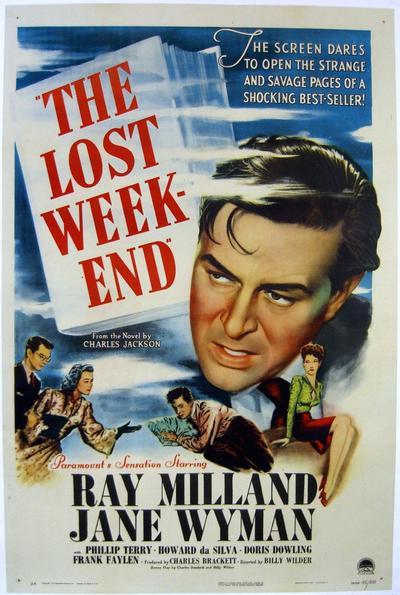
Billy Wilder – The Lost Weekend (1945)
Drama1941-1950Billy WilderFilm NoirQueer Cinema(s)USA

Don Birnam, long-time alcoholic, has been “on the wagon” for ten days and seems to be over the worst; but his craving has just become more insidious. Evading a country weekend planned by his brother Wick and girlfriend Helen, he begins a four-day bender. In flashbacks we see past events, all gone wrong because of the bottle. But this bout looks like being his last…one way or the other.Read More »