Philosophy on Screen

  • Jason Barker – Marx Reloaded (English Version) [+ Extras] (2011)

    2001-2010Alexandra WeltzGermanyJason BarkerPhilosophyPhilosophy on ScreenPolitics

    A cultural documentary that uses some of the central ideas of 19th century German socialist and philosopher Karl Marx to try to make sense of the global financial crisis of 2008-09. This crisis prompted the U.S. government to spend more than 1 trillion dollars in order to rescue its banking system from financial meltdown. But can the largest financial losses in history really be put down to the natural risks and uncertainties of the free market? Or is there another explanation as to why the crisis happened and what its implications are for the future of our society, our economy, for our whole way of life?Read More »

  • Chris Marker – Chris Marker-Cornelius Castoriadis : une leçon de démocratie (1989)

    1981-1990Chris MarkerDocumentaryFrancePhilosophyPhilosophy on ScreenTV

    Quote:
    This interview with Castoriadis was conducted in 1989 by famed filmmaker Chris Marker for Marker’s own television series L’héritage de la chouette (“The Owl’s Legacy”). Eighty-one minutes long, the raw footage originally recorded in French has been translated into English (via easy-to-read subtitles) and edited anonymously as a public service. Here, Castoriadis lays out and examines the contributions of ancient Greece to questions of contemporary relevance relating to democracy, politics, philosophy, art, poetry, economic and social reorganization, and the creative chaos that underlies all existence.Read More »

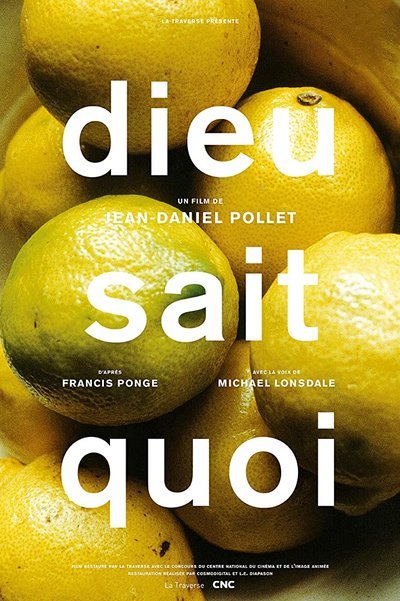
  • Jean-Daniel Pollet – Dieu sait quoi (1994)

    1991-2000ExperimentalFranceJean-Daniel PolletPhilosophyPhilosophy on Screen

    Quote:

    Dieu sait quoi can be described as a cinematographic essay managing to convey Francis Ponge’s approach to the world, his special relation between silent objects and speech, defining the space of life and knowledge.Read More »

  • Fred Zinnemann – A Man for All Seasons (1966)

    Drama1961-1970ClassicsFred ZinnemannPhilosophy on ScreenUnited Kingdom

    Synopsis:
    The story takes place in sixteenth century England. But men like Sir Thomas More, who love life yet have the moral fiber to lay down their lives for their principles, are found in every century. Concentrating on the last seven years of the English Chancellor’s life, the struggle between More and King Henry VIII hinges on Henry’s determination to break with Rome so he can divorce his current wife and wed again, and good Catholic More’s inability to go along with such heresy. More resigns as Chancellor, hoping to be able to live out his life as a private citizen. But Henry will settle for nothing less than that the much respected More give public approval to his headstrong course.Read More »

  • Roberto Rossellini – Agostino d’Ippona AKA Augustine of Hippo [+Extras] (1972)

    1971-1980DocumentaryItalyPhilosophyPhilosophy on ScreenRoberto Rossellini

    In the time of the Roman Empire’s waning, decadent, self-indulgent days, the Algerian-born Catholic convert Augustine was appointed Bishop of Hippo in Roman North Africa. Seeing his own time, with its widespread poverty, greed and materialism, the Vietnam War, reflected in this fifth-century world, Roberto Rossellini turned his series of present-tense histories to the figure of Augustine, the splendid result being Agostino d’Ippona.Read More »

  • Samuel Beckett & Alan Schneider – Film (1965)

    USA1961-1970Alan SchneiderPhilosophyPhilosophy on ScreenSamuel BeckettShort Film

    F I L M I N F O
    1. Samuel Beckett made a single work for projected cinema. It’s in essence a chase film; the craziest ever committed to celluloid. It’s a chase between camera and pursued image that finds existential dread embedded in the very apparatus of the movies itself. The link to cinema’s essence is evident in the casting, as the chased object is none other than an aged Buster Keaton, who was understandably befuddled at Beckett and director Alan Schneider’s imperative that he keep his face hidden from the camera’s gaze. The archetypal levels resonate further in the exquisite cinematography of Academy Award-winner Boris Kaufman, whose brothers Dziga Vertov and Mikhail Kaufman created the legendary self-reflexive masterpiece Man With a Movie Camera. Commissioned and produced by Grove Press’s Barney Rosset, FILM is at once the product of a stunningly all-star assembly of talent, and a cinematic conundrum that asks more questions than it answers.Read More »

  • Roberto Rossellini – Socrate (1971)

    1971-1980DramaItalyPhilosophy on ScreenRoberto Rossellini

    ‘Socrates’ Mirrors the Platonic Touch of Rossellini
    Something more than wordplay is involved when one describes Roberto Rossellini’s “Socrates,” which opened yesterday at the New Yorker Theater, as the great Italian director’s most Socratic film, in his most Platonic style.

    Although the movie was shot entirely in Spain with lots of correctly costumed extras, who walk around what look to be the freshly painted, spruced-up remains of the sets of Anthony Mann’s unfortunate “Fall of the Roman Empire,” it concedes no more than it absolutely must to the demands of a popular cinema that seeks access to the intellect through visual grandeur and primal emotions.Read More »

  • Vladimir Kobrin – Son Plyashuschih Chelovechkov AKA The Dream of the Little Dancing Men (1997)

    1991-2000ArthouseExperimentalPhilosophy on ScreenRussiaVladimir Kobrin

    Film is about communication. Kobrin pays homage to Vasili Nalimov, to his work and life. Nalimov was a mathematician and philosopher, but was also an eccentric anarchist with mystic tendencies who spent eighteen years in a concentration camp.
    Nalimov’s philosophy relies on probabilistic methods in the natural and social sciences and applies them to the study of language and consciousness.
    The film’s name Kobrin took from Arthur Conan Doyle’s “The Adventure of the Dancing Men”.Read More »

  • Ermanno Olmi – Il segreto del bosco vecchio AKA The Secret of the Old Woods (1993)

    1991-2000Ermanno OlmiFantasyItalyPhilosophyPhilosophy on Screen

    This Ecological Fairy Tale, with live actors and talking animals tells the story of a colonel (Paolo Villaggio) who is entrusted with a large estate of woodlands until his schoolboy nephew comes of age. Disregarding local tradition and the practice of his esteemed deceased brother, the military man decides to selectively cut the old growth timber. He is confronted with the protestations of the tree spirits (Giulio Brogi) and the local townsfolk, to no avail. Over their objection he releases the unpredictable wind from the cave to which it has been confined, and even wishes for the early demise of his nephew so he can own the woods outright. But he comes to value human contact more, starts to come to terms with most of the spirits, and reverses some plots to get rid of his nephew. A bit like a live action Hayan Miyazaki tale such as Princess Mononoke, but not so violent.Read More »

Back to top button