Plot Synopsis from allmovie:
As a newlywed couple boards a train bound for India and are forced to reconcile atheism and faith in director Mohsen Makhmalbaf’s spiritual-themed drama. He is a non-believer that is consumed by doubt, and she has faith that life’s answers will come to her through prayer. Though there is little that this newlywed couple can agree upon — including the prospect of having children — they do love each other and are intent upon sharing a spiritual honeymoon. In the midst of a philosophical debate, a holy man on the tracks forces the train to grind to a halt. While the local beggars revere the man for his power over the imposing locomotives, the truth is much less mystical. Years ago the man failed in committing suicide on the tracks when the oncoming train saw him and slowed down. These days he is compelled by the beggars to reenact the “miracle” daily so that the train will stop and they can collect alms from the passengers.Read More »
Mohsen Makhmalbaf
-
Mohsen Makhmalbaf – Scream of the Ants (2006)
2001-2010ArthouseIranMohsen MakhmalbafPhilosophyPhilosophy on Screen -
Mohsen Makhmalbaf – Arousi-ye Khouban AKA Marriage of the Blessed (1989)
Drama1981-1990IranMohsen MakhmalbafReview by Jonathan Rosenbaum
A 1989 film by Mohsen Makhmalbaf about the upsetting discoveries made by a shell-shocked veteran of the Iran-Iraq war after he returns to his job as a photojournalist in Tehran and to his fiancee, the daughter of a wealthy merchant. As in The Peddler, Makhmalbaf shows considerable talent and passion for dealing with the contradictions of contemporary Iranian life, and the restless and eclectic style of his direction makes this one of his most penetrating and disturbing works. In Farsi with subtitles. 75 min.This one is also on Rosenbaum’s top 1000 list.Read More »
-
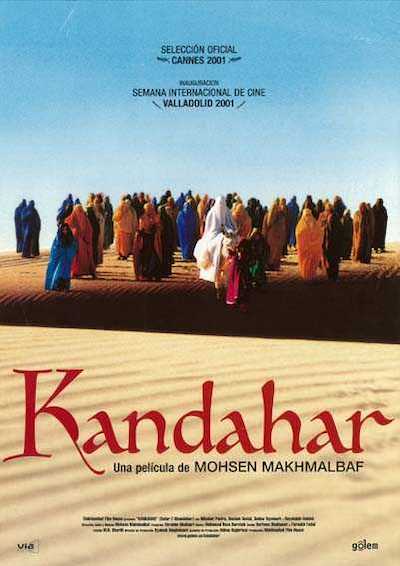
Mohsen Makhmalbaf – Safar e Ghandehar AKA Kandahar (2001)
2001-2010DocumentaryDramaIranMohsen Makhmalbaf

Synopsis:
Nafas is a reporter who was born in Afghanistan, but fled with her family to Canada when she was a child. However, her sister wasn’t so lucky; she lost her legs to a land mine while young, and when Nafas and her family left the country, her sister was accidentally left behind. Nafas receives a letter from her sister announcing that she’s decided to commit suicide during the final eclipse before the dawn of the 21st century; desperate to spare her sister’s life, Nafas makes haste to Afghanistan, where she joins a caravan of refugees who, for a variety of reasons, are returning to the war-torn nation. As Nafas searches for her sister, she soon gets a clear and disturbing portrait of the toll the Taliban regime has taken upon its people.Read More » -
Mohsen Makhmalbaf – Nun va Goldoon AKA A Moment of Innocence (1996)
1991-2000DramaIranMohsen Makhmalbaf
Quote:
Analyzing the intricacies and variances between differing film titles is something of an indulgence for film critics, especially when they’re searching for a quick, utilitarian lead into otherwise complex films. Mohsen Makhmalbaf’s film à clef revisitation (or, rather, a cinematic palimpsest) of a violent 1974 encounter from his past as an angry young fundamentalist went by the title A Moment of Innocence in its European and American releases, but its original Farsi title was actually Bread and Flower. The latter title refers to the two objects that play into the all-important remembered event, when Makhmalbaf stabbed one of the Iranian Shaw’s policemen in an attempt to snatch his gun away, an attack that led to the future director’s incarceration. (Makhmalbaf hid his knife under a circle of flatbread; the policeman was holding a flower he intended to offer the entrancing young girl who, unbeknownst to him, was actually a decoy intended to distract the cop so Makhmalbaf could steal his firearm.) Some 20 years later, while a reformed and de-radicalized Makhmalbaf was directing Salaam Cinema, the now former-policeman approached Makhmalbaf again, their meeting (and triggered memories) spurning A Moment of Innocence, a title of which seems to echo the film’s aura of reflective enlightenment and mutual cooperation between the two men (as opposed to the Farsi title’s emphasis on the fragmented multiplicity of memory).Read More » -
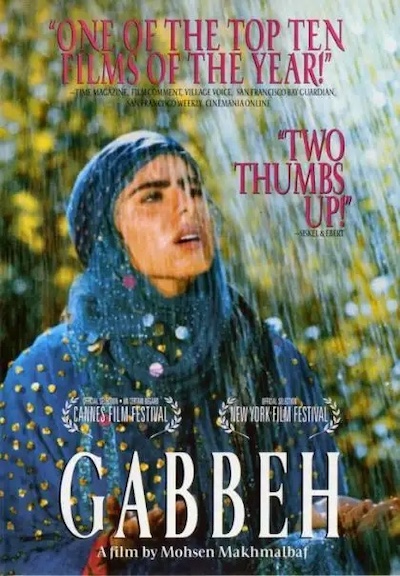
Mohsen Makhmalbaf – Gabbeh (1996)
Arthouse1981-1990FantasyIranMohsen Makhmalbaf

Quote:
Gabbeh is a brilliantly colorful, profoundly romantic ode to beauty, nature, love and art. Mohsen Makhmalbaf originally traveled to the remote steppes of southeastern Iran to document the lives of an almost extinct tribe of nomads. For centuries, these wandering families created special carpets – Gabbeh – that served both as artistic expression and autobiographical record of the lives of the weavers. Spellbound by the exotic countryside, and by the tales behind the Gabbehs, Makhmalbaf’s intended documentary evolved into a fictional love story which uses a gabbeh as a magic story – telling device weaving past and present’ fantasy and reality.Read More »