Marguerite Duras

  • Benoît Jacquot & Marguerite Duras – La mort du jeune aviateur anglais AKA The Death of the Young English Aviator (1993)

    1991-2000ArthouseBenoît JacquotBenoît Jacquot AND Marguerite DurasDocumentaryFranceMarguerite Duras

    29f7c043f76a2bde437fd0d52a185152

    La mort du jeune aviateur anglais tells the story of a British airman whose grave Marguerite Duras discovered near Deauville. Although we don’t know where fiction begins, Duras’ narrative has a remarkable authenticity. A veritable manifesto of spontaneous writing, brilliantly directed by Benoît Jacquot, where the “direct writing” of Duras meshes perfectly with the unpretentious approach of the filmmaker. (Allocine)Read More »

  • Marguerite Duras – L’homme atlantique (1981)

    1981-1990ArthouseFranceMarguerite DurasShort Film

    29f7c043f76a2bde437fd0d52a185152

    Quote:
    “In this avant-garde short, Duras uses outtakes from Agatha et les lectures illimitées, removing Agatha and leaving only the voice and likeness of her brother (Yann Andréa). Duras scholar Leslie Hill contends that for the first time in her work, “the gap between image and sound is now aligned with the fissure of sexual difference itself.”” (filmlinc.org)Read More »

  • Marguerite Duras – Jaune le soleil (1971)

    1971-1980ArthouseCultFranceMarguerite Duras

    29f7c043f76a2bde437fd0d52a185152

    Quote:
    Adapted from Duras’ Abahn Sabana David.

    Jaune le soleil est un film de Marguerite Duras sorti en 1972, adapté de son roman Abahn Sabana David.

    Tout le film se passe dans une seule pièce où sont réunis les représentants des deux forces politiques et leur ennemi “le juif”. Un personnage féminin établit le dialogue entre ces individus et commente l’idéologie de chacun ; ceci jusqu’à la scène finale où chacun semble se rallier à une idée commune.

    Note de tournage :
    “Il faudrait que le film donne l’impression d’avoir été tourné sans électricité, que tout effet de lumière en soit complètement banni. Que tout le film baigne dans une lumière uniforme qui n’avantage aucun personnage. Que ce soit la même lumière pour tous. C’est un film sur la parole, l’image ici sert à porter la parole. .(…) Ici c’est la parole qui tient lieu de contact corporel, ainsi que les bruits, les cris des chiens, le bruit des mots….” Cahiers du cinéma n° 400 Octobre 1987Read More »

  • Marguerite Duras – Le camion AKA The Lorry AKA The Truck [+Extra] (1977)

    1971-1980ArthouseFranceMarguerite Duras

    29f7c043f76a2bde437fd0d52a185152

    Synopsis:
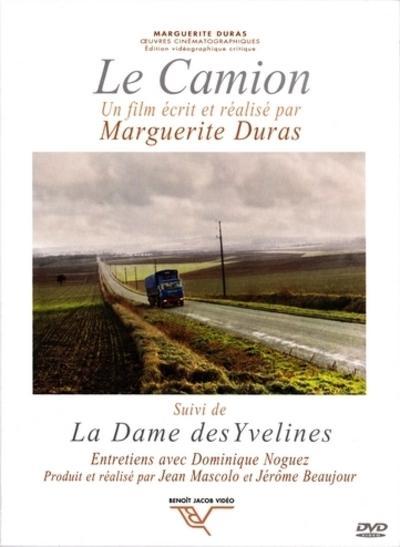
    We are confronted with two images, a lorry driving through the night until dawn, a depiction of the loneliness and determination of the long-distance driver, and, intercut with it, an all-night conversation between Marguerite Duras herself and her young collaborator and lover, who are writing the script together, imagining the lorry- driver and discussing the emotions they are trying to depict and their method in doing so. Two frustrations, that of their creative imaginations, and the that of the driver they are depicting, become identified.Read More »

  • Marguerite Duras – Des journées entières dans les arbres aka Entire Days in the Trees (1977)

    1971-1980ArthouseDramaFranceMarguerite Duras

    29f7c043f76a2bde437fd0d52a185152

    A woman whose son has been estranged from her for years travels to visit him in Paris. Despite offers of money and position, he would prefer to remain a petty thief, gigolo, and paid dancer rather than have anything to do with his mother. She has factories in Indochina which, despite political reverses, still run under her direction, and they could have been put under his control. The lad is happy enough to steal the jewels and money she has left lying around for just that purpose, knowing that he is too proud to accept gifts. His unhappy childhood in Indochina has left him too bitter to be approached.

    Based on her novel and prior to directing a film version of the novel, Duras had already modified it into a stageplay that had enjoyed a theatrical run.Read More »

  • Marguerite Duras – Détruire dit-elle AKA Destroy, She Said (1969)

    1961-1970ArthouseFranceMarguerite Duras

    29f7c043f76a2bde437fd0d52a185152

    Quote:
    “Marguerite Duras’ Destroy, She Said seems to be a film out of time and out of space, but could only have been made after May, 1968 … Significantly, it is only this year that she has felt able to write and direct her own film-without any compromises … It explodes into life, and one is hypnotically captive until the end. The dramatic power of the film, and its way of haunting one for days, are not surprising; what is, however, is the degree of visual virtuosity that Mme. Duras achieves. In short, here is a ‘difficult’ film which more than compensates for the demands it makes on the viewer.”-Richard Roud, The Guardian (Manchester)
    ” …Destroy. She Said is a triumph … In my estimation its glum enchantments constitute a masterpiece.”-Elliott Stein, The Financial Times (London)Read More »

  • Marguerite Duras – La femme du Gange aka Woman of the Ganges (1974)

    1971-1980ArthouseDramaFranceMarguerite Duras

    29f7c043f76a2bde437fd0d52a185152

    A man returns to the place he once lived a passionate love affair with a woman who is now dead.  So powerful are the emotions that seize him that he imagines she is still alive, and begins to live as if this were the case…

    INTRODUCTION BY MARGUERITE DURAS
    “Woman of the Ganges” is in a way two films. Parallel to the film is played out a purely vocal film, unaccompanied by images.
    To avoid any contempt, we would like to let the spectator know that the two Voices Off of women do not belong at all to the characters which appear in the images.
    We can add that the characters seen in the images are entirely unaware of the existence of the two women in the story who manifest themselves only in the dialogue which they hold.Read More »

  • Marguerite Duras – Le navire Night (1979)

    1971-1980ArthouseDramaFranceMarguerite Duras

    29f7c043f76a2bde437fd0d52a185152

    Quote:

    The plot of Le Navire Night concerns a love affair between a young man and a woman, F., who first make contact by telephone one night, quite by chance. They have never seen each other or met before, but a relationship begins as a result of the conversation; F. continues telephoning. He, however, never learns F.’ s full name, telephone number or address, and all initiative for the relationship falls to her. The affair unfolds purely as an affair of the human voice, but this adds to the sexual intensity of the relationship rather than detracting from it: ‘C’est un orgasme noir,’ one hears the voice of Bulle Ogier saying. ‘Sans toucher réciproque. Ni visage. Les yeux fermés. Ta voix, seule’ (‘It’s a dark orgasm. Without mutual touching. Nor a face. Eyes closed. Just your voice’, N, 27–8). Three years go by, and the pair agree to meet. (In the 1978 magazine version the meeting is F.’ s idea, while, in the later version, it is the man who insists on seeing F., but only as a way of putting an end to his fear of seeing her [N, 33]; in this respect it is as though the desire to see belongs to neither her nor him, but circulates between them as a necessary step that must continually be envisaged yet constantly deferred.)Read More »

Back to top button