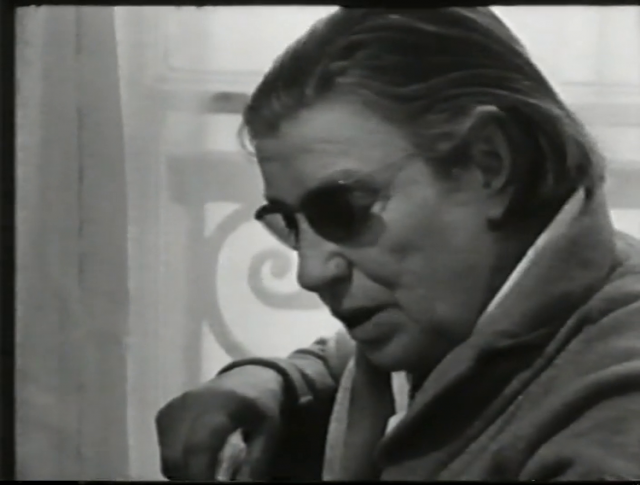
Alix Cléo Roubaud, a photographer, describes her images to Eustache’s son Boris. An “essay in the shape of a hoax”, Eustache’s last film wittily questions the relationship between showing and telling as it gradually shifts Alix’s narration out of sync with what we see.Read More »
As political and social tumult rocked France in May and June of 1968, Jean Eustache used his first documentary to focus on persistent tradition, in the form of a centuries-old ceremony in his hometown of Pessac. Each year, Pessac’s civic leaders choose a young woman they consider an exemplar of moral virtue, with a daylong celebration commemorating the changing of the guard from the previous year’s “virgin” to the present one. Eustache observes the exacting selection process, the fostering of communal bonds, and a bold implication by Pessac’s presiding priest that the ritual upholds the same Christian values for which leftist students and workers were then currently fighting.Read More »
Quote: Small (though long), quiet (literally – there is no music score, for example), observant (like its lead), nostalgic coming-of-age tale. Not much plot, just a series of daily-life blackout vignettes. It definitely has its boring moments, but also some wonderful ones, like the boy getting his first kiss in a movie theater playing “Pandora And The Flying Dutchman”. Successfully captures both small-town and country atmosphere, thanks in large part to Nestor Almendros’ beautiful cinematography. *** out of 4.Read More »
Quote: After the success of The Mother and the Whore, French director Jean Eustache was finally able to make Mes petites amoureuses, an equally personal but vastly different film — a portrait of his childhood in the south of France in which every footstep, every gesture, and every visual detail feels as though it’s been drawn directly from the filmmaker’s memory.Read More »
Quote: A group of friends listen as one man tells them a story about a time when, in a small cafe, he discovered a peephole into the ladies’ bathroom and became addicted to looking through it at female genitals. They ask him questions and come to conclusions about sex. This is a filmed, scripted version. Then, the actual person who this happened to relates the same story; this time, however, it is an unscripted documentary, in which the same things occur as in the scripted one.Read More »
A few days of a dandyish French intellectual in his late 20s named Alexandre (Jean-Pierre Leaud), who’s living with and supported by his lover, Marie (Bernadette Lafont); she’s in her mid-30s and runs a small boutique. In the first scene he borrows a neighbor’s car and tracks down a former girlfriend, Gilberte (Isabelle Weingarten), who’s just started a new semester at the Sorbonne, and tries to persuade her to marry him, only to discover that she’s just agreed to marry someone else. (We and Alexandre briefly glimpse Gilberte with her husband, played by Eustache, toward the end of the film, in the liquor section of a department store.) After hanging out with an equally idle friend (Jacques Renard) at the Deux Magots cafe, Alexandre follows a young woman after she leaves a nearby table, asks for her phone number, and scores; the remainder of the film is devoted to his courting of her.Read More »
Unfinished film by Jean Eustache (1961, or ’63), with Jean-André Fieschi, Chantal Simon, Paul Vecchiali and André S. Labarthe. 7 minutes – No sound
Quote: Premier film de Jean Eustache, librement inspiré d’une nouvelle de Maupassant, inachevé et sans bande son. Ce film retrouvé il y a une dizaine d’années fait l’objet d’une projection inédite. « Un homme invite des amis, pour leur donner lecture d’un texte sur le cinéma dont il est l’auteur et qui vient d’être publié. On pense qu’il s’agit de « Vivre le film », l’article publié par Jean-Louis Comolli dans les “Cahiers”. L’ambiance a quelque chose de très Nouvelle Vague » Cahiers du cinéma n° 523, avril 1998Read More »
Two men in their twenties spend their time in Parisian cafes trying to pick up women. They take one girl dancing, and then steal her purse when she prefers to dance with another man.Read More »