Quote:
The scene of the story is laid in a tranquil village in some future world, where high technology is integrated with its nostalgic scenery.
Under “the exhausted tree”, a machine is built, which supports the life of the tree.
There lives “an old craftsman” who fixes it. “The Box” made by him is rambling along the old railroad, taking the memories of the people and the events in the village in it. In his quiet life, The old craftsman is worried about The Box, saying ” I have not fulfilled his wish yet”.
Then, the monotonous and peaceful scene in the village has begun to change slowly after the old craftsman’s death – the tree fallen down, The Box broken.
The mourning for The Box, however, will open up a new prospect.
What is the wish of The Box which is now appearing ?Read More »
Japan
-
Kanji Nakajima – Hako aka Box (2003)
Arthouse2001-2010JapanKanji NakajimaSci-Fi -
Hiroshi Shimizu – Tokyo no eiyu AKA A Hero of Tokyo (1935)
1931-1940AsianClassicsHiroshi ShimizuJapan“This late silent film is little more than an hour long, and achieves a narrative concentration and emotional intensity which place it among the neglected gems of the Japanese cinema of the 1930s. The story focuses on the widower Nemoto, ostensibly a businessman, who has one son, Kanichi, the hero of the title. Nemoto remarries; his new wife is a widow with a son and daughter of her own. However, Nemoto’s business turns out to be out a shady scam, and he disappears, leaving his wife to raise the three children alone. In order to support the family, she is obliged to become a bar hostess. She conceals this shameful employment from the children, but the truth comes out years later, after her daughter is rejected by her husband’s family when they investigate her background. The film contains powerful performances from Mitsugu Fujii, here making the last of his regular appearances for Shimizu, and Mitsuko Yoshikawa, a specialist in the haha-mono (“mother-film”) genre.Read More »
-
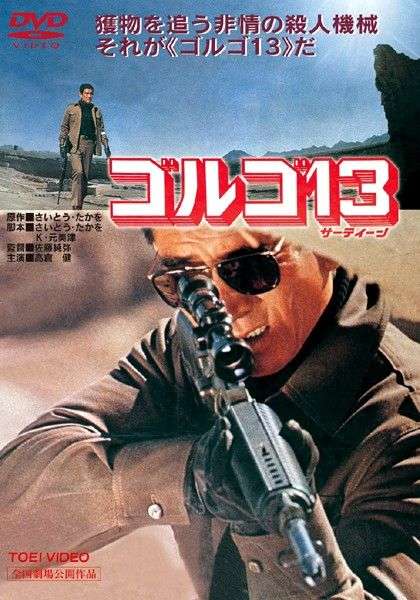
Jun’ya Satô – Golgo 13 (1973)
1971-1980ActionAsianJapanJun'ya Satô
Review @ sketchesofcinema
Takao Saito’s Golgo 13 comics aren’t very easy to adapt into live action features due to their international nature, but Toei went all the way with this first attempt. Junya Sato shot the film on location in Iran with mostly foreign cast. The lead role is played by the heavenly cool Ken Takakura, whose combination of charisma, black sunglasses and M16 assault rifle makes him one of the coolest asssassins in film history. Both execution and storywise the film could be better – and it would’ve been a good to opt for local languages istead of having the entire Iran speak Japanese – but with its rare international setting, superb leading man and some exciting action Golgo 13 easily ranks more interesting than Toei’s average action thrillers of the era. Due to the high expenses the studio didn’t allow Golgo 13 to return to the big screen until in 1977 in a slightly inferior Shinichi Chiba film Golgo 13: Kowloon Assignment.Read More » -
Yoshishige Yoshida – Kaigenrei AKA Coup D’Etat (1973)
1971-1980ArthouseAsianJapanYoshishige YoshidaQuote:
This film, considered to be the completion of Yoshida’s style, focuses on Kita Ikki, the prewar ideological leader of Japanese rightist terrorism and military revolts. The key factor is Kita’s relation to the emperor.Read More » -
Isao Takahata – Kaguyahime no monogatari AKA The Tale of The Princess Kaguya (2013)
2011-2020AnimationAsianIsao TakahataJapanFound inside a shining stalk of bamboo by an old bamboo cutter and his wife, a tiny girl grows rapidly into an exquisite young lady. The mysterious young princess enthralls all who encounter her – but ultimately she must confront her fate, the punishment for her crime. Read More »
-
Yoshihiro Nakamura – Shirayuki hime satsujin jiken AKA The Snow White Murder Case (2014)
2011-2020AsianJapanThrillerYoshihiro NakamuraPlot:
Yuji Akahoshi (Gou Ayano) for a television show. He receives a phone call from an old high school friend, Risako Kano (Misako Renbutsu). She tells him that her co-worker at a cosmetics compay was stabbed to death and then doused in flames. Yuji Akahoshi decides to interview workers at the company and others that knew the victim, Noriko Miki (Nanao), for his television show.Yuji Akahoshi soon discovers that another co-worker, Miki Shirono (Mao Inoue) disappeared the same night of the murder. She was last seen running to the train station shortly after Noriko Miki’s death. Yuji attempts to unravel the mystery of Miki Shirono. Read More »
-
Koji Wakamatsu – Tenshi no kôkotsu AKA Ecstacy of the Angels (1972)
1971-1980ArthouseEroticaJapanKoji WakamatsuQuote:
A group of militant extremists whom we know only by their code names – the days of the week – realize that they’ve been betrayed by their own organization when a nocturnal weapons raid on a U.S. Army base goes awry. The delicate internal balance of trust and friendship splinters apart. Their already fragile, idealistic young psyches quickly disintegrate into a morass of sexual paranoia, violent recrimination and sadistic torture that completely destroys their ability to function as an organizationRead More » -
Hayao Miyazaki – Tonari no Totoro AKA My Neighbor Totoro (1988)
1981-1990AnimationDramaHayao MiyazakiJapanQuote:
No number of superlatives that I could laud upon Hayao Miyazaki’s My Neighbor Totoro could convey the amount of joy that it brings me, but I’ll throw out a few anyway. It’s Miyazaki’s finest work! It’s the best film of 1988! It’s the best animated feature ever made (even better than two other great animated films of ’88: Who Framed Roger Rabbit? and Akira!)! I’ve seen it countless times, but it never loses a bit of its enchanting luster. It invigorates me with the same sense of gleeful pleasure that most people talk about when they describe movies like E.T. and The Wizard of Oz, but I’d gladly take it over either of those two classics. Read More » -
Koji Wakamatsu – Gendai sei hanzai zekkyo hen: riyu naki boko aka Violence Without A Cause (1969)
1961-1970ArthouseAsianJapanKoji WakamatsuSynopsis
Three poor young university student dropouts, with hardly any money left, hang around and decide to move to countryside Aomori where they stay at one of the boys small appartment. As they wander around the beach they spot a young couple and decide to rape the girl. They all feel rejected by society and try to get out of their state. One of the boys eventually gets a hold of a gun and commits suicide, while the other accidentally finds a gun and shoots at a policeman. The story was probably inspired by the figure of Norio Nagayama, a 19 year old serial killer who was convicted of killing 4 people in a cross-country murder spree in 1968 (see Masao Adachi’s movie AKA Serial Killer which is about this figure).Read More »