

Quote:
A rich and sadistic man, who enjoys to degrade women as part of elaborate S&M games, abducts a female journalist. She is subjected to his unpleasant games but soon the roles begin to be reversed.Read More »
Quote:
A rich and sadistic man, who enjoys to degrade women as part of elaborate S&M games, abducts a female journalist. She is subjected to his unpleasant games but soon the roles begin to be reversed.Read More »
Written by John Parrot On 20th April 2012,
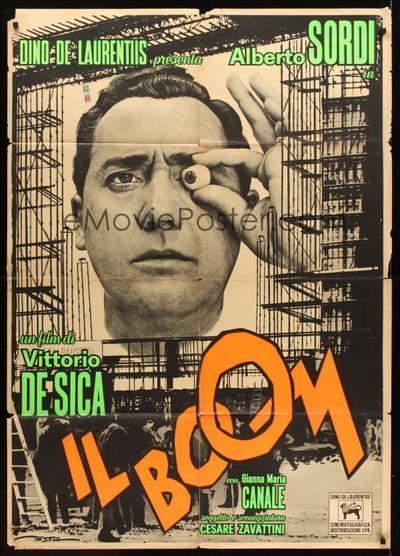
By the release of Il Boom in 1963, the Italian economy had seen spectacular growth since 1951 in a growth spurt christened ‘il boom’. The country had left behind both neo-realism and penury. Life may have been sweeter for many people but, as we in the 2010s know, il boom is usually followed by il bust. Even if the Italian economy had been able to defy gravity and travel on a one-way trajectory to the stars, Vittorio De Sica would have been there to bring everyone back down to earth. Il Boom, starring one of Italy’s biggest comic movie stars, Alberto Sordi, looks beneath the glossy surface of the economic miracle to the festering truth of the matter.Read More »

Quote:
The film is a frequently clever examination of a cynical social climber who finds himself in trouble. Arrested at his home and complete with a phoney alibi to cover his infidelity, our antique-dealer hero soon learns that he’s under suspicion for having murdered his ex-lover. Unfortunately for him, he’s not noted for his loving-kindness (he takes financial advantage of the desperate as he relieves them of their valuables) and is, romantically speaking, a cad, having exploited the soon-to-be-deceased lover for career purposes while romancing a younger bubblehead under her nose. All of this inhumanity seems to point to his being the killer, plunging him into a Kafka-lite nightmare that forces him to face up to his own brutishness.Read More »

Marcello is in the compartment of an Italian train, facing forward when the mineral water of the woman seated across from him starts to fall toward him. He catches the bottle and makes eye contact and follows her when she leaves the compartment. For a few moments she finds him attractive too. Then suddenly she gets off the train and starts walking through a field. Marcello follows her, loses her, finds himself in a large hotel surrounded by women. A feminist conference is taking place and he tries to escape. Read More »

Maddalena (the radiant Catherine Spaak) is obliged to dress as a young cleric to escape an invading army, which gets her into hot water as she is forcibly drafted to fight on the other side under the fiery Alcibiade (Robert Hossein). This leads to a series of comic misunderstandings as Alcibiade begins to suspect himself of unnatural feelings for a brother officer. A delightfully frivolous, sexy entertainment, enhanced by the director’s light touch with period detail.Read More »
Synopsis:
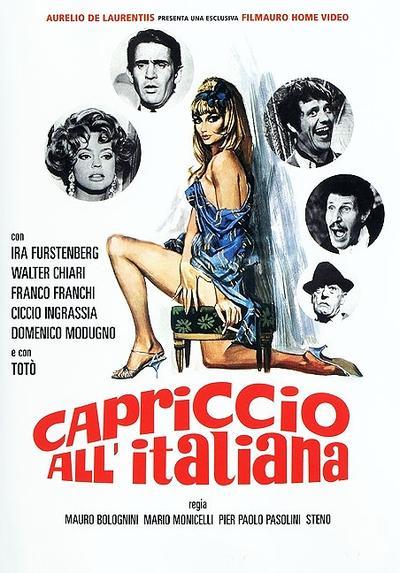
The film consists of six short stories created by different directors, but all the stories share one thing: a warm irony to current events.
Review:
Italian PORTMANTEAU film, a bit uneven.
Segment four by Pier Paolo Pasolini is by far the best; a completely MINDBLOWING and DERANGED rendering of OTHELLO played in a puppet theatre with human marionettes!
TOTÒ has the main role in this, and also in segment 2, where he hates Italian beatniks and stalks them as THE SUNDAY MONSTER! Both segments are very funny in completely different ways, but segment 2 would probably not have worked without Totò.
Segment 5 is completely unlike everything else; four minutes short, based on a animated cartoon by Pino Zac, and with Silvana Mangano as the Queen of England, and with guest appearances by James Bond (model Sean Connery)! The other three segments are fully watchable, although not so FAR OUT as number 2, 4 and 5.Read More »
Quote:
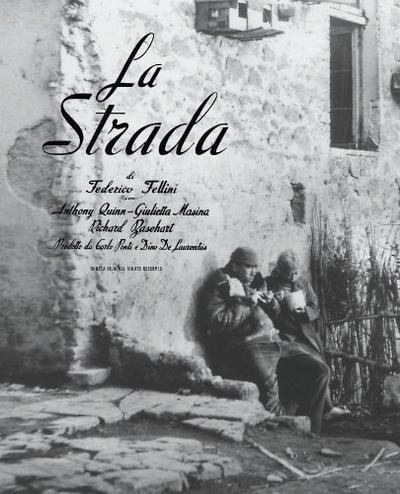
La Strada is Federico Fellini’s moving masterpiece that explores the soul’s eternal conflict between the heart and mind. Zampano (Anthony Quinn) is a cruel, traveling carnival strongman who buys his assistant, a simple minded young woman named Gelsomina (Giulietta Masina), from her poverty-stricken family. Gelsomina is innocent and childlike (Masina’s exquisite performance is as comic as it is heartbreaking). She does Zampano’s bidding without question or resistance, even though he is abusive to her. He abandons her in the street to spend the night with a woman. He lashes her with a tree branch when she misquotes her introductory lines. He forces her to steal from a convent. Yet, she remains faithful and uncomplaining.Read More »

Synopsis:
In Rosi’s film I magliari (The Weavers, sometimes known as The Swindlers, 1959) the Southern Problem is articulated through the theme of emigration. The film is, in fact, both set and shot entirely in Germany where a motley group of Italian immigrants try to make their fortune by engaging in a series of organised scams that appear to revolve around the sale of poor quality textiles to Germans at inflated prices. Although the latter part of the film develops into something of a love story between the rather good-hearted young Tuscan emigrant, Mario (Renato Salvatore), and Paola (Belinda Lee), the wife of the German boss, much of the film focuses on male groups exercising, challenging and negotiating power in a desperate effort to secure spoils and territory.Read More »

Synopsis:
A barber, murderer because of jealousy, spends twenty years in jail. He cannot, however adjust himself to a changed world and to the hypocracy of his own relatives and decides to return behind bars.
— IMDb.Read More »