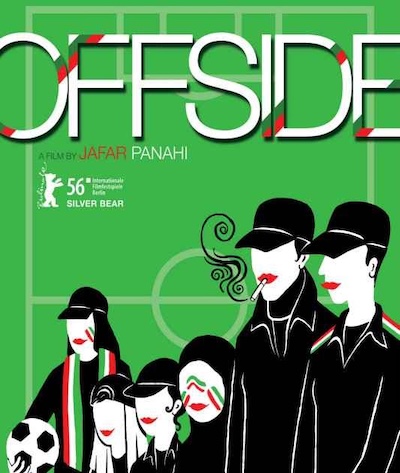
Since women are banned from soccer matches, Iranian females masquerade as males so they can slip into Tehran’s stadium to see the game between Iran and Bahrain. The ones who are caught and arrested are taken to a holding area and guarded by soldiers. One sympathetic soldier agrees to watch the game through a peephole and recount the action to the impatient fans.Read More »
Synopsis:
This is the story of women at three stages of life in Iran. The first part centers on a young girl on her ninth birthday who is told that she can no longer play with the boys she had been playing with only the day before because she is now a “woman”. Told from the perspective of a nine year old “woman” who does not feel like or know what that label refers to, we see how devastatingly this affects both the girl and the boy with whom she had been friends. The second part is about a young woman who decides to enter a bicycle race against her husband’s wishes. As first the husband and then increasing numbers of men from the village ride beside her to convince her to return home, the race begins to symbolize a freedom she desperately wants from the limitations which have been placed on her. Finally, the third part shows us an old woman who has come into some money and is now free to do what she wants. The way she chooses to use this freedom, however, makes one wonder just how free she is.Read More »
A documentary on the Iranian revolution from the point of view of Lebanese filmmaker Jocelyne Saab with Rafic Boustani. Filmed in 1980 during the early stages of post-revolution transition also captured in Kianoush Ayari’s Taze Nafas-ha, the film contains rare footage of many interesting and pertinent subjects: public rallies of the Mojahedin (before the organization was banned and when Masoud Rajavi was alive); the beginnings of the IRGC forces (when women participated); Khamenei; Kurdish fighters; Baluchs in the borderlands, and the remnants of Shahr-e No in the immediate aftermath of its destruction. Read More »
At times, the world is filled with things we cannot understand. [Ashkan, the Charmed Ring and Other Stories] reveals the complicated interlinked chains of the world that people cannot comprehend. Shahrooz and Reza try to rob a jewelry shop despite their blindness. Hotel employee Ashkan tries again and again to kill himself. He meets Shahrooz and Reza and joins in their crime. To Ashkan, this is only another means of suicide. But this is not the whole story.Read More »
After the 1979 Islamic revolution in Iran, a boy grew up obsessed with all the movies he couldn’t see. He met a mysterious film collector who saved thousands of films from destruction by the new regime. Despite arrest and torture, the collector refused to give up his secret hoard. Together they forged a friendship based on passion for cinema and resistance against tyranny. The boy escaped to exile in London to become a filmmaker, and tells their shared story of obsession and celluloid dreams.Read More »
Quote:
When an auto mechanic encounters the man who may have been his torturer in prison, he kidnaps him to exact vengeance. But since the sole clue to Eghbal’s identity is the squeak of his prosthetic leg, Vahid turns to other now-freed victims for confirmation. And the danger only escalates.Read More »
Quote:
“Araz” lives with his witch mother, “Marhamat”, and he’s fallen under her spell to stay with her and not to go after his love. However, “Araz” tries to get rid of his mother’s spell and the closer he approaches his love, the weaker his mother gets. “Ara”z has to make a choice between his love to mother or his beloved and the evil leads him toward his love and his conscience toward to his sinful mother. The man gives the spell to his love as she would make decision on “Araz” life and his mother.Read More »