Germany

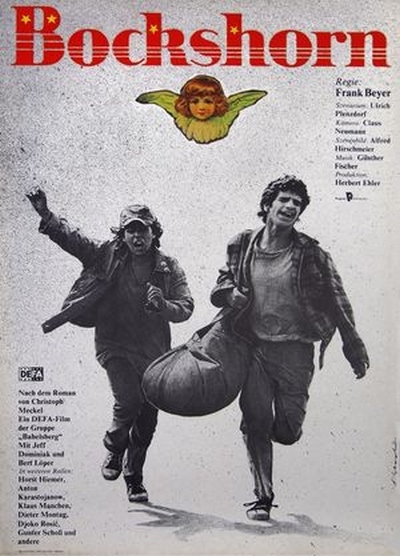
  • Frank Beyer – Bockshorn (1984)

    1981-1990DramaFrank BeyerGermany

    Synopsis
    Two adolescents, Sauly and Mick, get to know each other while hitchhiking and stick together for the long haul. They both want to reach the ocean, which is some thousand kilometers away. An old car picks them up, but the trip ends shortly thereafter in a sleazy motel. At the bar, a man named Landolfi approaches them. He explains to Sauly that he must have sold his guardian angel to a man by the name of Miller in the city of Prince. Though the boys do not believe in guardian angels, Sauly slowly succumbs to his own fears. He would like to have his guardian angel back again. On their trip, Sauly becomes sick. Mick works on a farm to pay the doctor’s bills. Once Sauly is well, they travel farther – until they reach Prince. In this mysterious city, all of the people are named Miller, and once Sauly and Mick finally are at the ocean, they meet Landolfi once more.Read More »

  • Douglas Sirk – Schlußakkord AKA The Final Chord (1936)

    1931-1940ClassicsDouglas SirkDramaGermanyThird Reich Cinema

    Plot:
    A young, impoverished German woman named Hanna (Maria von Tasnady) gives her infant up for adoption and emigrates to American to live with her husband. When her husband commits suicide, Hanna returns to Germany and works her way into becoming the live-in maid and nurse to her child being raised by an orchestra conductor and his wife.Read More »

  • Hans Rolf Strobel & Heinrich Tichawsky – Notizen aus dem Altmühltal aka Notes from the Altmühltal (1961)

    1961-1970DocumentaryGermanyHans Rolf StrobelHeinrich TichawskyShort Film

    A sociological essay on a Bavarian region where the economic miracle is left out. The documentary emphasises the declining populations due to migration and notes how such places come with “a lot of past [but] not much present or future”.Read More »

  • Jürgen Böttcher – Der Sekretär AKA The Secretary (1967)

    1961-1970DocumentaryGermanyJürgen Böttcher

    Quote:
    Presentation of a commited State Party (Socialist Unity Party of Germany) secretary at the Chemicals Combine in Buna. A former miner and small farmer rises to a leading political position – symbol of a typical Party career.Read More »

  • Christoph Schlingensief – My Wife in 5 (1985)

    1981-1990Christoph SchlingensiefExperimentalGermanyShort Film

    Quote:
    Between Broadway act, classical music and operetta – cinema never came that close to the good old mixtape!

    In MY WIFE IN FIVE, Schlingensief composes tracks and takes to a shimmering cinematic music piece. The playlist changes constantly between the styles, as if this record had a jump – Irving Berlin’s This Is The Army, Mr. Jones, an Ave Maria Variation and Jacques Offenbach’s world-famous Infernal Galop can be heard. Equally to the music the pictures also have scratches.

    The music film MY WIFE IN FIVE was created during a sound seminar by Christoph Schlingensief with students of the Hochschule für Gestaltung Offenbach. It already contains all forms of cinematic means and alienation, which he later used in his theatre and opera productions.Read More »

  • Siegfried Kühn – Das zweite Leben des Friedrich Wilhelm Georg Platow (1973)

    Drama1971-1980GermanySiegfried Kühn

    SYNOPSIS
    Friedrich Wilhelm Georg Platow worked for the railways his entire working life. He took up service at the small station of Luege 34 years ago. Now, the line is to be electrified and Platow, who cannot cope with the new technology, has to work on a secondary local line. Georg, his son, a railway worker as well, is to attend a training course, but Georg refuses to go. Then his father comes to a surprising and highly unusual decision. He pretends to be Georg Platow, making himself twenty years younger than he really is and registers for the course.Read More »

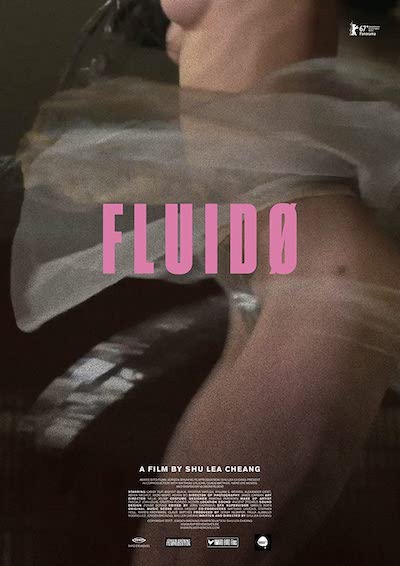
  • Shu Lea Cheang – Fluidø (2017)

    2011-2020EroticaExperimentalGermanyQueer Cinema(s)Shu Lea Cheang

    EXPLICIT CONTENT
    It is the year 2060 and AIDS has been eradicated. However, in some, the HIV virus has now mutated into a gene from which a drug can be produced that has become the white powder of the twenty-first century. With a virtually supported scanning system, secret police are trying to identify anyone who carries this gene. Filmed in Berlin, Taiwan-born multimedia artist and filmmaker Shu Lea Cheang’s science fiction dystopia revolves around a struggle to gain control over the production and exploitation of bodily fluids. Her film is like an orgiastic opera; a breathless round of bodies, secretions, performances and sexual acts often performed in the service of an overriding economy. An unusual, largely experimental and deliberately parapornographic drama in which the borders between the sexes as well as homo-, hetero-, bi-, trans- or intersexual are constantly blurred.Read More »

  • Rüdiger Neumann – Rüdiger Neumann – Archiv der Blicke (1980-1993)

    1981-1990ExperimentalGermanyRüdiger Neumann

    Quote:
    Rüdiger Neumann is a filmmaker and professor at the Hochschule für bildende Künste in Hamburg whose teaching has influenced two generations of filmmakers, many of whom now play an active role in shaping German cinema today. In the 1980s and 1990s, the HfbK was the only experimental and political alternative to the film schools in Munich and Berlin. Rüdiger Neumann’s controversial Thursday seminars are legendary. These five keys films by Rüdiger Neumann are released for the first time on this DVD.Read More »

  • Hans Steinhoff – Hitlerjunge Quex: Ein Film vom Opfergeist der deutschen Jugend AKA Our Flags Lead Us Forward (1933)

    1931-1940GermanyHans SteinhoffPoliticsThird Reich CinemaWar

    Young Heini Volker has a problem. His unemployed father demands he joins Berlin’s young communists. But his heart belongs to the Hitler Youth. As violence escalates between these camps, Heini’s quandary deepens. How he finds his way to National Socialism is the story of Hitlerjunge Quex. Produced in 1933, just after Hitler’s ascension to power, this movie draws from the real-life story of Herbert Norkus, a Hitler Youth killed by communists in 1932. With its vivid recreations of Depression-era misery, it offers a fascinating portrait of Berlin’s working-class life viewed through the transformative lens of Nazi ideology. An immediate box office success, the film became a Nazi propaganda staple, viewed by 20 million by 1945.Read More »

Back to top button