Germany

  • Wim Wenders – Die Angst des Tormanns beim Elfmeter AKA The Goalkeeper’s Fear of the Penalty Kick (1972)

    1971-1980ArthouseDramaGermanyWim Wenders

    29f7c043f76a2bde437fd0d52a185152

    IMDB User Comments (Frank from Iceland):

    The Goalie s Anxiety at the Penalty Kick is the first collaboration of
    Wim Wenders and Peter Handke, a collaboration which produced Wings of
    Desire in 1987. In The Goalie, Handke and Wenders explore patterns of
    thought and their relation to reality.

    The main action of the film occurs in the first minute, where we get
    one view of how the Goalie misses blocking a penalty kick and loses
    the game for his team.

    Later, we get to hear him describe the action and we also get a view
    of the way it really happened, the videotaped highlights on the tv
    news. They are three wonderfully different plausible representations
    which each explain the result just as well. While only one explains
    the goalie’s anxiety before the penalty kick, all three allow for his
    anxiety afterwards.Read More »

  • Wim Wenders – Summer in the City (1970)

    Drama1961-1970ArthouseGermanyWim Wenders
    Summer in the City (1970)

    Prison discharges Hans into the inhospitable freedom of a cold Munich winter. As a stranger, he strays through familiar streets and bars and tries unsuccessfully to contact old friends. Eventually he takes a plane to a friend in Berlin, fleeing from invisible enemies, on the way to an indeterminate destination.

    Wenders’s graduation film for the University of Television and Film Munich already reveals an innovative and individual style. Many of the themes that are woven through his later films, such as his enthusiasm for and inspiration from rock music, already appear here.Read More »

  • Wim Wenders – Aufzeichnungen zu Kleidern und Städten AKA A Notebook on Clothes and Cities (1989)

    1981-1990ArthouseDocumentaryGermanyWim Wenders

    From tankmagazine
    “Fashion, I’ll have nothing of it,” announces Wim Wenders in the opening to his 1990 fashion documentary Notebook on Cities and Clothes. It was the year after the Berlin Wall fell, and there is a sense in his introduction, of the German film-maker defending a subject his critics might view as superficial. In a voiceover, Wenders explains that he had been invited to make a short film about the fashion industry by the Centre Pompidou. And while initially dismissive, he found that the idea grew on him – “After all, why not examine fashion… Maybe fashion and cinema had something in common.”Read More »

  • Wim Wenders – Falsche Bewegung AKA The Wrong Movement (1975)

    1971-1980DramaGermanyWim Wenders

    Quote:
    A loose contemporary adaptation of Goethe’s Wilhelm Meister’s Apprenticeship, the middle installment of Wim Wenders’ “road movie trilogy” opens with a scene that’s pure Wenders — a young man gazes out his window while American rock rollicks out of the LP player, until he suddenly puts both fists through the glass, quietly sobbing. That’s Wilhelm (Rudiger Vogler), who grudgingly accepts that, if he’s ever to become the writer he wants to be, he has to overcome his dislike for people and venture out to accumulate experiences. In place of inspiration, the journey hooks him up with a group of fellow loners, the “dead souls of Germany”: an apathetic actress (Hanna Schygulla), an aged ex-Nazi whose nose bleeds from “remembering” (Hans Christian Blech), his mute street-performer travelling companion (a teenage, almost tomboyish Nastassja Kinski), a pudgy poet (Peter Kern), and a suicidally bereft industrialist (Ivan Desny). Read More »

  • Wim Wenders – Palermo Shooting (2008)

    2001-2010GermanyPhilosophySci-FiWim Wenders

    Wim Wenders muses on love, death and his perennial bugbear, the ‘Crisis of the Image’ in The Palermo Shooting, a metaphysical thriller cum philosophical essay that marks another step on the downwards slope for this once-vital film-maker. Unwisely cast, leadenly written and ultimately farcical in its earnestness, The Palermo Shooting is a glossy travelogue-thriller with metaphysical pretentions, and one of the low points of this year’s Cannes Competition. Unlikely to fare well in the market, the film may also find festivals preferring to tactfully take a rain check.Read More »

  • Wim Wenders – Der Himmel über Berlin aka Wings of Desire (1987)

    1981-1990ArthouseDramaGermanyWim Wenders

    Quote:
    Wim Wender’s deliberately paced, hauntingly realized contemporary masterpiece, Wings of Desire is, all at once: a political allegory for the reunification of Germany, an existential parable on a soul’s search for connection, a metaphor for the conflict between, what Friedrich Nietzsche defines as, the Appolinian intellect and the Dionysian passion, a euphemism for creation. A dispassionate angel stands atop a statue on a winter morning, watching over Berlin. His name is Damiel (Bruno Ganz): a spiritual guide for the desperate, an eternal spectator of life. The world is gray through his eyes, unable to experience the subtlety of the hues and textures of physical being. Read More »

  • Wim Wenders – Der Amerikanische Freund aka The American Friend (1977)

    1971-1980CrimeGermanyMysteryWim Wenders

    Quote:
    A convoluted and cloudy murder mystery, The American Friend succeeds because of, and in spite of, its myriad ambiguities. Ripley (Dennis Hopper) drops by Derwatt (Nicholas Ray), a painter who’s faked his own death so that he can sell his works at a premium. This is a lucrative partnership since Ripley passes on the pictures in Europe while Derwatt lives his life out in peace. In a Berlin auction house Derwatt’s latest work is snapped up for a mighty sum, pleasing Ripley. On the way out he briefly chats with the happy purchaser and his colleague Jonathan Zimmermann (Bruno Ganz), who plys his trade as a restorer/frame-maker. Jonathan appears quite aggressive, hinting that he “knows” about Ripley and mentioning that the blues of the picture are subtly different from those of earlier works. Back at his ostentatious villa, Ripley is asked to fulfil a debt by shifty-looking Raoul Minot (Gérard Blain). He requires someone totally innocent to undertake a contract killing, leaving no ties to Raoul.Read More »

  • Wim Wenders – Pina (2011)

    2011-2020DocumentaryGermanyWim Wenders
    Pina (2011)

    Our first film was Pina, the documentary on contemporary dancing directed by Wim Wenders. I’m so glad to have chosen Wim over Bono, though, because Pina is an impressive and audaciously original piece of filmmaking.
    Pina is an essay on the life and work of renowned choreographer Pina Bausch. Pina appears in some archival footage, and several members of her dance troupe testify to her ingenuity and artistic inspiration. The spirit of Pina, however, lives on in her dances: the film offers four of Bausch’s famed dances in their entirety, but dispersed and intercut throughout the film.Read More »

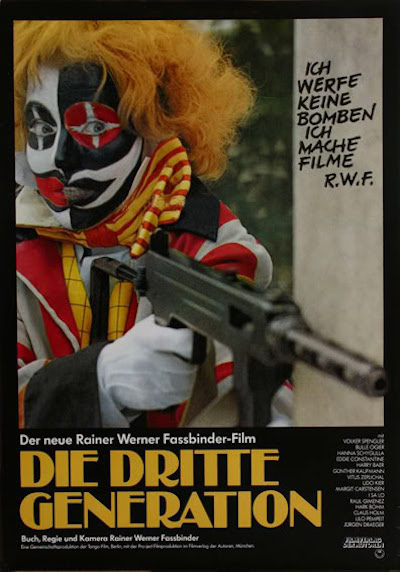
  • Rainer Werner Fassbinder – Die Dritte Generation AKA The Third Generation (1979)

    1971-1980ComedyCrimeGermanyRainer Werner Fassbinder

    Quote:
    “A comedy in six parts,” each introduced with a quote taken from a public bathroom wall (“Slave seeks master to train me as his dog,” etc.). The Kaiser Wilhelm Church dominates the Berlin skyline as seen from a glass-paneled, high-rise office, a shooting takes place on a monitor. Surveillance footage? No, the ending of The Devil, Probably. Each generation has the revolutionaries it deserves, after the Baader-Meinhoff affair you’re stuck with middle-class ninnies: leader Volker Spengler secretary Hanna Schygulla, schoolteacher Bulle Ogier, composer Udo Kier, housewife Margit Carstensen. The puppet master is the industrialist (Eddie Constantine) who heralds cinema’s utopian lies (“As long as films are sad, life isn’t”); his corporate must promote security equipment, so he manipulates the radicals into kidnapping him and sits back to enjoy the clown show.Read More »

Back to top button